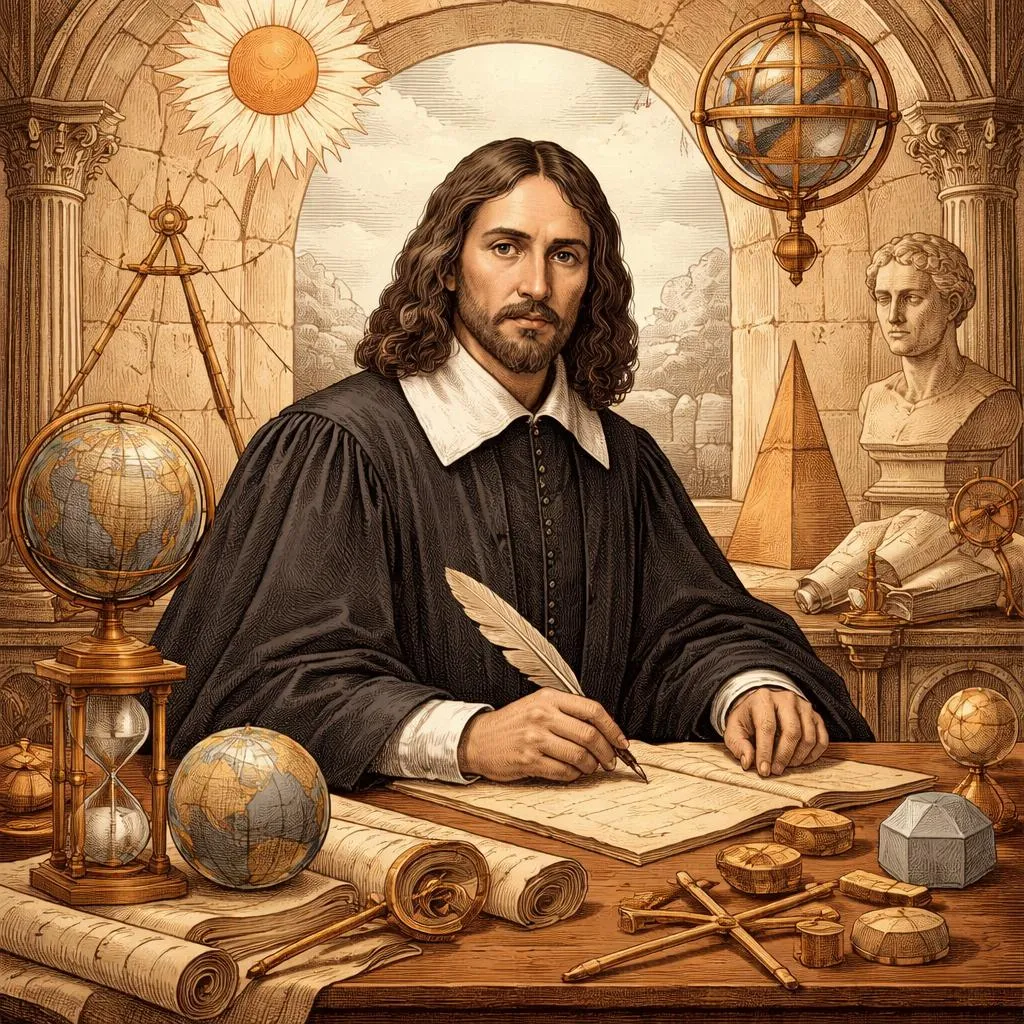

Isaac Barrow was born in London in 1630, and died at Cambridge in 1677. He went to school first at Charterhouse (where he was so troublesome that his father was heard to pray that if it pleased God to take any of his children he could best spare Isaac), and subsequently to Felstead. He completed his education at Trinity College, Cambridge; after taking his degree in 1648, he was elected to a fellowship in 1649; he then resided for a few years in college, but in 1655 he was driven out by the persecution of the Independents. He spent the next four years in the East of Europe, and after many adventures returned to England in 1659. He was ordained the next year, and appointed to the professorship of Greek at Cambridge. In 1662 he was made professor of geometry at Gresham College, and in 1663 was selected as the first occupier of the Lucasian chair at Cambridge. He resigned the latter to his pupil Newton in 1669, whose superior abilities he recognized and frankly acknowledged. For the remainder of his life he devoted himself to the study of divinity. He was appointed master of Trinity College in 1672, and held the post until his death.
He is described as "low in stature, lean, and of a pale complexion," slovenly in his dress, and an inveterate smoker. He was noted for his strength and courage, and once when travelling in the East he saved the ship by his own prowess from capture by pirates. A ready and caustic wit made him a favourite of Charles II., and induced the courtiers to respect even if they did not appreciate him. He wrote with a sustained and somewhat stately eloquence, and with his blameless life and scrupulous conscientiousness was an impressive personage of the time.
His earliest work was a complete edition of the Elements of Euclid, which he issued in Latin in 1655, and in English in 1660; in 1657 he published an edition of the Data. His lectures, delivered in 1664, 1665, and 1666, were published in 1683 under the title Lectiones Mathematicae; these are mostly on the metaphysical basis for mathematical truths. His lectures for 1667 were published in the same year, and suggest the analysis by which Archimedes was led to his chief results. In 1669 he issued his Lectiones Opticae et Geometricae. It is said in the preface that Newton revised and corrected these lectures, adding matter of his own, but it seems probable from Newton's remarks in the fluxional controversy that the additions were confined to the parts which dealt with optics. This, which is his most important work in mathematics, was republished with a few minor alterations in 1674. In 1675 he published an edition with numerous comments of the first four books of the Conics of Apollonius, and of the extant works of Archimedes and Theodosius.
In the optical lectures many problems connected with the reflexion and refraction of light are treated with ingenuity. The geometrical focus of a point seen by reflexion or refraction is defined; and it is explained that the image of an object is the locus of the geometrical foci of every point on it. Barrow also worked out a few of the easier properties of thin lenses, and considerably simplified the Cartesian explanation of the rainbow.
The geometrical lectures contain some new ways of determining the areas and tangents of curves. The most celebrated of these is the method given for the determination of tangents to curves, and this is sufficiently important to require a detailed notice, because it illustrates the way in which Barrow, Hudde and Sluze were working on the lines suggested by Fermat towards the methods of the differential calculus.
Fermat had observed that the tangent at a point P on a curve was determined if one other point besides P on it were known; hence, if the length of the subtangent MT could be found (thus determining the point T), then the line TP would be the required tangent. Now Barrow remarked that if the abscissa and ordinate at a point Q adjacent to P were drawn, he got a small triangle PQR (which he called the differential triangle, because its sides PR and PQ were the differences of the abscissae and ordinates of P and Q), so that
TM : MP = QR : RP.
To find QR : RP he supposed that x, y were the co-ordinates of P, and x - e, y - a those of Q (Barrow actually used p for x and m for y, but I alter these to agree with modern practice). Substituting the co-ordinates of Q in the equation of the curve, and neglecting the squares and higher powers of e and a as compared with their first powers, he obtained e : a. The ratio a/e was subsequently (in accordance with a suggestion made by Sluze) termed the angular coefficient of the tangent at the point. Barrow applied this method to the curves (i) x² (x² + y²) = r²y²;(ii) x³ + y³ = r³; (iii) x³ + y³ = rxy, called la galande; (iv) y = (r - x) tan πx/2r, the quadratrix; and (v) y = r tan πx/2r. It will be sufficient here if I take as an illustration the simpler case of the parabola y² = px. Using the notation given above, we have for the point P, y² = px; and for the point Q, (y - a)² = p(x - e). Subtracting we get 2ay - a² = pe. But, if a be an infinitesimal quantity, a² must be infinitely smaller and therefore may be neglected when compared with the quantities 2ay and pe. Hence 2ay = pe, that is, e : a = 2y : p. Therefore TP : y = e : a = 2y : p. Hence TM = 2y²/p = 2x. This is exactly the procedure of the differential calculus, except that there we have a rule by which we can get the ratio a/e or dy/dx directly without the labour of going through a calculation similar to the above for every separate case.
Antecedentes e Introdução do Autor
Isaac Barrow foi um notável matemático e teólogo do século 17. Nascido em Londres em 1630, ele viveu em uma época de grande descoberta científica e mudança intelectual. Barrow não era apenas um estudioso, mas também um aventureiro corajoso, conhecido por sua força e inteligência. Apesar de sua juventude um tanto rebelde, ele se tornou um dos principais matemáticos de sua época, ocupando posições acadêmicas de prestígio na Universidade de Cambridge. O trabalho de Barrow lançou importantes bases para o cálculo, um ramo da matemática que mais tarde seria desenvolvido por seu famoso aluno, Isaac Newton.
A história de vida de Barrow nos ensina sobre perseverança, curiosidade intelectual e a importância de reconhecer e incentivar o talento nos outros. Sua decisão de renunciar à sua prestigiosa Cadeira Lucasiana para Newton demonstra humildade e um compromisso com o avanço do conhecimento além da ambição pessoal.
Explicação Detalhada e Significado
O texto acima descreve as contribuições de Barrow para a matemática, especialmente em geometria e óptica. Ele trabalhou em problemas envolvendo reflexão e refração da luz, explicando como as imagens são formadas através de lentes — um tópico ainda fundamental em física e óptica hoje. Suas palestras sobre geometria introduziram novos métodos para encontrar tangentes a curvas, que é um conceito-chave no cálculo.
A abordagem de Barrow às tangentes envolvia o que hoje chamamos de "triângulo diferencial", uma ferramenta geométrica inteligente que o ajudou a aproximar as inclinações das curvas antes do desenvolvimento formal do cálculo. Este método foi um trampolim para as técnicas poderosas que Newton e Leibniz formalizariam mais tarde. O trabalho de Barrow sobre seções cônicas e seu comentário sobre matemáticos antigos como Apolônio e Arquimedes também ajudaram a preservar e avançar o conhecimento matemático clássico.
O Que os Estudantes Podem Aprender
-
Contexto Histórico da Matemática: Compreender o trabalho de Barrow ajuda os alunos a apreciar como as ideias matemáticas evoluem ao longo do tempo. Mostra que o cálculo, um assunto frequentemente visto como difícil, foi desenvolvido passo a passo por muitos pensadores que construíram sobre as descobertas uns dos outros.
-
Aprendizagem Interdisciplinar: Barrow combinou seus interesses em matemática, teologia e filosofia, demonstrando o valor de uma educação ampla e a interconexão de diferentes campos.
-
Pensamento Crítico e Resolução de Problemas: O método de Barrow de analisar curvas e luz ensina os alunos a abordar problemas de forma criativa e lógica, dividindo ideias complexas em partes mais simples.
-
Humildade e Mentoria: O reconhecimento de Barrow do talento superior de Newton e sua disposição em ceder é uma lição poderosa de humildade e da importância de apoiar o crescimento dos outros.
Aplicações na Vida e Aprendizagem
-
Na Escola: Os alunos podem aplicar o exemplo de Barrow sendo curiosos e persistentes em seus estudos, especialmente em disciplinas desafiadoras como matemática e ciência. Aprender a história por trás dos conceitos pode torná-los mais interessantes e fáceis de entender.
-
Em Ambientes Sociais: A história de Barrow incentiva o respeito pelos talentos dos outros e a importância da mentoria. Ajudar os colegas de classe e reconhecer seus pontos fortes pode construir uma comunidade de aprendizado positiva.
-
No Crescimento Pessoal: A vida de Barrow mostra que erros ou dificuldades iniciais não definem o futuro de uma pessoa. Com esforço e dedicação, qualquer pessoa pode alcançar grandes coisas.
Como Cultivar Traços Positivos da História de Barrow
-
Curiosidade: Sempre faça perguntas e procure entender como as coisas funcionam, assim como Barrow explorou a natureza da luz e das curvas.
-
Coragem: Não tenha medo de enfrentar desafios ou novas experiências, como Barrow fez ao viajar e enfrentar piratas.
-
Humildade: Reconheça quando os outros têm melhores ideias e esteja disposto a aprender com elas.
-
Consciência: Busque integridade e trabalho cuidadoso, como Barrow fez em sua vida acadêmica e pessoal.
Reflexão e Apreciação
A leitura sobre Isaac Barrow pode inspirar os alunos a valorizar tanto o conhecimento quanto o caráter. Sua combinação de brilho intelectual e coragem pessoal o torna um modelo não apenas para aspirantes a cientistas e matemáticos, mas para qualquer pessoa que queira crescer como um indivíduo atencioso, respeitoso e corajoso. Ao estudar sua vida e obra, os jovens aprendizes podem ver como a dedicação ao aprendizado e a gentileza com os outros andam de mãos dadas para causar um impacto significativo no mundo.
