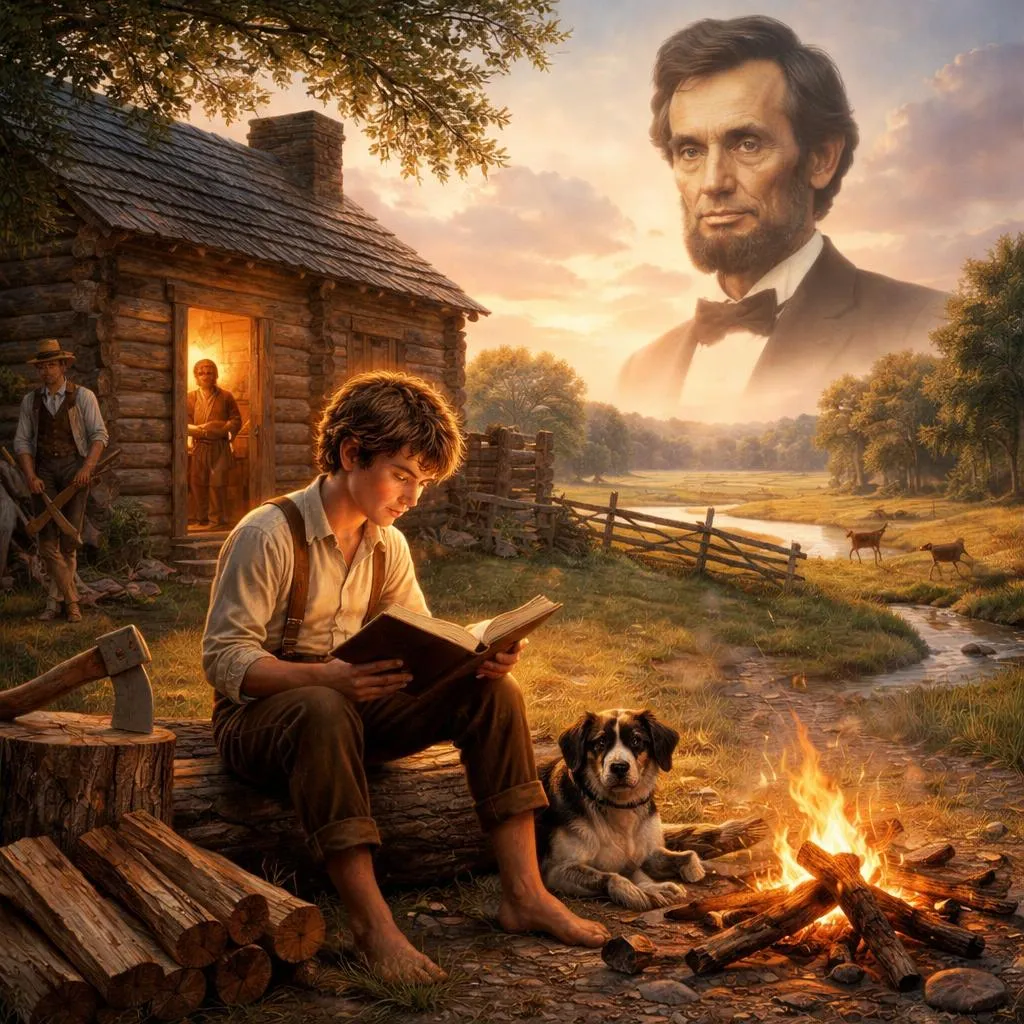

A severe and mysterious sickness broke out in the little Kentucky settlement where the Lincolns lived when Abe was about seven. Nancy Hanks Lincoln, the mother of young Abraham Lincoln died. Meanwhile, Sarah Bush Johnston had married about the time Lincoln’s father married Nancy Hanks. Her husband had died too. She was left with three children. Lincoln’s father went back to his home and married the widow Sarah.
The household goods that she brought with her to the Lincoln home filled a four-horse wagon. Her own three children were well clothed and cared for. She was able to bring little Abraham and his eleven year old sister Sarah comforts they had never known.
The new stepmother quickly became very fond of Abraham. She encouraged him in every way to study and improve himself. Mr. Lincoln once wrote, “It was a wild region, with many bears and other wild animals still in the woods. There I grew up.”
The family moved to Indiana. For two years Lincoln went without schooling of any sort. The school he attended shortly after Sarah came was very simple. The Pigeon Creek settlement had only eight or ten very poor families. They lived deep in the forest. Even if they had the money, it would have been impossible to buy books, slates, pens, ink, or paper.
In Lincoln’s seventeenth year he had more books and better teachers, but he had to walk four or five miles to reach them. We know that he learned to write, and was given pen, ink, a copybook, and a very small supply of writing paper. The instruction he received from his five teachers—two in Kentucky and three in Indiana—stretched over nine years. All together his schooling did not amount to one year.
The fact that he received this instruction, as he himself said, “by littles,” was an advantage. A lazy or not caring boy would have forgotten what was taught him at school. Abraham was neither indifferent or not caring. Every moment of instruction was a precious step to self-help. He worked on his studies with very unusual purpose and determination. He wanted to understand them at the moment. He also wanted to fix them firmly in his mind. His early companions all agree that he employed every spare moment to his studies. His stepmother tells us that “When he came across a passage that struck him, he would write it down on boards if he had no paper. He would keep it there until he did get paper. Then he would rewrite it, look at it, and repeat it. He had a copybook, a kind of scrapbook, in which he put down all things, and thus saved them.” He spent long evenings writing sums on the fire-shovel. Abraham worked his sums by the flickering firelight, making his figures with a piece of charcoal. When the shovel was all covered, he used a drawing-knife to shave it clean again.
He borrowed every book in the neighborhood. The list is a short one: Robinson Crusoe, Aesop’s Fables, Bunyan’s Pilgrim’s Progress, Weems’s Life of Washington, and A History of the United States. When everything else had been read, he began on the Revised Statutes of Indiana, which he visited a neighbor in order to read.
He was a social, sunny-tempered lad, as fond of jokes and fun as he was kindly and industrious. His stepmother said of him: “I can say, what scarcely one mother in a thousand can say, Abe never gave me a cross word or look, and never refused . . . to do anything I asked him. . . I must say . . that Abe was the best boy I ever saw or expect to see.”
He was not only a tall, strong country boy: he soon grew to be a tall, strong, sinewy man. He soon reached the unusual height of six feet four inches. His long arms gave him power as an axman. He usually beat his friends in races and mind puzzles. He could out-run, out-lift, out-wrestle his friends, that he could chop faster, split more rails in a day, carry a heavier log at a “raising,” or beat the neighborhood champion in any frontier athletics made him proud; but stronger than that was his hunger for learning. He felt that using the mind rather than muscle was the key to success. He wished not only to wrestle with the best of them, but also to be able to talk like the preacher, spell and cipher like the schoolmaster, argue like the lawyer, and write like the editor.
Because of his reading and his excellent memory, he soon became the best storyteller among his companions. The training from his studies made his naturally bright mind grow. His wit might be mischievous, but it was never malicious, and his nonsense was never intended to wound. He took no pleasure in hunting. Almost every youth of the backwoods early became an excellent shot and sportsman. The woods still swarmed with game, and every cabin depended largely upon this for its supply of food. But to his strength was added a gentleness, which made him shrink from killing or inflicting pain. The time the other boys spent lying in ambush, he preferred to spend in reading or improving his mind.
In March, 1831, at the end of a terrible winter, Abraham Lincoln left his father’s cabin to seek his own fortune in the world.
Contexto e Introdução do Autor
Esta história relata a vida inicial de Abraham Lincoln, o 16º Presidente dos Estados Unidos, conhecido por sua liderança durante a Guerra Civil Americana e seus esforços para abolir a escravidão. A narrativa é extraída de relatos históricos e biografias que detalham os humildes começos de Lincoln em um assentamento de fronteira. A história de vida de Lincoln foi contada e recontada em inúmeras biografias, livros infantis e romances históricos, enfatizando sua perseverança, autoeducação e caráter moral.
A história de Abraham Lincoln não é apenas sobre um líder famoso, mas sobre o poder da determinação e do aprendizado, apesar das dificuldades. O autor de muitas dessas histórias biográficas visa inspirar os jovens leitores, mostrando como Lincoln superou a pobreza, a perda e a educação limitada para se tornar um grande homem.
Interpretação Detalhada e Significado
Esta história destaca vários temas-chave: resiliência diante da adversidade, o valor da educação e a importância do caráter. A morte da mãe de Lincoln e a chegada de uma madrasta atenciosa mostram como o apoio familiar desempenha um papel crucial no desenvolvimento pessoal. Apesar dos recursos e oportunidades limitados, a sede de conhecimento e a autossuperação de Lincoln brilham.
A história também revela os desafios da vida na fronteira — escolas escassas, longas distâncias para os professores e a necessidade de equilibrar o trabalho físico com o estudo. O método de Lincoln de escrever em tábuas e copiar passagens ilustra sua criatividade e determinação em aprender. Seu empréstimo de livros como Robinson Crusoe e Fábulas de Esopo mostra sua ânsia de explorar diferentes ideias e histórias.
A força física e o atletismo de Lincoln são equilibrados por sua natureza gentil e curiosidade intelectual, retratando um personagem completo. Sua preferência pela leitura em vez da caça sugere uma mente pensativa focada no crescimento, em vez da mera sobrevivência.
Lições e Insights para Estudantes
- Perseverança e Autodisciplina: A história de Lincoln ensina aos alunos a importância de trabalhar duro e aproveitar ao máximo cada oportunidade de aprendizado, mesmo quando as circunstâncias são difíceis.
- Valor da Educação: Mesmo com menos de um ano de escolaridade formal, a dedicação de Lincoln à leitura e à escrita o ajudou a ter sucesso. Isso mostra que a educação não se trata apenas do tempo gasto na escola, mas da qualidade do esforço e do envolvimento.
- Criatividade no Aprendizado: Usando os materiais disponíveis, Lincoln encontrou maneiras de praticar a escrita e memorizar passagens importantes. Isso incentiva os alunos a serem engenhosos e persistentes.
- Caráter e Bondade: O comportamento respeitoso e gentil de Lincoln em relação à sua madrasta e amigos dá um exemplo de boas maneiras e interação social positiva.
- Equilibrando Força e Gentileza: Ser forte não significa ser rude; a gentileza de Lincoln, juntamente com seu poder físico, ensina empatia e respeito pelos outros.
Aplicações na Vida Diária
- No Aprendizado: Os alunos podem emular Lincoln dedicando tempo para estudar regularmente, usando métodos criativos se os recursos forem limitados e buscando conhecimento além dos livros didáticos.
- Em Ambientes Sociais: A atitude respeitosa de Lincoln lembra aos alunos que tratem os outros com gentileza e sejam cooperativos, o que ajuda a construir relacionamentos fortes.
- Na Superação de Desafios: Ao enfrentar dificuldades, os alunos podem se lembrar do exemplo de persistência e otimismo de Lincoln, entendendo que os contratempos fazem parte do crescimento.
- No Crescimento Pessoal: Equilibrar atividades físicas com atividades intelectuais pode ajudar a desenvolver uma personalidade completa, assim como Lincoln combinou força com amor pela leitura.
Cultivando Traços Positivos da História
- Curiosidade: Incentive a fazer perguntas e explorar novos tópicos.
- Diligência: Defina metas para estudo e pratique regularmente.
- Respeito: Mostre apreço pela família, professores e colegas.
- Resiliência: Aprenda a se recuperar de fracassos ou obstáculos.
- Empatia: Entenda os sentimentos dos outros e evite causar danos.
A história da vida inicial de Abraham Lincoln é um exemplo poderoso para os jovens leitores. Ela mostra que a grandeza começa com pequenos esforços consistentes e que caráter e bondade são tão importantes quanto inteligência e força. Ao aprender com sua jornada, os alunos podem encontrar inspiração para perseguir seus próprios sonhos com coragem e coração.
