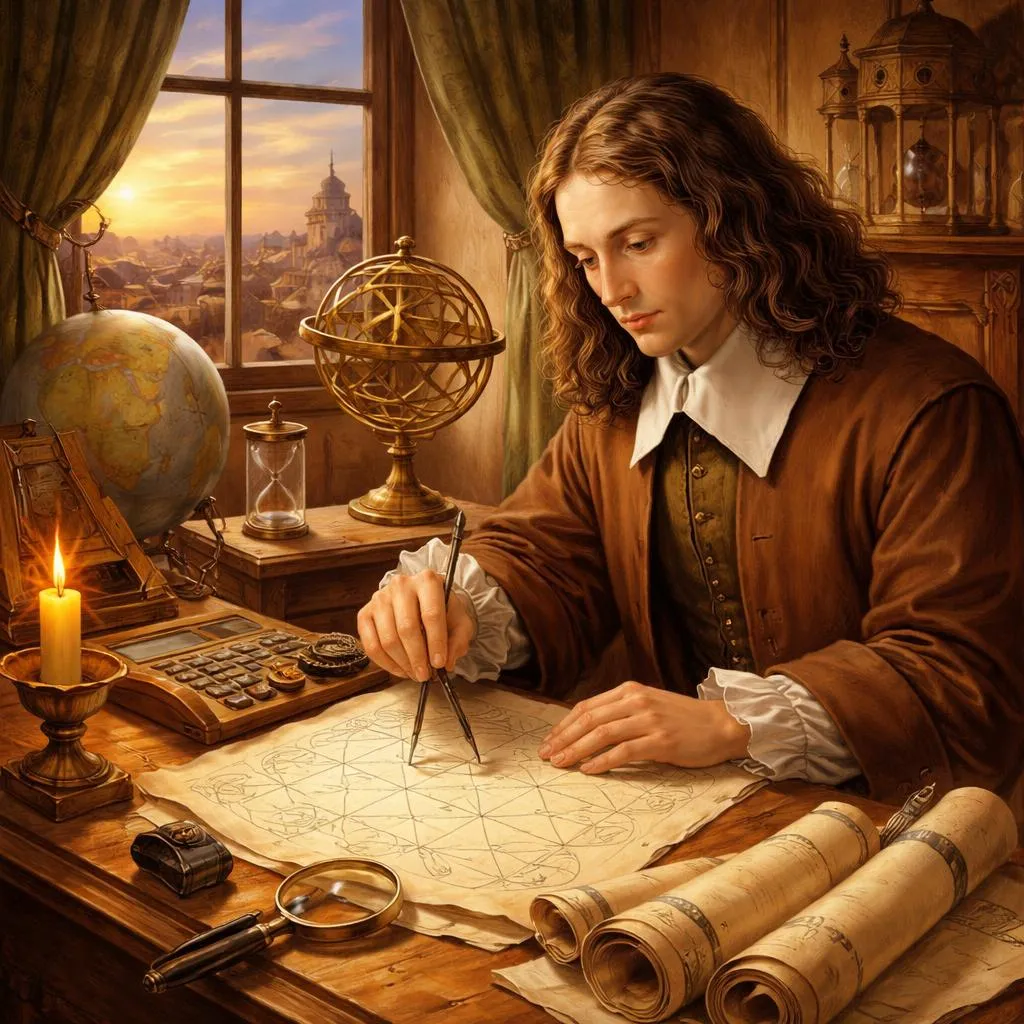

Among the contemporaries of Descartes none displayed greater natural genius than Pascal, but his mathematical reputation rests more on what he might have done than on what he actually effected, as during a considerable part of his life he deemed it his duty to devote his whole time to religious exercises.
Blaise Pascal was born at Clermont on June 19, 1623, and died at Paris on Aug. 19, 1662. His father, a local judge at Clermont, and himself of some scientific reputation, moved to Paris in 1631, partly to prosecute his own scientific studies, partly to carry on the education of his only son, who had already displayed exceptional ability. Pascal was kept at home in order to ensure his not being overworked, and with the same object it was directed that his education should be at first confined to the study of languages, and should not include any mathematics. This naturally excited the boy's curiosity, and one day, being then twelve years old, he asked in what geometry consisted. His tutor replied that it was the science of constructing exact figures and of determining the proportions between their different parts. Pascal, stimulated no doubt by the injunction against reading it, gave up his play-time to this new study, and in a few weeks had discovered for himself many properties of figures, and in particular the proposition that the sum of the angles of a triangle is equal to two right angles. I have read somewhere, but I cannot lay my hand on the authority, that his proof merely consisted in turning the angular points of a triangular piece of paper over so as to meet in the centre of the inscribed circle: a similar demonstration can be got by turning the angular points over so as to meet at the foot of the perpendicular drawn from the biggest angle to the opposite side. His father, struck by this display of ability, gave him a copy of Euclid's Elements , a book which Pascal read with avidity and soon mastered.
At the age of fourteen he was admitted to the weekly meetings of Roberval, Mersenne, Mydorge, and other French geometricians; from which, ultimately, the French Academy sprung. At sixteen Pascal wrote an essay on conic sections; and in 1641, at the age of eighteen, he constructed the first arithmetical machine, an instrument which, eight years later, he further improved. His correspondence with Fermat about this time shews that he was then turning his attention to analytical geometry and physics. He repeated Torricelli's experiments, by which the pressure of the atmosphere could be estimated as a weight, and he confirmed his theory of the cause of barometrical variations by obtaining at the same instant readings at different altitudes on the hill of Puy-de-Dôme.
In 1650, when in the midst of these researches, Pascal suddenly abandoned his favourite pursuits to study religion, or, as he says in his Pensées , "contemplate the greatness and the misery of man"; and about the same time he persuaded the younger of his two sisters to enter the Port Royal society.
In 1653 he had to administer his father's estate. He now took up his old life again, and made several experiments on the pressure exerted by gases and liquids; it was also about this period that he invented the arithmetical triangle, and together with Fermat created the calculus of probabilities. He was meditating marriage when an accident again turned the current of his thoughts to a religious life. He was driving a four-in-hand on November 23, 1654, when the horses ran away; the two leaders dashed over the parapet of the bridge at Neuilly, and Pascal was saved only by the traces breaking. Always somewhat of a mystic, he considered this a special summons to abandon the world. He wrote an account of the accident on a small piece of parchment, which for the rest of his life he wore next to his heart, to perpetually remind him of his covenant; and shortly moved to Port Royal, where he continued to live until his death in 1662. Constitutionally delicate, he had injured his health by his incessant study; from the age of seventeen or eighteen he suffered from insomnia and acute dyspepsia, and at the time of his death was physically worn out.
His famous Provincial Letters directed against the Jesuits, and his Pensées , were written towards the close of his life, and are the first example of that finished form which is characteristic of the best French literature. The only mathematical work that he produced after retiring to Port Royal was the essay on the cycloid in 1658. He was suffering from sleeplessness and toothache when the idea occurred to him, and to his surprise his teeth immediately ceased to ache. Regarding this as a divine intimation to proceed with the problem, he worked incessantly for eight days at it, and completed a tolerably full account of the geometry of the cycloid.
I now proceed to consider his mathematical works in rather greater detail.
His early essay on the geometry of conics, written in 1639, but not published till 1779, seems to have been founded on the teaching of Desargues. Two of the results are important as well as interesting. The first of these is the theorem known now as "Pascal's Theorem," namely, that if a hexagon be inscribed in a conic, the points of intersection of the opposite sides will lie in a straight line. The second, which is really due to Desargues, is that if a quadrilateral be inscribed in a conic, and a straight line be drawn cutting the sides taken in order in the points A , B , C , and D , and the conic in P and Q , then
PA . PC : PB . PD = QA . QC : QB . QD .
Pascal employed his arithmetical triangle in 1653, but no account of his method was printed till 1665. The triangle is constructed as in the figure below, each horizontal line being formed form the one above it by making every number in it equal to the sum of those above and to the left of it in the row immediately above it; ex. gr. the fourth number in the fourth line, namely, 20, is equal to 1 + 3 + 6 + 10.
The numbers in each line are what are now called figurate numbers. Those in the first line are called numbers of the first order; those in the second line, natural numbers or numbers of the second order; those in the third line, numbers of the third order, and so on. It is easily shewn that the mth number in the nth row is (m+n-2)! / (m-1)!(n-1)!
Pascal's arithmetical triangle, to any required order, is got by drawing a diagonal downwards from right to left as in the figure. The numbers in any diagonal give the coefficients of the expansion of a binomial; for example, the figures in the fifth diagonal, namely 1, 4, 6, 4, 1, are the coefficients of the expansion ( a + b ) 4 . Pascal used the triangle partly for this purpose, and partly to find the numbers of combinations of m things taken n at a time, which he stated, correctly, to be (n+1)(n+2)(n+3) ... m / (m-n)!
Perhaps as a mathematician Pascal is best known in connection with his correspondence with Fermat in 1654 in which he laid down the principles of the theory of probabilities. This correspondence arose from a problem proposed by a gamester, the Chevalier de Méré, to Pascal, who communicated it to Fermat. The problem was this. Two players of equal skill want to leave the table before finishing their game. Their scores and the number of points which constitute the game being given, it is desired to find in what proportion they should divide the stakes. Pascal and Fermat agreed on the answer, but gave different proofs. The following is a translation of Pascal's solution. That of Fermat is given later.
The following is my method for determining the share of each player when, for example, two players play a game of three points and each player has staked 32 pistoles.
Suppose that the first player has gained two points, and the second player one point; they have now to play for a point on this condition, that, if the first player gain, he takes all the money which is at stake, namely, 64 pistoles; while, if the second player gain, each player has two points, so that there are on terms of equality, and, if they leave off playing, each ought to take 32 pistoles. Thus if the first player gain, then 64 pistoles belong to him, and if he lose, then 32 pistoles belong to him. If therefore the players do not wish to play this game but to separate without playing it, the first player would say to the second, "I am certain of 32 pistoles even if I lose this game, and as for the other 32 pistoles perhaps I will have them and perhaps you will have them; the chances are equal. Let us then divide these 32 pistoles equally, and give me also the 32 pistoles of which I am certain." Thus the first player will have 48 pistoles and the second 16 pistoles.
Next, suppose that the first player has gained two points and the second player none, and that they are about to play for a point; the condition then is that, if the first player gain this point, he secures the game and takes the 64 pistoles, and, if the second player gain this point, then the players will be in the situation already examined, in which the first player is entitled to 48 pistoles and the second to 16 pistoles. Thus if they do not wish to play, the first player would say to the second, "If I gain the point I gain 64 pistoles; if I lose it, I am entitled to 48 pistoles. Give me then the 48 pistoles of which I am certain, and divide the other 16 equally, since our chances of gaining the point are equal." Thus the first player will have 56 pistoles and the second player 8 pistoles.
Finally, suppose that the first player has gained one point and the second player none. If they proceed to play for a point, the condition is that, if the first player gain it, the players will be in the situation first examined, in which the first player is entitled to 56 pistoles; if the first player lose the point, each player has then a point, and each is entitled to 32 pistoles. Thus, if they do not wish to play, the first player would say to the second, "Give me the 32 pistoles of which I am certain, and divide the remainder of the 56 pistoles equally, that is divide 24 pistoles equally." Thus the first player will have the sum of 32 and 12 pistoles, that is, 44 pistoles, and consequently the second will have 20 pistoles.
Pascal proceeds next to consider the similar problems when the game is won by whoever first obtains m + n points, and one player has m while the other has n points. The answer is obtained using the arithmetical triangle. The general solution (in which the skill of the players is unequal) is given in many modern text-books on algebra, and agrees with Pascal's result, though of course the notation of the latter is different and less convenient.
Pascal made an illegitimate use of the new theory in the seventh chapter of his Pensées . In effect, he puts his argument that, as the value of eternal happiness must be infinite, then, even if the probability of a religious life ensuring eternal happiness be very small, still the expectation (which is measured by the product of the two) must be of sufficient magnitude to make it worth while to be religious. The argument, if worth anything, would apply equally to any religion which promised eternal happiness to those who accepted its doctrines. If any conclusion may be drawn from the statement, it is the undersirability of applying mathematics to questions of morality of which some of the data are necessarily outside the range of an exact science. It is only fair to add that no one had more contempt than Pascal for those who changes their opinions according to the prospect of material benefit, and this isolated passage is at variance with the spirit of his writings.
The last mathematical work of Pascal was that on the cycloid in 1658. The cycloid is the curve traced out by a point on the circumference of a circular hoop which rolls along a straight line. Galileo, in 1630, had called attention to this curve, the shape of which is particularly graceful, and had suggested that the arches of bridges should be built in this form. Four years later, in 1634, Roberval found the area of the cycloid; Descartes thought little of this solution and defied him to find its tangents, the same challenge being also sent to Fermat who at once solved the problem. Several questions connected with the curve, and with the surface and volume generated by its revolution about its axis, base, or the tangent at its vertex, were then proposed by various mathematicians. These and some analogous question, as well as the positions of the centres of the mass of the solids formed, were solved by Pascal in 1658, and the results were issued as a challenge to the world, Wallis succeeded in solving all the questions except those connected with the centre of mass. Pascal's own solutions were effected by the method of indivisibles, and are similar to those which a modern mathematician would give by the aid of the integral calculus. He obtained by summation what are equivalent to the integrals of sin φ , sin 2 φ , and φ sin φ , one limit being either 0 or 1/2π. He also investigated the geometry of the Archimedean spiral. These researches, according to D'Alembert, form a connecting link between the geometry of Archimedes and the infinitesimal calculus of Newton.
Введение в Блеза Паскаля и его наследие
Блез Паскаль был выдающимся французским математиком, физиком, изобретателем, писателем и философом, жившим в 17 веке. Родившийся в 1623 году, Паскаль проявил необычайный талант с юных лет, особенно в математике и естественных науках. Несмотря на его ранние успехи и значительный вклад, большая часть его жизни была посвящена религиозным размышлениям и философии. Его работы оказали долгосрочное влияние на многие области, включая геометрию, теорию вероятностей и даже литературу.
Предпосылки и исторический контекст
Паскаль жил в эпоху, когда наука и религия часто пересекались, а иногда и вступали в противоречия. 17 век был периодом великих научных открытий, когда такие деятели, как Декарт и Галилей, бросали вызов старым идеям и закладывали основу для современной науки. Паскаль был частью этой интеллектуальной революции, но также был глубоко вовлечен в религиозную мысль, в частности, через свою связь с янсенистским движением в Пор-Рояле, религиозной общиной, подчеркивающей благочестие и моральную строгость.
Его отец, сам судья и ученый, сыграл решающую роль в воспитании Паскаля. Интересно, что Паскалю изначально было запрещено изучать математику, что только подстегнуло его любопытство и привело к тому, что он самостоятельно открыл многие математические истины. Это раннее самообучение подготовило почву для его более поздних достижений.
Основные достижения Паскаля
-
Математика и геометрия: Паскаль сделал важные открытия в проективной геометрии, включая теорему Паскаля о шестиугольниках, вписанных в конические сечения. Он также разработал знаменитый треугольник Паскаля, инструмент, который помогает вычислять комбинации и биномиальные разложения, который до сих пор преподают в школах.
-
Теория вероятностей: Наряду с Пьером де Ферма, Паскаль заложил основу современной теории вероятностей. Их переписка началась с проблемы азартных игр и превратилась в формальную математическую теорию, которая помогает нам понять случайность и риск — область, необходимую для статистики, экономики и принятия решений.
-
Физика и изобретения: Паскаль проводил эксперименты с атмосферным давлением, подтверждая и расширяя более ранние работы Торричелли. Он изобрел один из первых механических калькуляторов, ранний шаг к современным вычислениям.
-
Философия и литература: «Мысли» Паскаля — это сборник размышлений о природе человека, религии и философии. Его знаменитый аргумент «пари» использует вероятность для рассуждения о вере в Бога, демонстрируя его уникальное сочетание научного мышления и духовности.
Значение и важность для студентов
Жизнь и творчество Паскаля предлагают богатые уроки для студентов и юных читателей:
-
Любопытство и самообучение: Раннее неповиновение Паскаля ограничениям и его самостоятельное изучение показывают силу любопытства и независимого обучения. Студенты могут узнать, что иногда сомнение в правилах и самостоятельное изучение приводят к великим открытиям.
-
Междисциплинарное мышление: Паскаль объединил математику, естественные науки и философию, демонстрируя, что знания взаимосвязаны. Это побуждает студентов быть непредубежденными и видеть, как разные предметы могут информировать и обогащать друг друга.
-
Баланс между страстью и размышлением: Переход Паскаля от науки к религиозному созерцанию напоминает нам о важности баланса между интеллектуальными занятиями и личными ценностями и размышлениями.
-
Устойчивость и цель: Несмотря на проблемы со здоровьем и личные трудности, Паскаль продолжал работать и глубоко размышлять о важных вопросах. Его настойчивость вдохновляет любого, кто сталкивается с трудностями.
Применение в повседневной жизни и обучении
-
Математика и решение задач: Понимание треугольника Паскаля и вероятности может улучшить логическое мышление и навыки принятия решений студентов, полезные в играх, учебе и реальных ситуациях, связанных с риском.
-
Этика и критическое мышление: Философские размышления Паскаля побуждают студентов думать о больших вопросах — о счастье, цели и вере — что может помочь им развить собственные ценности и моральное мышление.
-
Научное исследование: Эксперименты Паскаля показывают важность наблюдений, тестирования и любопытства в науке, побуждая студентов исследовать и подвергать сомнению мир вокруг них.
-
Литературное восприятие: Ясный и элегантный стиль письма Паскаля в его письмах и «Мыслях» является отличным примером того, как просто и красиво выражать сложные идеи, навык, ценный во всех видах общения.
Как развивать дух Паскаля
-
Оставайтесь любопытными: Как и Паскаль, не бойтесь исследовать новые темы, даже те, которые кажутся сложными или запрещенными.
-
Думайте о предметах: Попытайтесь связать идеи из разных областей — математики, естественных наук, литературы, философии — чтобы получить более глубокое понимание.
-
Размышляйте о своих убеждениях: Уделите время, чтобы подумать о том, что для вас важно, как это делал Паскаль в свои последние годы.
-
Будьте настойчивы: Трудности и неудачи являются частью обучения; продолжайте работать над своими целями с преданностью.
Заключение
История Блеза Паскаля — это не просто математика или естественные науки; это путешествие молодого ума через любопытство, открытия, веру и размышления. Для современных студентов его жизнь учит ценности интеллектуальной страсти, моральных вопросов и устойчивости. Изучая Паскаля, молодые ученики могут развивать навыки и отношения, которые помогут им добиться успеха в учебе и вырасти как вдумчивые, всесторонне развитые личности.
