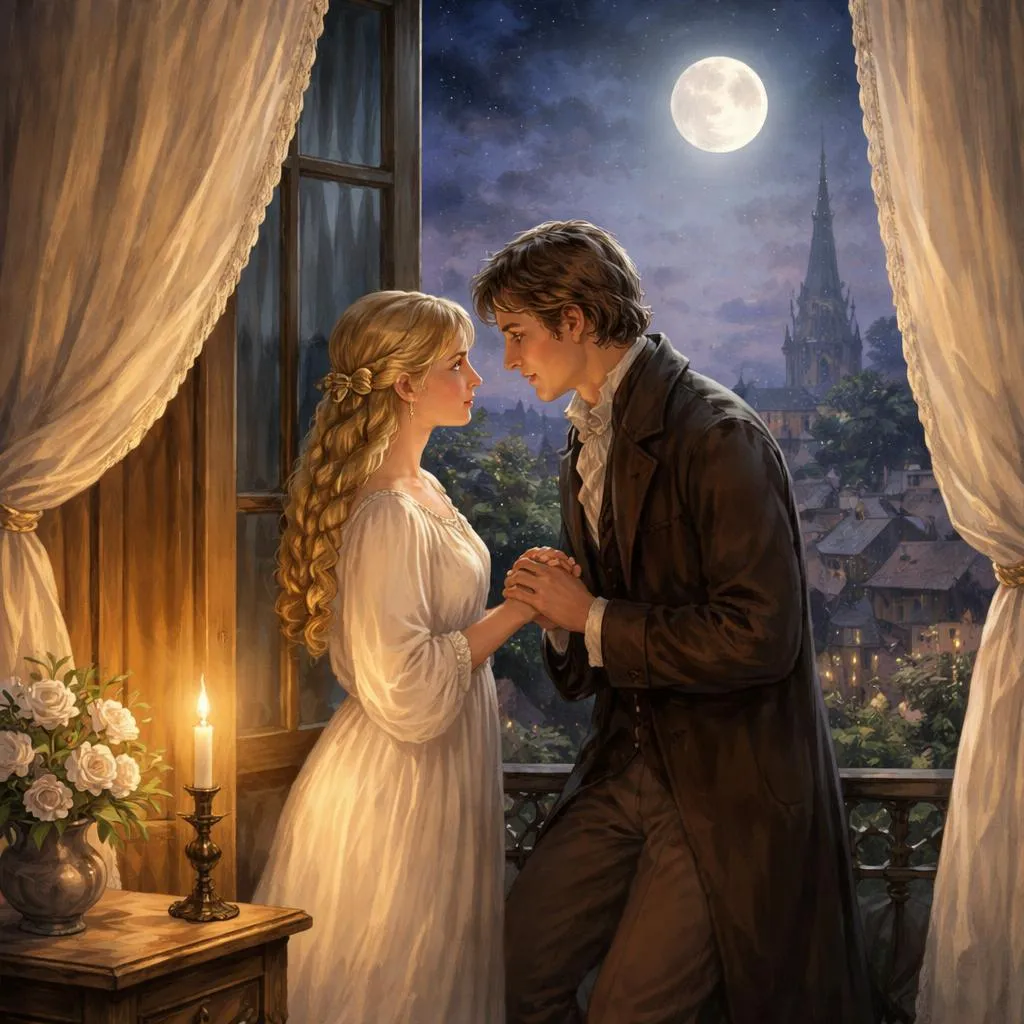

Never did the sun go down with a brighter glory on the quiet corner in Soho, than one memorable evening when the Doctor and his daughter sat under the plane-tree together. Never did the moon rise with a milder radiance over great London, than on that night when it found them still seated under the tree, and shone upon their faces through its leaves.
Lucie was to be married to-morrow. She had reserved this last evening for her father, and they sat alone under the plane-tree.
“You are happy, my dear father?”
“Quite, my child.”
They had said little, though they had been there a long time. When it was yet light enough to work and read, she had neither engaged herself in her usual work, nor had she read to him. She had employed herself in both ways, at his side under the tree, many and many a time; but, this time was not quite like any other, and nothing could make it so.
“And I am very happy to-night, dear father. I am deeply happy in the love that Heaven has so blessed—my love for Charles, and Charles’s love for me. But, if my life were not to be still consecrated to you, or if my marriage were so arranged as that it would part us, even by the length of a few of these streets, I should be more unhappy and self-reproachful now than I can tell you. Even as it is—”
Even as it was, she could not command her voice.
In the sad moonlight, she clasped him by the neck, and laid her face upon his breast. In the moonlight which is always sad, as the light of the sun itself is—as the light called human life is—at its coming and its going.
“Dearest dear! Can you tell me, this last time, that you feel quite, quite sure, no new affections of mine, and no new duties of mine, will ever interpose between us? I know it well, but do you know it? In your own heart, do you feel quite certain?”
Her father answered, with a cheerful firmness of conviction he could scarcely have assumed, “Quite sure, my darling! More than that,” he added, as he tenderly kissed her: “my future is far brighter, Lucie, seen through your marriage, than it could have been—nay, than it ever was—without it.”
“If I could hope THAT, my father!—”
“Believe it, love! Indeed it is so. Consider how natural and how plain it is, my dear, that it should be so. You, devoted and young, cannot fully appreciate the anxiety I have felt that your life should not be wasted—”
She moved her hand towards his lips, but he took it in his, and repeated the word.
”—wasted, my child—should not be wasted, struck aside from the natural order of things—for my sake. Your unselfishness cannot entirely comprehend how much my mind has gone on this; but, only ask yourself, how could my happiness be perfect, while yours was incomplete?”
“If I had never seen Charles, my father, I should have been quite happy with you.”
He smiled at her unconscious admission that she would have been unhappy without Charles, having seen him; and replied:
“My child, you did see him, and it is Charles. If it had not been Charles, it would have been another. Or, if it had been no other, I should have been the cause, and then the dark part of my life would have cast its shadow beyond myself, and would have fallen on you.”
It was the first time, except at the trial, of her ever hearing him refer to the period of his suffering. It gave her a strange and new sensation while his words were in her ears; and she remembered it long afterwards.
“See!” said the Doctor of Beauvais, raising his hand towards the moon. “I have looked at her from my prison-window, when I could not bear her light. I have looked at her when it has been such torture to me to think of her shining upon what I had lost, that I have beaten my head against my prison-walls. I have looked at her, in a state so dun and lethargic, that I have thought of nothing but the number of horizontal lines I could draw across her at the full, and the number of perpendicular lines with which I could intersect them.” He added in his inward and pondering manner, as he looked at the moon, “It was twenty either way, I remember, and the twentieth was difficult to squeeze in.”
The strange thrill with which she heard him go back to that time, deepened as he dwelt upon it; but, there was nothing to shock her in the manner of his reference. He only seemed to contrast his present cheerfulness and felicity with the dire endurance that was over.
“I have looked at her, speculating thousands of times upon the unborn child from whom I had been rent. Whether it was alive. Whether it had been born alive, or the poor mother’s shock had killed it. Whether it was a son who would some day avenge his father. (There was a time in my imprisonment, when my desire for vengeance was unbearable.) Whether it was a son who would never know his father’s story; who might even live to weigh the possibility of his father’s having disappeared of his own will and act. Whether it was a daughter who would grow to be a woman.”
She drew closer to him, and kissed his cheek and his hand.
“I have pictured my daughter, to myself, as perfectly forgetful of me —rather, altogether ignorant of me, and unconscious of me. I have cast up the years of her age, year after year. I have seen her married to a man who knew nothing of my fate. I have altogether perished from the remembrance of the living, and in the next generation my place was a blank.”
“My father! Even to hear that you had such thoughts of a daughter who never existed, strikes to my heart as if I had been that child.”
“You, Lucie? It is out of the Consolation and restoration you have brought to me, that these remembrances arise, and pass between us and the moon on this last night.—What did I say just now?”
“She knew nothing of you. She cared nothing for you.”
“So! But on other moonlight nights, when the sadness and the silence have touched me in a different way—have affected me with something as like a sorrowful sense of peace, as any emotion that had pain for its foundations could—I have imagined her as coming to me in my cell, and leading me out into the freedom beyond the fortress. I have seen her image in the moonlight often, as I now see you; except that I never held her in my arms; it stood between the little grated window and the door. But, you understand that that was not the child I am speaking of?”
“The figure was not; the—the—image; the fancy?”
“No. That was another thing. It stood before my disturbed sense of sight, but it never moved. The phantom that my mind pursued, was another and more real child. Of her outward appearance I know no more than that she was like her mother. The other had that likeness too —as you have—but was not the same. Can you follow me, Lucie? Hardly, I think? I doubt you must have been a solitary prisoner to understand these perplexed distinctions.”
His collected and calm manner could not prevent her blood from running cold, as he thus tried to anatomise his old condition.
“In that more peaceful state, I have imagined her, in the moonlight, coming to me and taking me out to show me that the home of her married life was full of her loving remembrance of her lost father. My picture was in her room, and I was in her prayers. Her life was active, cheerful, useful; but my poor history pervaded it all.”
“I was that child, my father, I was not half so good, but in my love that was I.”
“And she showed me her children,” said the Doctor of Beauvais, “and they had heard of me, and had been taught to pity me. When they passed a prison of the State, they kept far from its frowning walls, and looked up at its bars, and spoke in whispers. She could never deliver me; I imagined that she always brought me back after showing me such things. But then, blessed with the relief of tears, I fell upon my knees, and blessed her.”
“I am that child, I hope, my father. O my dear, my dear, will you bless me as fervently to-morrow?”
“Lucie, I recall these old troubles in the reason that I have to-night for loving you better than words can tell, and thanking God for my great happiness. My thoughts, when they were wildest, never rose near the happiness that I have known with you, and that we have before us.”
He embraced her, solemnly commended her to Heaven, and humbly thanked Heaven for having bestowed her on him. By-and-bye, they went into the house.
There was no one bidden to the marriage but Mr. Lorry; there was even to be no bridesmaid but the gaunt Miss Pross. The marriage was to make no change in their place of residence; they had been able to extend it, by taking to themselves the upper rooms formerly belonging to the apocryphal invisible lodger, and they desired nothing more.
Doctor Manette was very cheerful at the little supper. They were only three at table, and Miss Pross made the third. He regretted that Charles was not there; was more than half disposed to object to the loving little plot that kept him away; and drank to him affectionately.
So, the time came for him to bid Lucie good night, and they separated. But, in the stillness of the third hour of the morning, Lucie came downstairs again, and stole into his room; not free from unshaped fears, beforehand.
All things, however, were in their places; all was quiet; and he lay asleep, his white hair picturesque on the untroubled pillow, and his hands lying quiet on the coverlet. She put her needless candle in the shadow at a distance, crept up to his bed, and put her lips to his; then, leaned over him, and looked at him.
Into his handsome face, the bitter waters of captivity had worn; but, he covered up their tracks with a determination so strong, that he held the mastery of them even in his sleep. A more remarkable face in its quiet, resolute, and guarded struggle with an unseen assailant, was not to be beheld in all the wide dominions of sleep, that night.
She timidly laid her hand on his dear breast, and put up a prayer that she might ever be as true to him as her love aspired to be, and as his sorrows deserved. Then, she withdrew her hand, and kissed his lips once more, and went away. So, the sunrise came, and the shadows of the leaves of the plane-tree moved upon his face, as softly as her lips had moved in praying for him.
Введение и представление автора
Этот отрывок из «Повести о двух городах» — знаменитого романа, написанного Чарльзом Диккенсом, одним из величайших английских романистов XIX века. Опубликованный в 1859 году, роман разворачивается в бурные времена Французской революции и исследует темы самопожертвования, воскрешения, любви и искупления. Диккенс написал эту историю, чтобы подчеркнуть контрасты между Лондоном и Парижем, миром и насилием, отчаянием и надеждой. Персонажи романа, в том числе доктор Манетт и его дочь Люси, символизируют эти темы через свои личные страдания и взаимоотношения.
Подробный анализ и значение
В этой трогательной сцене доктор Манетт и его дочь Люси проводят тихий, интимный момент накануне ее свадьбы. Отрывок раскрывает глубокую связь между ними, сформированную годами лишений и разлуки. Прошлое заключение доктора Манетта и его страдания оставили шрамы, но любовь и присутствие Люси приносят ему исцеление и надежду на будущее. Лунный свет и платан символизируют как печаль, так и мир, отражая сложные эмоции, которые они испытывают.
Диалог между отцом и дочерью показывает их взаимную преданность и жертвы, которые они принесли друг другу. Беспокойство Люси о том, изменит ли ее брак их отношения, подчеркивает тему верности и страха потери. Размышления доктора Манетта о его заключении и воображаемой дочери раскрывают боль его прошлого, но также и утешение, которое он находит в любви Люси. Эта сцена подчеркивает силу семейной любви в преодолении травм и важность надежды и веры в трудные времена.
Уроки и вдохновение для учеников
-
Сила семейных уз: Эта история учит нас тому, как семейная любовь может обеспечить силу и утешение даже в самые мрачные моменты. Ученики могут узнать ценность поддержки и заботы о членах своей семьи, особенно в трудные времена.
-
Устойчивость и исцеление: Путь доктора Манетта показывает, что даже после перенесения больших трудностей можно исцелиться и снова обрести счастье. Это побуждает юных читателей быть стойкими и надеяться, сталкиваясь с трудностями.
-
Жертвенность и самоотверженность: Преданность Люси своему отцу и ее забота о его счастье напоминают нам о важности постановки нужд других выше своих собственных. Это ценный урок эмпатии и доброты.
-
Мужественное столкновение с прошлым: Размышления доктора о его заключении показывают, как столкновение с прошлым и его понимание может привести к личностному росту и миру. Ученики могут научиться мужественно встречать свои собственные страхи и прошлые ошибки.
Применение этих уроков в повседневной жизни
-
В школе: Ученики могут практиковать эмпатию, помогая одноклассникам, которые могут испытывать трудности или чувствовать себя одинокими, как Люси поддерживает своего отца. Они также могут развивать устойчивость, не сдаваясь, когда сталкиваются с академическими трудностями.
-
В дружбе: История поощряет честность и верность. Друзья должны быть рядом друг с другом в хорошие и плохие времена, предлагая поддержку и понимание.
-
Дома: Молодые люди могут выражать признательность своим родителям и членам семьи, признавая жертвы, принесенные ради них. Простые акты доброты и совместное времяпрепровождение укрепляют семейные узы.
Развитие положительных качеств из истории
-
Любовь и сострадание: Как и Люси, ученики могут научиться открыто выражать любовь и заботу, помогая другим чувствовать себя ценными и поддержанными.
-
Терпение и понимание: Спокойный и задумчивый характер доктора Манетта учит важности терпения в исцелении эмоциональных ран.
-
Надежда и оптимизм: Несмотря на трудности, персонажи сохраняют надежду на лучшее будущее. Ученики должны развивать позитивное мышление, даже сталкиваясь с трудностями.
Заключение
Этот отрывок из «Повести о двух городах» предлагает богатые представления о человеческих эмоциях, отношениях и силе любви и надежды. Для учеников и юных читателей это прекрасное напоминание о том, что даже во времена печали доброта, стойкость и семейная поддержка могут осветить путь вперед. Размышляя над этими темами и применяя их в своей жизни, молодые люди могут вырасти в сострадательных, сильных и полных надежды личностей.
