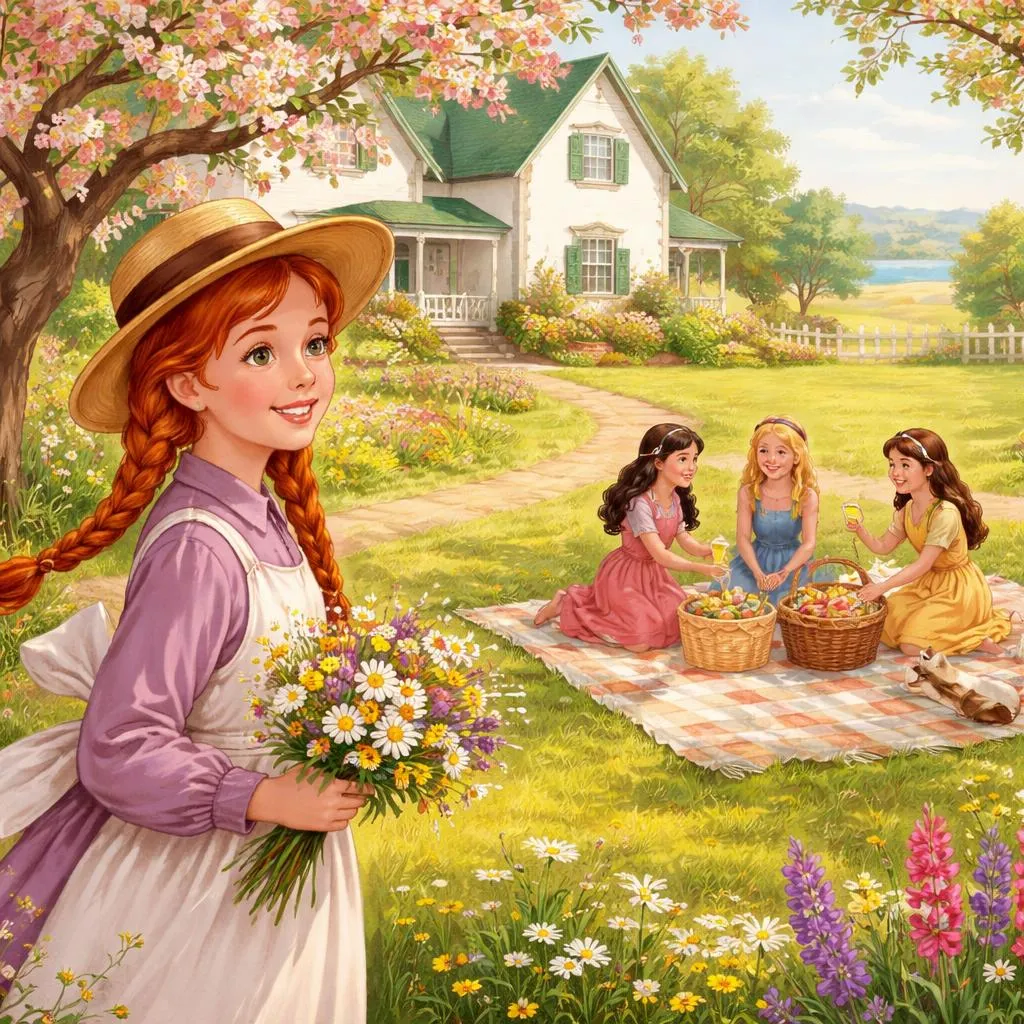

THE next afternoon Anne, bending over her patchwork at the kitchen window, happened to glance out and beheld Diana down by the Dryad’s Bubble beckoning mysteriously. In a trice Anne was out of the house and flying down to the hollow, astonishment and hope struggling in her expressive eyes. But the hope faded when she saw Diana’s dejected countenance.
“Your mother hasn’t relented?” she gasped.
Diana shook her head mournfully.
“No; and oh, Anne, she says I’m never to play with you again. I’ve cried and cried and I told her it wasn’t your fault, but it wasn’t any use. I had ever such a time coaxing her to let me come down and say good-bye to you. She said I was only to stay ten minutes and she’s timing me by the clock.”
“Ten minutes isn’t very long to say an eternal farewell in,” said Anne tearfully. “Oh, Diana, will you promise faithfully never to forget me, the friend of your youth, no matter what dearer friends may caress thee?”
“Indeed I will,” sobbed Diana, “and I’ll never have another bosom friend—I don’t want to have. I couldn’t love anybody as I love you.”
“Oh, Diana,” cried Anne, clasping her hands, “do you LOVE me?”
“Why, of course I do. Didn’t you know that?”
“No.” Anne drew a long breath. “I thought you LIKED me of course but I never hoped you LOVED me. Why, Diana, I didn’t think anybody could love me. Nobody ever has loved me since I can remember. Oh, this is wonderful! It’s a ray of light which will forever shine on the darkness of a path severed from thee, Diana. Oh, just say it once again.”
“I love you devotedly, Anne,” said Diana stanchly, “and I always will, you may be sure of that.”
“And I will always love thee, Diana,” said Anne, solemnly extending her hand. “In the years to come thy memory will shine like a star over my lonely life, as that last story we read together says. Diana, wilt thou give me a lock of thy jet-black tresses in parting to treasure forevermore?”
“Have you got anything to cut it with?” queried Diana, wiping away the tears which Anne’s affecting accents had caused to flow afresh, and returning to practicalities.
“Yes. I’ve got my patchwork scissors in my apron pocket fortunately,” said Anne. She solemnly clipped one of Diana’s curls. “Fare thee well, my beloved friend. Henceforth we must be as strangers though living side by side. But my heart will ever be faithful to thee.”
Anne stood and watched Diana out of sight, mournfully waving her hand to the latter whenever she turned to look back. Then she returned to the house, not a little consoled for the time being by this romantic parting.
“It is all over,” she informed Marilla. “I shall never have another friend. I’m really worse off than ever before, for I haven’t Katie Maurice and Violetta now. And even if I had it wouldn’t be the same. Somehow, little dream girls are not satisfying after a real friend. Diana and I had such an affecting farewell down by the spring. It will be sacred in my memory forever. I used the most pathetic language I could think of and said ‘thou’ and ‘thee.’ ‘Thou’ and ‘thee’ seem so much more romantic than ‘you.’ Diana gave me a lock of her hair and I’m going to sew it up in a little bag and wear it around my neck all my life. Please see that it is buried with me, for I don’t believe I’ll live very long. Perhaps when she sees me lying cold and dead before her Mrs. Barry may feel remorse for what she has done and will let Diana come to my funeral.”
“I don’t think there is much fear of your dying of grief as long as you can talk, Anne,” said Marilla unsympathetically.
The following Monday Anne surprised Marilla by coming down from her room with her basket of books on her arm and hip and her lips primmed up into a line of determination.
“I’m going back to school,” she announced. “That is all there is left in life for me, now that my friend has been ruthlessly torn from me. In school I can look at her and muse over days departed.”
“You’d better muse over your lessons and sums,” said Marilla, concealing her delight at this development of the situation. “If you’re going back to school I hope we’ll hear no more of breaking slates over people’s heads and such carryings on. Behave yourself and do just what your teacher tells you.”
“I’ll try to be a model pupil,” agreed Anne dolefully. “There won’t be much fun in it, I expect. Mr. Phillips said Minnie Andrews was a model pupil and there isn’t a spark of imagination or life in her. She is just dull and poky and never seems to have a good time. But I feel so depressed that perhaps it will come easy to me now. I’m going round by the road. I couldn’t bear to go by the Birch Path all alone. I should weep bitter tears if I did.”
Anne was welcomed back to school with open arms. Her imagination had been sorely missed in games, her voice in the singing and her dramatic ability in the perusal aloud of books at dinner hour. Ruby Gillis smuggled three blue plums over to her during testament reading; Ella May MacPherson gave her an enormous yellow pansy cut from the covers of a floral catalogue—a species of desk decoration much prized in Avonlea school. Sophia Sloane offered to teach her a perfectly elegant new pattern of knit lace, so nice for trimming aprons. Katie Boulter gave her a perfume bottle to keep slate water in, and Julia Bell copied carefully on a piece of pale pink paper scalloped on the edges the following effusion:“
When twilight drops her curtain down And pins it with a star Remember that you have a friend Though she may wander far.
It’s so nice to be appreciated,” sighed Anne rapturously to Marilla that night.
The girls were not the only scholars who “appreciated” her. When Anne went to her seat after dinner hour—she had been told by Mr. Phillips to sit with the model Minnie Andrews—she found on her desk a big luscious “strawberry apple.” Anne caught it up all ready to take a bite when she remembered that the only place in Avonlea where strawberry apples grew was in the old Blythe orchard on the other side of the Lake of Shining Waters. Anne dropped the apple as if it were a red-hot coal and ostentatiously wiped her fingers on her handkerchief. The apple lay untouched on her desk until the next morning, when little Timothy Andrews, who swept the school and kindled the fire, annexed it as one of his perquisites. Charlie Sloane’s slate pencil, gorgeously bedizened with striped red and yellow paper, costing two cents where ordinary pencils cost only one, which he sent up to her after dinner hour, met with a more favorable reception. Anne was graciously pleased to accept it and rewarded the donor with a smile which exalted that infatuated youth straightway into the seventh heaven of delight and caused him to make such fearful errors in his dictation that Mr. Phillips kept him in after school to rewrite it.
But as,
The Caesar's pageant shorn of Brutus' bust Did but of Rome's best son remind her more.
so the marked absence of any tribute or recognition from Diana Barry who was sitting with Gertie Pye embittered Anne’s little triumph.
“Diana might just have smiled at me once, I think,” she mourned to Marilla that night. But the next morning a note most fearfully and wonderfully twisted and folded, and a small parcel were passed across to Anne.
Dear Anne (ran the former)
Mother says I’m not to play with you or talk to you even in school. It isn’t my fault and don’t be cross at me, because I love you as much as ever. I miss you awfully to tell all my secrets to and I don’t like Gertie Pye one bit. I made you one of the new bookmarkers out of red tissue paper. They are awfully fashionable now and only three girls in school know how to make them. When you look at it remember
Your true friend
Diana Barry.
Anne read the note, kissed the bookmark, and dispatched a prompt reply back to the other side of the school.
My own darling Diana:—
Of course I am not cross at you because you have to obey your mother. Our spirits can commune. I shall keep your lovely present forever. Minnie Andrews is a very nice little girl—although she has no imagination—but after having been Diana’s busum friend I cannot be Minnie’s. Please excuse mistakes because my spelling isn’t very good yet, although much improoved.
Yours until death us do part
Anne or Cordelia Shirley.
P.S. I shall sleep with your letter under my pillow tonight. A. OR C.S.
Marilla pessimistically expected more trouble since Anne had again begun to go to school. But none developed. Perhaps Anne caught something of the “model” spirit from Minnie Andrews; at least she got on very well with Mr. Phillips thenceforth. She flung herself into her studies heart and soul, determined not to be outdone in any class by Gilbert Blythe. The rivalry between them was soon apparent; it was entirely good natured on Gilbert’s side; but it is much to be feared that the same thing cannot be said of Anne, who had certainly an unpraiseworthy tenacity for holding grudges. She was as intense in her hatreds as in her loves. She would not stoop to admit that she meant to rival Gilbert in schoolwork, because that would have been to acknowledge his existence which Anne persistently ignored; but the rivalry was there and honors fluctuated between them. Now Gilbert was head of the spelling class; now Anne, with a toss of her long red braids, spelled him down. One morning Gilbert had all his sums done correctly and had his name written on the blackboard on the roll of honor; the next morning Anne, having wrestled wildly with decimals the entire evening before, would be first. One awful day they were ties and their names were written up together. It was almost as bad as a take-notice and Anne’s mortification was as evident as Gilbert’s satisfaction. When the written examinations at the end of each month were held the suspense was terrible. The first month Gilbert came out three marks ahead. The second Anne beat him by five. But her triumph was marred by the fact that Gilbert congratulated her heartily before the whole school. It would have been ever so much sweeter to her if he had felt the sting of his defeat.
Mr. Phillips might not be a very good teacher; but a pupil so inflexibly determined on learning as Anne was could hardly escape making progress under any kind of teacher. By the end of the term Anne and Gilbert were both promoted into the fifth class and allowed to begin studying the elements of “the branches”—by which Latin, geometry, French, and algebra were meant. In geometry Anne met her Waterloo.
“It’s perfectly awful stuff, Marilla,” she groaned. “I’m sure I’ll never be able to make head or tail of it. There is no scope for imagination in it at all. Mr. Phillips says I’m the worst dunce he ever saw at it. And Gil—I mean some of the others are so smart at it. It is extremely mortifying, Marilla.
“Even Diana gets along better than I do. But I don’t mind being beaten by Diana. Even although we meet as strangers now I still love her with an INEXTINGUISHABLE love. It makes me very sad at times to think about her. But really, Marilla, one can’t stay sad very long in such an interesting world, can one?”
Предыстория и знакомство с автором
Этот отрывок из книги «Энн из Зеленых Крыш» — классического романа, написанного канадской писательницей Люси Мод Монтгомери, впервые опубликованного в 1908 году. В рассказе повествуется об Энн Ширли, мечтательной и энергичной девочке-сироте, которую по ошибке отправляют жить к Марилле и Мэтью Катбертам, брату и сестре, которые намеревались удочерить мальчика, чтобы помочь им с их фермой на острове Принца Эдуарда. Приключения Энн, ее дружба и взросление составляют основу романа, который стал любимым во всем мире за его теплоту, юмор и яркое изображение детства и жизни общества.
Люси Мод Монтгомери черпала вдохновение из собственного детства и пейзажей острова Принца Эдуарда, наделяя свои произведения сильным чувством места и характера. «Энн из Зеленых Крыш» — первая книга из серии, повествующей о жизни Энн, и она была адаптирована в многочисленных фильмах, телесериалах и сценических постановках.
Детальная интерпретация и значимость
Этот отрывок запечатлевает трогательный момент в жизни Энн — болезненную разлуку с ее лучшей подругой Дианой Барри, навязанную матерью Дианы. Сцена прощания подчеркивает темы дружбы, верности и горько-сладкой природы взросления. Поэтический язык Энн и ее глубокая эмоциональная привязанность к Диане раскрывают ее чувствительную и романтичную натуру. Локон волос символизирует прочную связь, даже когда обстоятельства вынуждают к физической разлуке.
Возвращение Энн в школу и ее взаимодействие с одноклассниками иллюстрируют трудности приспособления, соперничества и стремления к признанию и одобрению. Ее соперничество с Гилбертом Блайтом вводит динамику, которая будет развиваться на протяжении всей серии, сочетая конкуренцию с последующей дружбой. Отрывок также затрагивает борьбу Энн с такими академическими предметами, как геометрия, показывая, что даже умные и целеустремленные ученики сталкиваются с трудностями, что является реалистичным и обнадеживающим посланием для юных читателей.
Уроки и вдохновение для учеников
-
Ценность настоящей дружбы: Связь Энн и Дианы учит нас верности, доверию и боли разлуки. Настоящие друзья поддерживают друг друга эмоционально, даже когда внешние силы создают дистанцию. Ученики могут научиться дорожить своей дружбой и открыто общаться с друзьями в трудные времена.
-
Эмоциональное выражение и жизнестойкость: Искреннее прощание Энн и ее поэтические выражения показывают, что выражать эмоции глубоко — это нормально. В то же время решение Энн вернуться в школу и сосредоточиться на учебе демонстрирует жизнестойкость — способность сталкиваться с печалью и продолжать двигаться вперед.
-
Положительное отношение к соперничеству: Соперничество между Энн и Гилбертом носит соревновательный, но в то же время уважительный характер. Это учит тому, что конкуренция может мотивировать нас к улучшению, но она не должна приводить к озлобленности или обидам. Ученики могут применять это, стремясь к личным рекордам, сохраняя при этом доброту по отношению к сверстникам.
-
Принятие вызовов: Трудности Энн с геометрией напоминают нам, что у каждого есть сильные и слабые стороны. Настойчивость и позитивное отношение к изучению нового имеют решающее значение. Учеников не следует обескураживать предметами, которые им кажутся сложными, а вместо этого следует обращаться за помощью и продолжать пытаться.
-
Воображение и индивидуальность: Воображение Энн обогащает ее жизнь и жизнь окружающих. Учеников призывают ценить свои уникальные качества и творческие таланты, которые могут помочь им решать проблемы и получать больше удовольствия от жизни.
Применение этих уроков в повседневной жизни
-
В школе: Ученики могут укреплять дружбу, проявляя доброту, надежность и поддержку. Столкнувшись с академическими трудностями, они должны помнить о решимости Энн и обращаться за помощью, когда это необходимо. Здоровая конкуренция может быть инструментом для роста, а не конфликта.
-
В социальных ситуациях: Честное и уважительное выражение чувств может углубить отношения. Когда дружба сталкивается с трудностями, важно сохранять надежду и общение. Как и Энн, ученики могут находить утешение в воспоминаниях и небольших знаках дружбы.
-
В личностном росте: Развитие жизнестойкости помогает преодолевать неудачи. Принятие своей уникальности и воображения может привести к полноценной и радостной жизни. Ученики должны праздновать свои успехи и учиться на ошибках, не теряя уверенности.
Развитие положительных черт из истории
- Верность: Будьте надежным другом, который поддерживает других в хорошие и плохие времена.
- Эмпатия: Понимайте и разделяйте чувства друзей, особенно в трудные моменты.
- Настойчивость: Продолжайте усердно работать, даже когда задачи кажутся сложными или обескураживающими.
- Уважительное соперничество: Соревнуйтесь честно и празднуйте достижения других.
- Творчество: Используйте воображение, чтобы обогатить обучение и решать проблемы.
Размышляя об опыте Энн, ученики могут развить эмоциональный интеллект, социальные навыки и любовь к учебе, которые сослужат им хорошую службу на протяжении всей жизни. «Энн из Зеленых Крыш» остается вневременной историей, которая вдохновляет читателей принимать радости и вызовы жизни с мужеством, добротой и надеждой.
