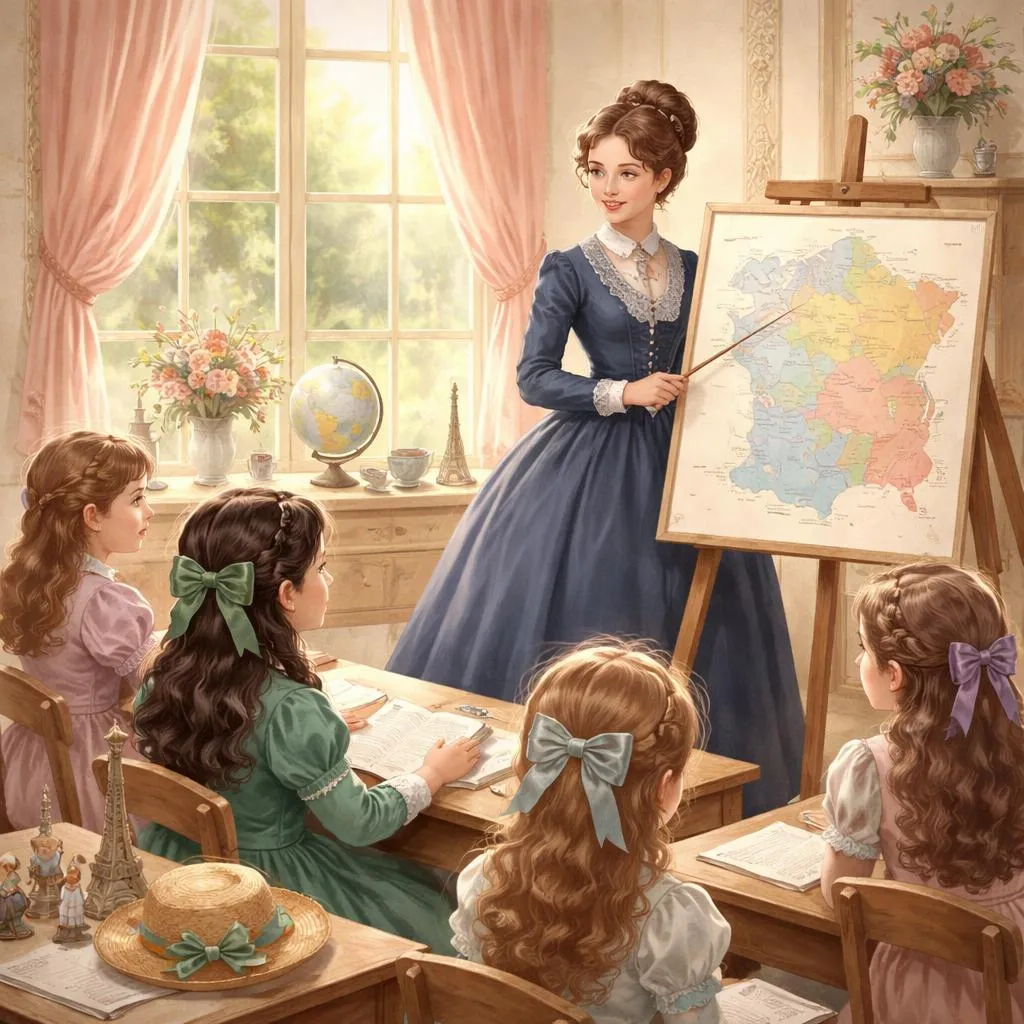

When Sara entered the schoolroom the next morning everybody looked at her with wide, interested eyes. By that time every pupil— from Lavinia Herbert, who was nearly thirteen and felt quite grown up, to Lottie Legh, who was only just four and the baby of the school— had heard a great deal about her. They knew very certainly that she was Miss Minchin’s show pupil and was considered a credit to the establishment. One or two of them had even caught a glimpse of her French maid, Mariette, who had arrived the evening before. Lavinia had managed to pass Sara’s room when the door was open, and had seen Mariette opening a box which had arrived late from some shop.
“It was full of petticoats with lace frills on them—frills and frills,” she whispered to her friend Jessie as she bent over her geography. “I saw her shaking them out. I heard Miss Minchin say to Miss Amelia that her clothes were so grand that they were ridiculous for a child. My mamma says that children should be dressed simply. She has got one of those petticoats on now. I saw it when she sat down.”
“She has silk stockings on!” whispered Jessie, bending over her geography also. “And what little feet! I never saw such little feet.”
“Oh,” sniffed Lavinia, spitefully, “that is the way her slippers are made. My mamma says that even big feet can be made to look small if you have a clever shoemaker. I don’t think she is pretty at all. Her eyes are such a queer color.”
“She isn’t pretty as other pretty people are,” said Jessie, stealing a glance across the room; “but she makes you want to look at her again. She has tremendously long eyelashes, but her eyes are almost green.”
Sara was sitting quietly in her seat, waiting to be told what to do. She had been placed near Miss Minchin’s desk. She was not abashed at all by the many pairs of eyes watching her. She was interested and looked back quietly at the children who looked at her. She wondered what they were thinking of, and if they liked Miss Minchin, and if they cared for their lessons, and if any of them had a papa at all like her own. She had had a long talk with Emily about her papa that morning.
“He is on the sea now, Emily,” she had said. “We must be very great friends to each other and tell each other things. Emily, look at me. You have the nicest eyes I ever saw—but I wish you could speak.”
She was a child full of imaginings and whimsical thoughts, and one of her fancies was that there would be a great deal of comfort in even pretending that Emily was alive and really heard and understood. After Mariette had dressed her in her dark-blue schoolroom frock and tied her hair with a dark-blue ribbon, she went to Emily, who sat in a chair of her own, and gave her a book.
“You can read that while I am downstairs,” she said; and, seeing Mariette looking at her curiously, she spoke to her with a serious little face.
“What I believe about dolls,” she said, “is that they can do things they will not let us know about. Perhaps, really, Emily can read and talk and walk, but she will only do it when people are out of the room. That is her secret. You see, if people knew that dolls could do things, they would make them work. So, perhaps, they have promised each other to keep it a secret. If you stay in the room, Emily will just sit there and stare; but if you go out, she will begin to read, perhaps, or go and look out of the window. Then if she heard either of us coming, she would just run back and jump into her chair and pretend she had been there all the time.”
“Comme elle est drole!” Mariette said to herself, and when she went downstairs she told the head housemaid about it. But she had already begun to like this odd little girl who had such an intelligent small face and such perfect manners. She had taken care of children before who were not so polite. Sara was a very fine little person, and had a gentle, appreciative way of saying, “If you please, Mariette,” “Thank you, Mariette,” which was very charming. Mariette told the head housemaid that she thanked her as if she was thanking a lady.
“Elle a l’air d’une princesse, cette petite,” she said. Indeed, she was very much pleased with her new little mistress and liked her place greatly.
After Sara had sat in her seat in the schoolroom for a few minutes, being looked at by the pupils, Miss Minchin rapped in a dignified manner upon her desk.
“Young ladies,” she said, “I wish to introduce you to your new companion.” All the little girls rose in their places, and Sara rose also. “I shall expect you all to be very agreeable to Miss Crewe; she has just come to us from a great distance—in fact, from India. As soon as lessons are over you must make each other’s acquaintance.”
The pupils bowed ceremoniously, and Sara made a little curtsy, and then they sat down and looked at each other again.
“Sara,” said Miss Minchin in her schoolroom manner, “come here to me.”
She had taken a book from the desk and was turning over its leaves. Sara went to her politely.
“As your papa has engaged a French maid for you,” she began, “I conclude that he wishes you to make a special study of the French language.”
Sara felt a little awkward.
“I think he engaged her,” she said, “because he—he thought I would like her, Miss Minchin.”
“I am afraid,” said Miss Minchin, with a slightly sour smile, “that you have been a very spoiled little girl and always imagine that things are done because you like them. My impression is that your papa wished you to learn French.”
If Sara had been older or less punctilious about being quite polite to people, she could have explained herself in a very few words. But, as it was, she felt a flush rising on her cheeks. Miss Minchin was a very severe and imposing person, and she seemed so absolutely sure that Sara knew nothing whatever of French that she felt as if it would be almost rude to correct her. The truth was that Sara could not remember the time when she had not seemed to know French. Her father had often spoken it to her when she had been a baby. Her mother had been a French woman, and Captain Crewe had loved her language, so it happened that Sara had always heard and been familiar with it.
“I—I have never really learned French, but—but—” she began, trying shyly to make herself clear.
One of Miss Minchin’s chief secret annoyances was that she did not speak French herself, and was desirous of concealing the irritating fact. She, therefore, had no intention of discussing the matter and laying herself open to innocent questioning by a new little pupil.
“That is enough,” she said with polite tartness. “If you have not learned, you must begin at once. The French master, Monsieur Dufarge, will be here in a few minutes. Take this book and look at it until he arrives.”
Sara’s cheeks felt warm. She went back to her seat and opened the book. She looked at the first page with a grave face. She knew it would be rude to smile, and she was very determined not to be rude. But it was very odd to find herself expected to study a page which told her that “le pere” meant “the father,” and “la mere” meant “the mother.”
Miss Minchin glanced toward her scrutinizingly.
“You look rather cross, Sara,” she said. “I am sorry you do not like the idea of learning French.”
“I am very fond of it,” answered Sara, thinking she would try again; “but—”
“You must not say `but’ when you are told to do things,” said Miss Minchin. “Look at your book again.”
And Sara did so, and did not smile, even when she found that “le fils” meant “the son,” and “le frere” meant “the brother.”
“When Monsieur Dufarge comes,” she thought, “I can make him understand.”
Monsieur Dufarge arrived very shortly afterward. He was a very nice, intelligent, middle-aged Frenchman, and he looked interested when his eyes fell upon Sara trying politely to seem absorbed in her little book of phrases.
“Is this a new pupil for me, madame?” he said to Miss Minchin. “I hope that is my good fortune.”
“Her papa—Captain Crewe—is very anxious that she should begin the language. But I am afraid she has a childish prejudice against it. She does not seem to wish to learn,” said Miss Minchin.
“I am sorry of that, mademoiselle,” he said kindly to Sara. “Perhaps, when we begin to study together, I may show you that it is a charming tongue.”
Little Sara rose in her seat. She was beginning to feel rather desperate, as if she were almost in disgrace. She looked up into Monsieur Dufarge’s face with her big, green-gray eyes, and they were quite innocently appealing. She knew that he would understand as soon as she spoke. She began to explain quite simply in pretty and fluent French. Madame had not understood. She had not learned French exactly—not out of books—but her papa and other people had always spoken it to her, and she had read it and written it as she had read and written English. Her papa loved it, and she loved it because he did. Her dear mamma, who had died when she was born, had been French. She would be glad to learn anything monsieur would teach her, but what she had tried to explain to madame was that she already knew the words in this book— and she held out the little book of phrases.
When she began to speak Miss Minchin started quite violently and sat staring at her over her eyeglasses, almost indignantly, until she had finished. Monsieur Dufarge began to smile, and his smile was one of great pleasure. To hear this pretty childish voice speaking his own language so simply and charmingly made him feel almost as if he were in his native land—which in dark, foggy days in London sometimes seemed worlds away. When she had finished, he took the phrase book from her, with a look almost affectionate. But he spoke to Miss Minchin.
“Ah, madame,” he said, “there is not much I can teach her. She has not learned French; she is French. Her accent is exquisite.”
“You ought to have told me,” exclaimed Miss Minchin, much mortified, turning to Sara.
“I—I tried,” said Sara. “I—I suppose I did not begin right.”
Miss Minchin knew she had tried, and that it had not been her fault that she was not allowed to explain. And when she saw that the pupils had been listening and that Lavinia and Jessie were giggling behind their French grammars, she felt infuriated.
“Silence, young ladies!” she said severely, rapping upon the desk. “Silence at once!”
And she began from that minute to feel rather a grudge against her show pupil.
Предыстория и знакомство с автором
Этот отрывок из книги «Маленькая принцесса», любимого детского романа, написанного Фрэнсис Ходжсон Бернетт, впервые опубликованного в 1905 году. Бернетт была британско-американской писательницей, известной своими произведениями, которые часто исследуют темы детства, стойкости и доброты. «Маленькая принцесса» рассказывает историю Сары Крю, молодой девушки, которая сталкивается с трудностями с достоинством и изяществом после потери своего богатого отца и попадания в нищету. Роман прославился своей богатой разработкой характеров и акцентом на силу воображения и внутренней силы.
Подробная интерпретация и значение истории
В этом отрывке мы видим, как Сара попадает в новую школьную среду, где ее одновременно восхищаются и завидуют ей одноклассники. Сцена подчеркивает уникальное происхождение Сары — ее богатство, ее французская горничная и ее изысканные манеры — которые отличают ее от других девочек. Тем не менее, Сара остается скромной и собранной, проявляя зрелость, превосходящую ее годы. Взаимодействие с мисс Минчин, строгой директрисой, вводит конфликт: непонимание мисс Минчин знаний Сары о французском языке символизирует более широкую тему неправильного суждения и предрассудков, с которыми сталкивается Сара.
Воображаемый разговор Сары со своей куклой Эмили раскрывает ее нежную и творческую натуру. Этот момент показывает, как Сара справляется с одиночеством и неопределенностью, создавая секретный мир комфорта и общения. Появление месье Дюфаржа, учителя французского языка, и беглая французская речь Сары еще больше подчеркивают ее интеллект и культурное богатство, резко контрастируя с узколобостью мисс Минчин.
Уроки и идеи для детей и учеников
-
Стойкость и изящество под давлением: Спокойствие Сары перед лицом пристального внимания и непонимания учит юных читателей важности сохранения достоинства и самоуважения, даже когда другие несправедливо осуждают.
-
Сила воображения: Вера Сары в то, что ее кукла Эмили может тайно оживать, побуждает детей использовать свое воображение как источник комфорта и творчества, особенно в трудные времена.
-
Культурное признание и изучение языков: Свободное владение Сарой французским языком, несмотря на предположения мисс Минчин, подчеркивает ценность культурного разнообразия и преимущества изучения новых языков. Это побуждает учащихся принимать и уважать разные культуры.
-
Доброта и вежливость: Мягкие манеры Сары, такие как уважительная благодарность Мариетт, показывают, как доброта и вежливость могут положительно влиять на отношения и создавать добрую волю.
Применение этих уроков в повседневной жизни
-
В школе: Учащиеся могут научиться сталкиваться с трудностями и недоразумениями с терпением и уверенностью, как Сара. Столкнувшись со сложными учителями или сверстниками, сохранение самообладания и вежливости может помочь поддерживать позитивную атмосферу.
-
В социальных условиях: Уважительное общение Сары напоминает нам о необходимости относиться ко всем с добротой, независимо от их статуса. Это помогает строить дружбу и заслуживать уважение.
-
В обучении: Принятие новых языков и культур расширяет кругозор и воспитывает сочувствие. Учащихся следует поощрять к изучению разных языков и традиций, чтобы стать более открытыми.
-
В личностном росте: Использование воображения и творчества, как это делает Сара, может быть здоровым способом справиться со стрессом или одиночеством. Написание рассказов, рисование или игра в игры с воображением могут способствовать эмоциональному благополучию.
Развитие положительных черт из истории
-
Эмпатия: Понимание чувств Сары помогает учащимся развивать эмпатию к другим, которые могут быть другими или непонятыми.
-
Уверенность: Тихая самоуверенность Сары вдохновляет детей верить в свои способности, даже когда другие сомневаются в них.
-
Любопытство: Интерес Сары к своему новому окружению и ее готовность изучать французский язык показывают важность любопытства и любви к учению.
-
Благодарность: Вежливые выражения благодарности Сары учат ценить усилия других.
Заключение
«Маленькая принцесса» — это больше, чем история о богатой девочке в школе; это вневременный урок доброты, стойкости и силы человеческого духа. Изучая опыт Сары, юные читатели могут получить ценную информацию о том, как справляться с жизненными трудностями с мужеством и изяществом, как ценить культурное разнообразие и как воспитывать свое воображение и сочувствие. Эти уроки важны не только для академических успехов, но и для построения значимых отношений и ведения сострадательной жизни.
