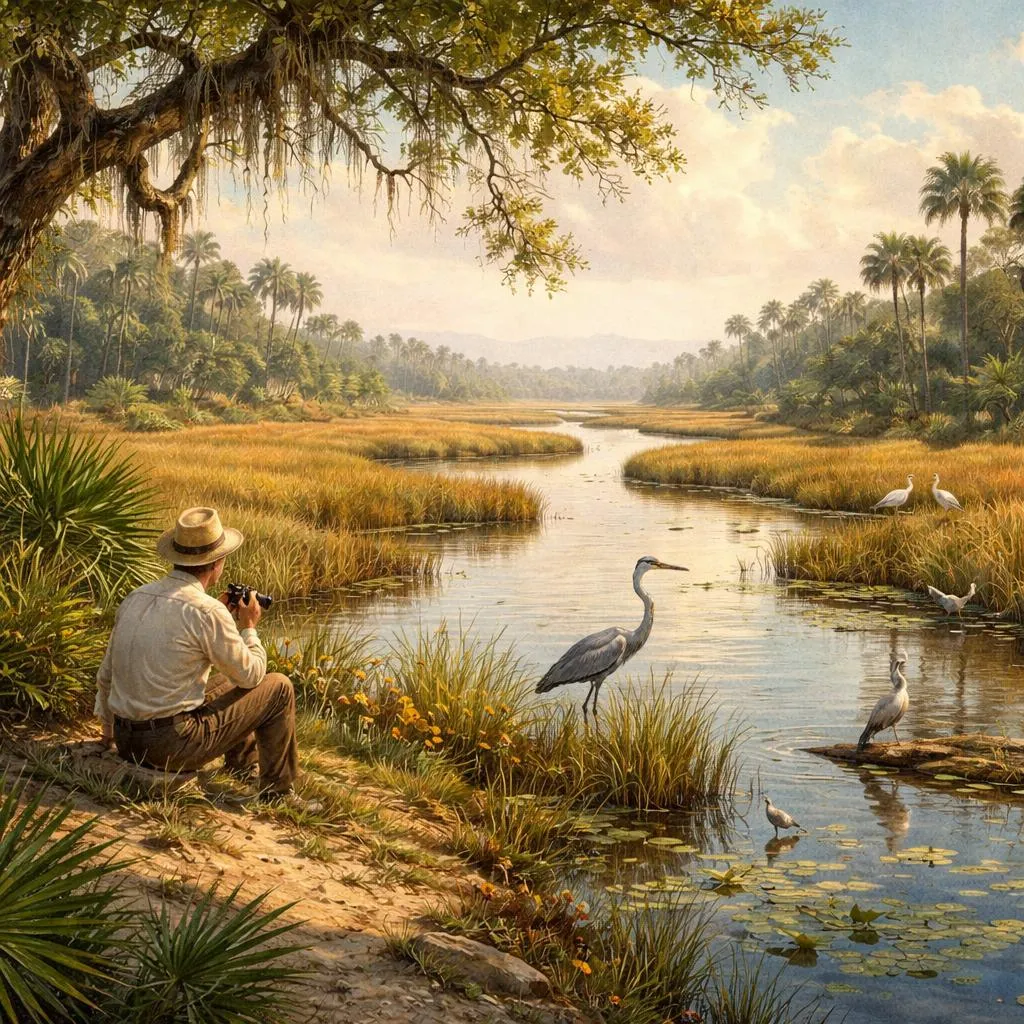

I am sitting upon the upland bank of a narrow winding creek. Before me is a sea of grass, brown and green of many shades. To the north themarsh is bounded by live-oak woods,—a line with numberlessindentations,—beyond which runs the Matanzas River, as I know by thepassing and repassing of sails behind the trees. Eastward aresand-hills, dazzling white in the sun, with a ragged green fringe alongtheir tops. Then comes a stretch of the open sea, and then, more to thesouth, St. Anastasia Island, with its tall black-and-white lighthouseand the cluster of lower buildings at its base. Small sailboats, and nowand then a tiny steamer, pass up and down the river to and from St.Augustine.
A delicious south wind is blowing (it is the 15th of February), and Isit in the shade of a cedar-tree and enjoy the air and the scene. Acontrast, this, to the frozen world I was living in, less than a weekago.
As I approached the creek, a single spotted sandpiper was teeteringalong the edge of the water, and the next moment a big blue heron rosejust beyond him and went flapping away to the middle of the marsh. Now,an hour afterward, he is still standing there, towering above the tallgrass. Once when I turned that way I saw, as I thought, a stake, andthen something moved upon it,—a bird of some kind. And what an enormousbeak! I raised my field-glass. It was the heron. His body was the post,and his head was the bird. Meanwhile, the sandpiper has stolen away, Iknow not when or where. He must have omitted the “tweet, tweet,” withwhich ordinarily he signalizes his flight. He is the first of his kindthat I have seen during my brief stay in these parts.
Now a multitude of crows pass over; fish crows, I think they must be,from their small size and their strange, ridiculous voices. And now asecond great blue heron comes in sight, and keeps on over the marsh andover the live-oak wood, on his way to the San Sebastian marshes, or somepoint still more remote. A fine show he makes, with his wide expanse ofwing, and his feet drawn up and standing out behind him. Next a marshhawk in brown plumage comes skimming over the grass. This way and thathe swerves in ever graceful lines. For one to whom ease and grace comeby nature, even the chase of meadow mice is an act of beauty, whileanother goes awkwardly though in pursuit of a goddess.
Several times I have noticed a kingfisher hovering above the grass (soit looks, but no doubt he is over an arm of the creek), striking the airwith quick strokes, and keeping his head pointed downward, after themanner of a tern. Then he disappeared while I was looking at somethingelse. Now I remark him sitting motionless upon the top of a post in themidst of the marsh.
A third blue heron appears, and he too flies over without stopping.Number One still keeps his place; through the glass I can see himdressing his feathers with his clumsy beak. The lively strain of awhite-eyed vireo, pertest of songsters, comes to me from somewhere on myright, and the soft chipping of myrtle warblers is all but incessant. Ilook up from my paper to see a turkey buzzard sailing majesticallynorthward. I watch him till he fades in the distance. Not once does heflap his wings, but sails and sails, going with the wind, yet turningagain and again to rise against it,—helping himself thus to itsadverse, uplifting pressure in the place of wing-strokes, perhaps,—andpassing onward all the while in beautiful circles. He, too, scavengerthough he is, has a genius for being graceful. One might almost bewilling to be a buzzard, to fly like that!
The kingfisher and the heron are still at their posts. An exquisiteyellow butterfly, of a sort strange to my Yankee eyes, flits past,followed by a red admiral. The marsh hawk is on the wing again, andwhile looking at him I descry a second hawk, too far away to be madeout. Now the air behind me is dark with crows,—a hundred or two, atleast, circling over the low cedars. Some motive they have for all theirclamor, but it passes my owlish wisdom to guess what it can be. A fourthblue heron appears, and drops into the grass out of sight.
Between my feet is a single blossom of the yellow oxalis, the onlyflower to be seen; and very pretty it is, each petal with an orange spotat the base.
Another buzzard, another marsh hawk, another yellow butterfly, and thena smaller one, darker, almost orange. It passes too quickly over thecreek and away. The marsh hawk comes nearer, and I see the strong yellowtinge of his plumage, especially underneath. He will grow handsomer ashe grows older. A pity the same could not be true of men. Behind me aresharp cries of titlarks. From the direction of the river come frequentreports of guns. Somebody is doing his best to be happy! All at once Iprick up my ears. From the grass just across the creek rises the brief,hurried song of a long-billed marsh wren. So he is in Florida, is he?Already I have heard confused noises which I feel sure are the work ofrails of some kind. No doubt there is abundant life concealed in thoseacres on acres of close grass.
The heron and the kingfisher are still quiet. Their morning hunt wassuccessful, and for to-day Fate cannot harm them. A buzzard, withnervous, rustling beats, goes directly above the low cedar under which Iam resting.
At last, after a siesta of two hours, the heron has changed his place. Ilooked up just in season to see him sweeping over the grass, into whichhe dropped the next instant. The tide is falling. The distant sand-hillsare winking in the heat, but the breeze is deliciously cool, the veryperfection of temperature, if a man is to sit still in the shade. It iseleven o’clock. I have a mile to go in the hot sun, and turn away. Butfirst I sweep the line once more with my glass. Yonder to the south aretwo more blue herons standing in the grass. Perhaps there are morestill. I sweep the line. Yes, far, far away I can see four heads in arow. Heads and necks rise above the grass. But so far away! Are theybirds, or only posts made alive by my imagination? I look again. Ibelieve I was deceived. They are nothing but stakes. See how in a rowthey stand. I smile at myself. Just then one of them moves, and anotheris pulled down suddenly into the grass. I smile again. “Ten great blueherons,” I say to myself.
All this has detained me, and meantime the kingfisher has taken wing andgone noisily up the creek. The marsh hawk appears once more. Akilldeer’s sharp, rasping note—a familiar sound in St. Augustine—comesfrom I know not where. A procession of more than twenty black vulturespasses over my head. I can see their feet drawn up under them. My own Imust use in plodding homeward.
Введение и представление автора
Этот яркий рассказ о природе представляет собой детальное наблюдение за экосистемой болот, запечатлевая красоту и жизнь прибрежной среды. Автор, личность которого здесь не указана, демонстрирует острое зрение и глубокую признательность к дикой природе, особенно к птицам. Такое описательное письмо типично для писателей-натуралистов, которые сочетают научное наблюдение с поэтическим языком, чтобы оживить природу для читателей. Этот стиль побуждает читателей, особенно студентов и молодежь, замедлиться и замечать маленькие чудеса окружающего их мира природы.
Детальная интерпретация и значение
Отрывок представляет собой снимок мирного, залитого солнцем дня на болоте недалеко от Сент-Огастина, Флорида. Тщательное внимание автора к поведению и внешнему виду птиц — голубых цапель, песочников, зимородков, болотных луней, грифов-индеек и других — приглашает читателей оценить разнообразие и грацию дикой природы. Повествование также противопоставляет теплую, живую сцену недавнему опыту автора, связанному с замерзшим зимним пейзажем, подчеркивая обновление и жизненную силу природы в более теплом климате.
История не только о птицах, но и о взаимосвязанности жизни и тихих ритмах мира природы. Движения, крики и взаимодействия птиц раскрывают сложную экосистему, где каждое существо играет свою роль. Размышления автора о красоте и грации даже таких птиц-падальщиков, как гриф, предполагают послание о нахождении ценности и достоинства во всех формах жизни.
Уроки и идеи для студентов
-
Навыки наблюдения: Подробные описания побуждают студентов развивать навыки тщательного наблюдения. Замечание мелких деталей — таких как оранжевые пятна на лепестке цветка или схема полета ястреба — может углубить понимание и признательность к природе.
-
Терпение и осознанность: Автор часами спокойно наблюдает за болотом, демонстрируя терпение и осознанность. Студенты могут узнать о важности замедления и присутствия, чтобы по-настоящему испытать и учиться у окружающей среды.
-
Уважение к природе: Повествование воспитывает уважение к дикой природе и окружающей среде. Понимание ролей, которые играют разные животные, помогает сформировать чувство ответственности за мир природы.
-
Связь с местом: Связь автора с болотом и его обитателями показывает, как места могут иметь особое значение. Студентов можно поощрять к исследованию и установлению связи со своей местной средой.
Применение в жизни, учебе и социальной среде
-
В учебе: Студенты могут применять показанные здесь методы наблюдения к научным исследованиям, улучшая свою способность записывать и интерпретировать данные. Эта история может вдохновить на ведение дневника природы или полевые исследования.
-
В социальной жизни: Уважение ко всем существам, включая менее уважаемых, таких как грифы, учит сочувствию и принятию разнообразия, ценным качествам в социальных отношениях.
-
В личностном росте: Продемонстрированное терпение и спокойствие могут помочь студентам справиться со стрессом и развить практики осознанности.
Развитие положительных качеств из истории
-
Любопытство и удивление: Поощрение любопытства к миру природы может привести к пожизненному обучению и открытиям.
-
Терпение: Умение ждать и внимательно наблюдать — это навык, который приносит пользу во многих сферах жизни.
-
Уважение и сочувствие: Видение ценности во всех существах способствует доброте и пониманию по отношению к другим.
-
Связь с природой: Проведение времени на свежем воздухе и наблюдение за дикой природой может улучшить психическое здоровье и способствовать экологической ответственности.
Заключение
Этот отрывок — прекрасный пример природоведческой литературы, который приглашает юных читателей замедлиться, наблюдать и ценить живой мир вокруг них. Он преподает ценные уроки о терпении, уважении и красоте жизни во всех ее формах. Взаимодействуя с такими историями, студенты могут развивать навыки и отношения, которые обогащают их образование и личную жизнь, помогая им вырасти в вдумчивых, заботливых людей, связанных как с природой, так и с обществом.
