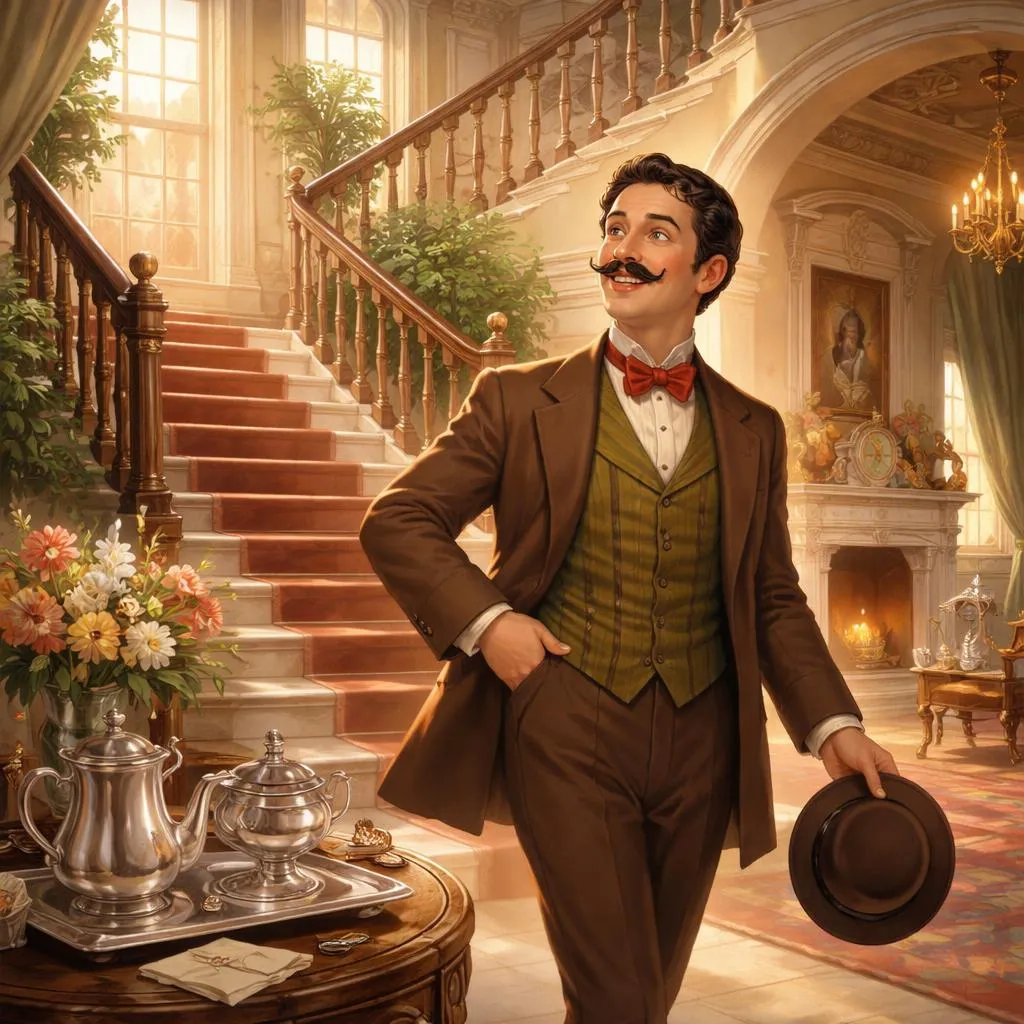

"Faith," muttered Passepartout, somewhat flurried, "I've seen people at Madame Tussaud's as lively as my new master!"
Madame Tussaud's "people," let it be said, are of wax, and are much visited in London; speech is all that is wanting to make them human.
During his brief interview with Mr. Fogg, Passepartout had been carefully observing him. He appeared to be a man about forty years of age, with fine, handsome features, and a tall, well-shaped figure; his hair and whiskers were light, his forehead compact and unwrinkled, his face rather pale, his teeth magnificent. His countenance possessed in the highest degree what physiognomists call "repose in action," a quality of those who act rather than talk. Calm and phlegmatic, with a clear eye, Mr. Fogg seemed a perfect type of that English composure which Angelica Kauffmann has so skilfully represented on canvas. Seen in the various phases of his daily life, he gave the idea of being perfectly well-balanced, as exactly regulated as a Leroy chronometer. Phileas Fogg was, indeed, exactitude personified, and this was betrayed even in the expression of his very hands and feet; for in men, as well as in animals, the limbs themselves are expressive of the passions.
He was so exact that he was never in a hurry, was always ready, and was economical alike of his steps and his motions. He never took one step too many, and always went to his destination by the shortest cut; he made no superfluous gestures, and was never seen to be moved or agitated. He was the most deliberate person in the world, yet always reached his destination at the exact moment.
He lived alone, and, so to speak, outside of every social relation; and as he knew that in this world account must be taken of friction, and that friction retards, he never rubbed against anybody.
As for Passepartout, he was a true Parisian of Paris. Since he had abandoned his own country for England, taking service as a valet, he had in vain searched for a master after his own heart. Passepartout was by no means one of those pert dunces depicted by Moliere with a bold gaze and a nose held high in the air; he was an honest fellow, with a pleasant face, lips a trifle protruding, soft-mannered and serviceable, with a good round head, such as one likes to see on the shoulders of a friend. His eyes were blue, his complexion rubicund, his figure almost portly and well-built, his body muscular, and his physical powers fully developed by the exercises of his younger days. His brown hair was somewhat tumbled; for, while the ancient sculptors are said to have known eighteen methods of arranging Minerva's tresses, Passepartout was familiar with but one of dressing his own: three strokes of a large-tooth comb completed his toilet.
It would be rash to predict how Passepartout's lively nature would agree with Mr. Fogg. It was impossible to tell whether the new servant would turn out as absolutely methodical as his master required; experience alone could solve the question. Passepartout had been a sort of vagrant in his early years, and now yearned for repose; but so far he had failed to find it, though he had already served in ten English houses. But he could not take root in any of these; with chagrin, he found his masters invariably whimsical and irregular, constantly running about the country, or on the look-out for adventure. His last master, young Lord Longferry, Member of Parliament, after passing his nights in the Haymarket taverns, was too often brought home in the morning on policemen's shoulders. Passepartout, desirous of respecting the gentleman whom he served, ventured a mild remonstrance on such conduct; which, being ill-received, he took his leave. Hearing that Mr. Phileas Fogg was looking for a servant, and that his life was one of unbroken regularity, that he neither travelled nor stayed from home overnight, he felt sure that this would be the place he was after. He presented himself, and was accepted, as has been seen.
At half-past eleven, then, Passepartout found himself alone in the house in Saville Row. He begun its inspection without delay, scouring it from cellar to garret. So clean, well-arranged, solemn a mansion pleased him; it seemed to him like a snail's shell, lighted and warmed by gas, which sufficed for both these purposes. When Passepartout reached the second story he recognised at once the room which he was to inhabit, and he was well satisfied with it. Electric bells and speaking-tubes afforded communication with the lower stories; while on the mantel stood an electric clock, precisely like that in Mr. Fogg's bedchamber, both beating the same second at the same instant. "That's good, that'll do," said Passepartout to himself.
He suddenly observed, hung over the clock, a card which, upon inspection, proved to be a programme of the daily routine of the house. It comprised all that was required of the servant, from eight in the morning, exactly at which hour Phileas Fogg rose, till half-past eleven, when he left the house for the Reform Club—all the details of service, the tea and toast at twenty-three minutes past eight, the shaving-water at thirty-seven minutes past nine, and the toilet at twenty minutes before ten. Everything was regulated and foreseen that was to be done from half-past eleven a.m. till midnight, the hour at which the methodical gentleman retired.
Mr. Fogg's wardrobe was amply supplied and in the best taste. Each pair of trousers, coat, and vest bore a number, indicating the time of year and season at which they were in turn to be laid out for wearing; and the same system was applied to the master's shoes. In short, the house in Saville Row, which must have been a very temple of disorder and unrest under the illustrious but dissipated Sheridan, was cosiness, comfort, and method idealised. There was no study, nor were there books, which would have been quite useless to Mr. Fogg; for at the Reform two libraries, one of general literature and the other of law and politics, were at his service. A moderate-sized safe stood in his bedroom, constructed so as to defy fire as well as burglars; but Passepartout found neither arms nor hunting weapons anywhere; everything betrayed the most tranquil and peaceable habits.
Having scrutinised the house from top to bottom, he rubbed his hands, a broad smile overspread his features, and he said joyfully, "This is just what I wanted! Ah, we shall get on together, Mr. Fogg and I! What a domestic and regular gentleman! A real machine; well, I don't mind serving a machine."
Введение и представление автора
Этот отрывок из классического романа «Вокруг света за восемьдесят дней» Жюля Верна, знаменитого французского писателя, известного своими приключенческими и научно-фантастическими произведениями. Написанный в 1873 году, этот роман отражает дух промышленной революции и увлечение новыми технологиями и глобальными путешествиями. Яркое воображение и детальные описания Верна оживляют волнение и трудности путешествия вокруг света в то время, когда такие путешествия были еще замечательным подвигом.
Подробный разбор истории
В отрывке представлены два главных героя: Филеас Фогг, человек строгой рутины и точности, и его новоиспеченный слуга Паспарту, чья живая и гибкая натура контрастирует с механической правильностью Фогга. Фогг изображен как образец английского самообладания и точности, живущий жизнью настолько упорядоченной, что каждая минута и движение планируются и выполняются с осторожностью. Паспарту, с другой стороны, теплый, человечный персонаж с красочным прошлым и стремлением к стабильности.
Это начало задает основу для центрального приключения романа: пари Фогга о том, чтобы обогнуть земной шар за восемьдесят дней. Контраст между методичной натурой Фогга и непредсказуемым миром, с которым ему предстоит столкнуться, создает напряжение и юмор на протяжении всей истории.
Чему могут научиться ученики
-
Ценность дисциплины и рутины: Персонаж Филеаса Фогга иллюстрирует силу дисциплины. Его пунктуальность, тщательное планирование и спокойное поведение показывают, как структура может помочь в достижении амбициозных целей. Ученики могут узнать о важности управления временем и организации в учебе и повседневной жизни.
-
Адаптируемость и непредвзятость: Персонаж Паспарту напоминает нам, что, хотя рутина ценна, гибкость и доброта не менее важны. Его прошлый опыт и непринужденный характер уравновешивают жесткость Фогга, уча учеников ценить разные личности и адаптироваться к новым ситуациям.
-
Мужество и приключения: Роман побуждает читателей принимать вызовы и выходить за пределы своей зоны комфорта. Путешествие Фогга — это метафора настойчивости и храбрости, вдохновляющая юных читателей на достижение своих мечтаний, несмотря на препятствия.
-
Культурная осведомленность: Поскольку история путешествует по разным странам и культурам, она открывает окно в разнообразие мира. Это расширяет кругозор учеников и воспитывает уважение к разным народам и традициям.
Применение этих уроков в жизни
- В учебе: Ученики могут перенять преданность Фогга, ставя четкие цели и следуя учебному графику, а также помня о гибкости Паспарту, чтобы достойно справляться с неожиданными изменениями или трудностями.
- В социальных условиях: Признание ценности разных личностей помогает строить эмпатию и командную работу. Так же, как Фогг и Паспарту дополняют друг друга, ученики могут научиться хорошо работать с одноклассниками, обладающими разными сильными сторонами.
- В личностном росте: Дух приключений поощряет любопытство и жизнестойкость. Ученики могут бросить себе вызов, чтобы попробовать новые занятия, путешествовать или исследовать новые идеи, развивая свою уверенность и мировоззрение.
Развитие положительных черт из истории
- Точность и ответственность: Как и Фогг, ученики могут практиковаться в ответственности за свои задачи и пунктуальности в своих обязательствах.
- Дружелюбие и поддержка: Вдохновленные Паспарту, проявление доброты и поддержки по отношению к другим создает крепкую дружбу и позитивную атмосферу.
- Решение проблем: История показывает, что возникают неожиданные проблемы, но спокойное мышление и решимость приводят к успеху. Ученики могут развивать навыки решения проблем, сохраняя спокойствие и творчески мысля.
Заключение
«Вокруг света за восемьдесят дней» — это больше, чем просто захватывающее приключение; это богатый источник уроков о характере, культуре и мужестве. Читая и размышляя над этой историей, ученики могут получить знания, которые помогут им в школе, отношениях и во многих жизненных путешествиях. Принятие как дисциплины, так и гибкости, уважение к разнообразию и смелость исследовать неизвестное — это вечные ценности, которые этот классический роман прекрасно передает.
