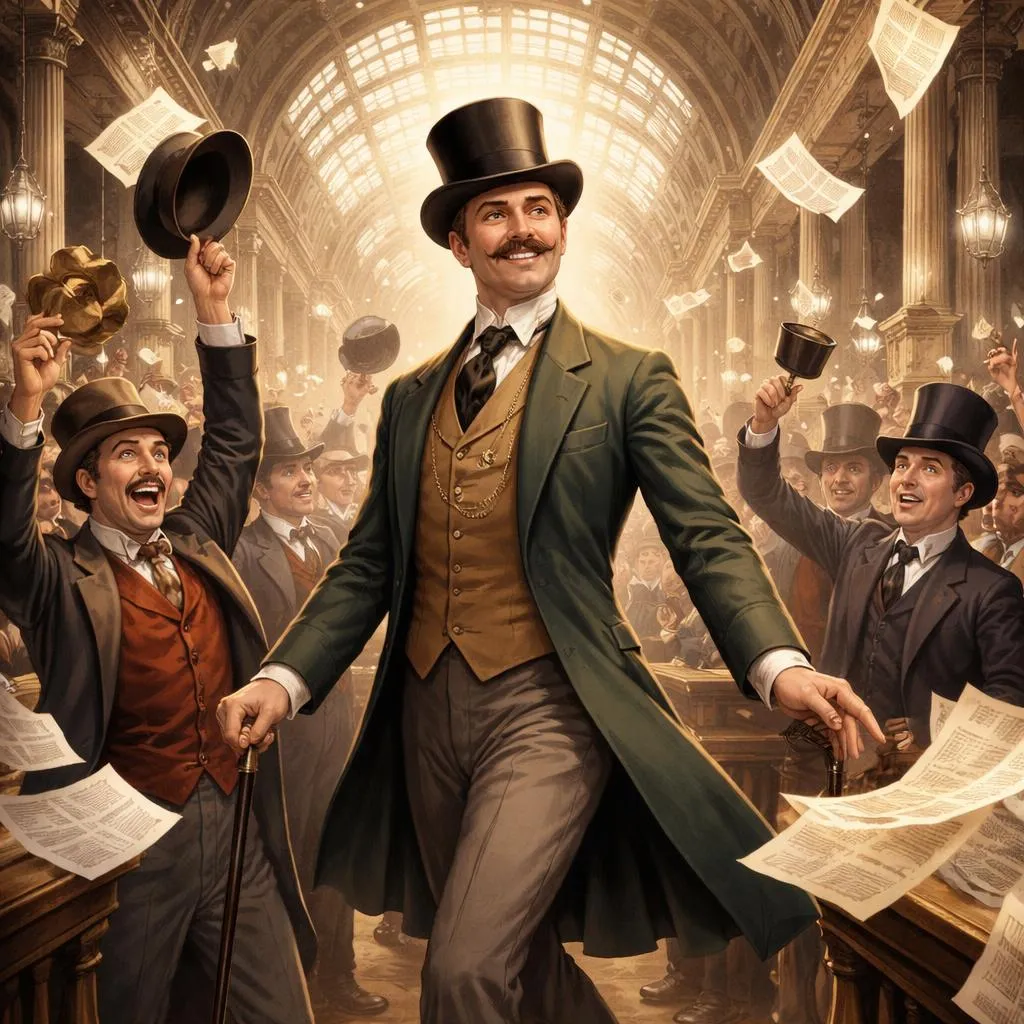

It is time to relate what a change took place in English public opinion when it transpired that the real bankrobber, a certain James Strand, had been arrested, on the 17th day of December, at Edinburgh. Three days before, Phileas Fogg had been a criminal, who was being desperately followed up by the police; now he was an honourable gentleman, mathematically pursuing his eccentric journey round the world.
The papers resumed their discussion about the wager; all those who had laid bets, for or against him, revived their interest, as if by magic; the "Phileas Fogg bonds" again became negotiable, and many new wagers were made. Phileas Fogg's name was once more at a premium on 'Change.
His five friends of the Reform Club passed these three days in a state of feverish suspense. Would Phileas Fogg, whom they had forgotten, reappear before their eyes! Where was he at this moment? The 17th of December, the day of James Strand's arrest, was the seventy–sixth since Phileas Fogg's departure, and no news of him had been received. Was he dead? Had he abandoned the effort, or was he continuing his journey along the route agreed upon? And would he appear on Saturday, the 21st of December, at a quarter before nine in the evening, on the threshold of the Reform Club saloon?
The anxiety in which, for three days, London society existed, cannot be described. Telegrams were sent to America and Asia for news of Phileas Fogg. Messengers were dispatched to the house in Saville Row morning and evening. No news. The police were ignorant what had become of the detective, Fix, who had so unfortunately followed up a false scent. Bets increased, nevertheless, in number and value. Phileas Fogg, like a racehorse, was drawing near his last turning–point. The bonds were quoted, no longer at a hundred below par, but at twenty, at ten, and at five; and paralytic old Lord Albemarle bet even in his favour.
A great crowd was collected in Pall Mall and the neighbouring streets on Saturday evening; it seemed like a multitude of brokers permanently established around the Reform Club. Circulation was impeded, and everywhere disputes, discussions, and financial transactions were going on. The police had great difficulty in keeping back the crowd, and as the hour when Phileas Fogg was due approached, the excitement rose to its highest pitch.
The five antagonists of Phileas Fogg had met in the great saloon of the club. John Sullivan and Samuel Fallentin, the bankers, Andrew Stuart, the engineer, Gauthier Ralph, the director of the Bank of England, and Thomas Flanagan, the brewer, one and all waited anxiously.
When the clock indicated twenty minutes past eight, Andrew Stuart got up, saying, "Gentlemen, in twenty minutes the time agreed upon between Mr. Fogg and ourselves will have expired."
"What time did the last train arrive from Liverpool?" asked Thomas Flanagan.
"At twenty–three minutes past seven," replied Gauthier Ralph; "and the next does not arrive till ten minutes after twelve."
"Well, gentlemen," resumed Andrew Stuart, "if Phileas Fogg had come in the 7:23 train, he would have got here by this time. We can, therefore, regard the bet as won."
"Wait; don't let us be too hasty," replied Samuel Fallentin. "You know that Mr. Fogg is very eccentric. His punctuality is well known; he never arrives too soon, or too late; and I should not be surprised if he appeared before us at the last minute."
"Why," said Andrew Stuart nervously, "if I should see him, I should not believe it was he."
"The fact is," resumed Thomas Flanagan, "Mr. Fogg's project was absurdly foolish. Whatever his punctuality, he could not prevent the delays which were certain to occur; and a delay of only two or three days would be fatal to his tour."
"Observe, too," added John Sullivan, "that we have received no intelligence from him, though there are telegraphic lines all along is route."
"He has lost, gentleman," said Andrew Stuart, "he has a hundred times lost! You know, besides, that the China the only steamer he could have taken from New York to get here in time arrived yesterday. I have seen a list of the passengers, and the name of Phileas Fogg is not among them. Even if we admit that fortune has favoured him, he can scarcely have reached America. I think he will be at least twenty days behind–hand, and that Lord Albemarle will lose a cool five thousand."
"It is clear," replied Gauthier Ralph; "and we have nothing to do but to present Mr. Fogg's cheque at Barings to–morrow."
At this moment, the hands of the club clock pointed to twenty minutes to nine.
"Five minutes more," said Andrew Stuart.
The five gentlemen looked at each other. Their anxiety was becoming intense; but, not wishing to betray it, they readily assented to Mr. Fallentin's proposal of a rubber.
"I wouldn't give up my four thousand of the bet," said Andrew Stuart, as he took his seat, "for three thousand nine hundred and ninety–nine."
The clock indicated eighteen minutes to nine.
The players took up their cards, but could not keep their eyes off the clock. Certainly, however secure they felt, minutes had never seemed so long to them!
"Seventeen minutes to nine," said Thomas Flanagan, as he cut the cards which Ralph handed to him.
Then there was a moment of silence. The great saloon was perfectly quiet; but the murmurs of the crowd outside were heard, with now and then a shrill cry. The pendulum beat the seconds, which each player eagerly counted, as he listened, with mathematical regularity.
"Sixteen minutes to nine!" said John Sullivan, in a voice which betrayed his emotion.
One minute more, and the wager would be won. Andrew Stuart and his partners suspended their game. They left their cards, and counted the seconds.
At the fortieth second, nothing. At the fiftieth, still nothing.
At the fifty–fifth, a loud cry was heard in the street, followed by applause, hurrahs, and some fierce growls.
The players rose from their seats.
At the fifty–seventh second the door of the saloon opened; and the pendulum had not beat the sixtieth second when Phileas Fogg appeared, followed by an excited crowd who had forced their way through the club doors, and in his calm voice, said, "Here I am, gentlemen!"
Введение и представление автора
Этот отрывок взят из классического приключенческого романа «Вокруг света за восемьдесят дней» Жюля Верна, французского писателя, известного своими новаторскими работами в области научной фантастики и приключенческой литературы. Написанный в 1873 году, этот роман отражает дух XIX века — время стремительного технического прогресса и глобальных исследований. Воображение Жюля Верна и детальные описания сделали его произведения вневременными, вдохновляя поколения читателей мечтать о далеких местах и смелых подвигах.
Детальная интерпретация и значение
История вращается вокруг Филеаса Фогга, точного и методичного английского джентльмена, который заключает пари, что сможет объехать земной шар всего за восемьдесят дней. Этот отрывок запечатлевает кульминацию истории, когда общественное мнение резко меняется, поскольку судьба Фогга висит на волоске. Первоначально подозреваемый в преступлении, честь и решимость Фогга восстанавливаются, когда настоящий виновник пойман. Напряжение нарастает, когда часы отсчитывают время до последнего момента пари, кульминацией которого становится триумфальное возвращение Фогга.
Эта сцена подчеркивает темы настойчивости, пунктуальности и триумфа человеческой воли над, казалось бы, невозможными обстоятельствами. Она также отражает увлечение викторианской эпохи прогрессом, пунктуальностью и расширением Британской империи. История умело сочетает в себе приключения с тонкой критикой социальных норм и ценности, придаваемой внешности и репутации.
Уроки и вдохновение для студентов
-
Настойчивость и решительность: Путешествие Филеаса Фогга учит важности приверженности своим целям, даже когда сталкиваешься с неудачами и сомнениями. Студенты могут научиться упорствовать в учебе и личных испытаниях, перенимая подобный образ мышления.
-
Управление временем и пунктуальность: Строгое соблюдение Фоггом своего расписания является ярким примером того, как эффективное управление временем может привести к успеху. Юные читатели могут поразмышлять о том, как планирование и пунктуальность помогают в учебе и повседневных обязанностях.
-
Критическое мышление и суждение: Колеблющееся общественное мнение о Фогге напоминает нам о том, что нельзя делать поспешных выводов на основе неполной информации. Студенты должны развивать навыки критического мышления и избегать поспешных суждений о других.
-
Смелость идти на риск: Пари Фогга смелое и рискованное, но оно подталкивает его к исследованию мира и росту. Это побуждает студентов выходить из зоны комфорта и принимать вызовы, которые способствуют обучению и самопознанию.
-
Социальная и эмоциональная устойчивость: Несмотря на общественные подозрения и давление пари, Фогг остается спокойным и собранным. Это учит эмоциональной устойчивости и ценности сохранения самообладания в стрессовых ситуациях.
Применение этих уроков в повседневной жизни
-
В учебе: Студенты могут ставить четкие цели и сроки для своих заданий, как Фогг планировал свое путешествие. Разделение больших задач на более мелкие шаги и соблюдение расписания может улучшить успеваемость.
-
В социальных взаимодействиях: Понимание важности того, чтобы не судить других преждевременно, помогает строить эмпатию и лучшие отношения. Студенты могут практиковать слушание и сбор фактов, прежде чем формировать мнения.
-
В личностном росте: Принятие просчитанных рисков, таких как вступление в новые клубы или проба новых хобби, может расширить кругозор и укрепить уверенность.
-
В развитии характера: Подражание спокойствию и решимости Фогга может помочь студентам справляться с экзаменами, соревнованиями или личными проблемами со спокойным умом.
Развитие положительных черт из истории
Учителя и родители могут побуждать детей к:
- Развитию чувства ответственности путем постановки личных целей.
- Практике пунктуальности путем создания распорядка дня.
- Развитию устойчивости путем обсуждения историй преодоления препятствий.
- Развитию любопытства к миру посредством чтения и исследований.
- Оценке ценности дружбы и поддержки, как видно на примере спутников Фогга.
В заключение, «Вокруг света за восемьдесят дней» — это не просто захватывающее приключение; это богатый источник жизненных уроков, которые вдохновляют юных читателей мечтать о великом, усердно работать и встречать жизненные вызовы с мужеством и честностью.
