
It seemed to me that this quaint lie was most simply and beautifully told; but then I had heard it only once, and that makes a difference; it was pleasant to the others when it was fresh, no doubt.
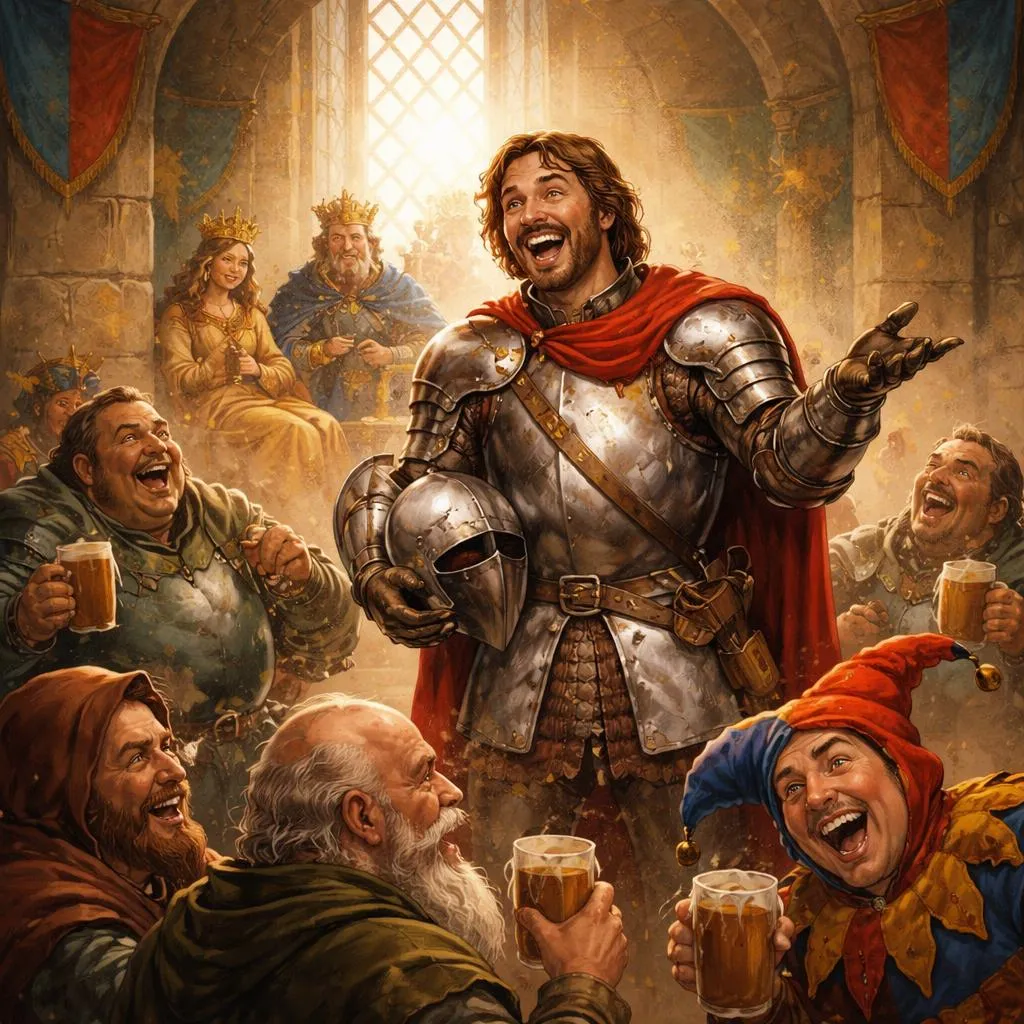
Sir Dinadan the Humorist was the first to awake, and he soon roused the rest with a practical joke of a sufficiently poor quality. He tied some metal mugs to a dog’s tail and turned him loose, and he tore around and around the place in a frenzy of fright, with all the other dogs bellowing after him and battering and crashing against everything that came in their way and making altogether a chaos of confusion and a most deafening din and turmoil; at which every man and woman of the multitude laughed till the tears flowed, and some fell out of their chairs and wallowed on the floor in ecstasy. It was just like so many children. Sir Dinadan was so proud of his exploit that he could not keep from telling over and over again, to weariness, how the immortal idea happened to occur to him; and as is the way with humorists of his breed, he was still laughing at it after everybody else had got through. He was so set up that he concluded to make a speech —of course a humorous speech. I think I never heard so many old played-out jokes strung together in my life. He was worse than the minstrels, worse than the clown in the circus. It seemed peculiarly sad to sit here, thirteen hundred years before I was born, and listen again to poor, flat, worm-eaten jokes that had given me the dry gripes when I was a boy thirteen hundred years afterwards. It about convinced me that there isn’t any such thing as a new joke possible. Everybody laughed at these antiquities —but then they always do; I had noticed that, centuries later. However, of course the scoffer didn’t laugh—I mean the boy. No, he scoffed; there wasn’t anything he wouldn’t scoff at. He said the most of Sir Dinadan’s jokes were rotten and the rest were petrified. I said “petrified” was good; as I believed, myself, that the only right way to classify the majestic ages of some of those jokes was by geologic periods. But that neat idea hit the boy in a blank place, for geology hadn’t been invented yet. However, I made a note of the remark, and calculated to educate the commonwealth up to it if I pulled through. It is no use to throw a good thing away merely because the market isn’t ripe yet.
Now Sir Kay arose and began to fire up on his history-mill with me for fuel. It was time for me to feel serious, and I did. Sir Kay told how he had encountered me in a far land of barbarians, who all wore the same ridiculous garb that I did—a garb that was a work of enchantment, and intended to make the wearer secure from hurt by human hands. However he had nullified the force of the enchantment by prayer, and had killed my thirteen knights in a three hours’ battle, and taken me prisoner, sparing my life in order that so strange a curiosity as I was might be exhibited to the wonder and admiration of the king and the court. He spoke of me all the time, in the blandest way, as “this prodigious giant,” and “this horrible sky-towering monster,” and “this tusked and taloned man-devouring ogre”, and everybody took in all this bosh in the naivest way, and never smiled or seemed to notice that there was any discrepancy between these watered statistics and me. He said that in trying to escape from him I sprang into the top of a tree two hundred cubits high at a single bound, but he dislodged me with a stone the size of a cow, which “all-to brast” the most of my bones, and then swore me to appear at Arthur’s court for sentence. He ended by condemning me to die at noon on the 21st; and was so little concerned about it that he stopped to yawn before he named the date.
I was in a dismal state by this time; indeed, I was hardly enough in my right mind to keep the run of a dispute that sprung up as to how I had better be killed, the possibility of the killing being doubted by some, because of the enchantment in my clothes. And yet it was nothing but an ordinary suit of fifteen-dollar slop-shops. Still, I was sane enough to notice this detail, to wit: many of the terms used in the most matter-of-fact way by this great assemblage of the first ladies and gentlemen in the land would have made a Comanche blush. Indelicacy is too mild a term to convey the idea. However, I had read “Tom Jones,” and “Roderick Random,” and other books of that kind, and knew that the highest and first ladies and gentlemen in England had remained little or no cleaner in their talk, and in the morals and conduct which such talk implies, clear up to a hundred years ago; in fact clear into our own nineteenth century—in which century, broadly speaking, the earliest samples of the real lady and real gentleman discoverable in English history—or in European history, for that matter—may be said to have made their appearance. Suppose Sir Walter, instead of putting the conversations into the mouths of his characters, had allowed the characters to speak for themselves? We should have had talk from Rebecca and Ivanhoe and the soft lady Rowena which would embarrass a tramp in our day. However, to the unconsciously indelicate all things are delicate. King Arthur’s people were not aware that they were indecent and I had presence of mind enough not to mention it.
They were so troubled about my enchanted clothes that they were mightily relieved, at last, when old Merlin swept the difficulty away for them with a common-sense hint. He asked them why they were so dull—why didn’t it occur to them to strip me. In half a minute I was as naked as a pair of tongs! And dear, dear, to think of it: I was the only embarrassed person there. Everybody discussed me; and did it as unconcernedly as if I had been a cabbage. Queen Guenever was as naively interested as the rest, and said she had never seen anybody with legs just like mine before. It was the only compliment I got—if it was a compliment.
Finally I was carried off in one direction, and my perilous clothes in another. I was shoved into a dark and narrow cell in a dungeon, with some scant remnants for dinner, some moldy straw for a bed, and no end of rats for company.
Введение и представление автора
Этот отрывок взят из романа Марка Твена «Янки из Коннектикута при дворе короля Артура», впервые опубликованного в 1889 году. Твен, один из величайших американских юмористов и социальных критиков, использует эту историю, чтобы объединить фэнтези, сатиру и историческую фантастику. В романе рассказывается о американском инженере XIX века, который таинственным образом переносится во времени в эпоху короля Артура. Твен использует эту воображаемую обстановку для исследования тем прогресса, технологий, социальной справедливости и человеческой природы.
Подробная интерпретация и значение
Отрывок передает юмористическое и часто абсурдное столкновение между современным и средневековым мирами. Главный герой, человек из будущего, наблюдает за рыцарями и дворянами легенды о короле Артуре со смесью иронии и недоверия. Розыгрыш сэра Динадана и преувеличенные рассказы сэра Кея подчеркивают контраст между рыцарскими идеалами и часто смешной реальностью, стоящей за ними.
Повествовательный стиль Твена сочетает в себе игривый тон с острой социальной критикой. «Причудливая ложь» и «старые избитые шутки» символизируют то, как истории и традиции могут искажаться или терять смысл со временем. Размышления главного героя о языке и манерах прошлого раскрывают критику Твеном социальных притязаний и лицемерия, как в средневековой обстановке, так и в его собственное время.
Заколдованная одежда и заключение главного героя иллюстрируют напряжение между суеверием и разумом, повторяющейся темой в романе. Практический совет Мерлина раздеть главного героя догола, чтобы разрушить чары, представляет собой триумф здравого смысла над слепой верой.
Уроки и идеи для студентов
-
Критическое мышление и скептицизм: История побуждает читателей подвергать сомнению общепринятые истины и традиции. Подобно тому, как главный герой сомневается в рассказах рыцарей и силе чар, студенты должны научиться критически относиться к информации и не принимать все на веру.
-
Юмор как инструмент для размышления: Использование юмора Твеном помогает разоблачать человеческие недостатки и социальные пороки. Студенты могут оценить, как смех и сатира могут быть мощными способами понимания и критики окружающего мира.
-
Понимание исторического контекста: Роман сочетает в себе историческую легенду с современными идеями, показывая, как меняются взгляды со временем. Это побуждает студентов исследовать историю с открытым сердцем и признавать влияние культуры и времени на истории и убеждения.
-
Уважение к знаниям и прогрессу: Происхождение главного героя как инженера символизирует важность науки и техники в развитии общества. Студенты могут вдохновиться на то, чтобы ценить образование и инновации, уважая уроки прошлого.
-
Эмпатия и непредвзятость: Опыт главного героя как постороннего в странном мире учит важности эмпатии и приспособляемости. Студенты могут научиться ценить разные культуры и точки зрения, что жизненно важно в современном разнообразном обществе.
Применение духа истории в повседневной жизни
-
В учебе: Примите любопытство и подвергайте сомнению предположения. Подходите к учебе с балансом скептицизма и открытости, подобно тому, как главный герой ориентируется в незнакомом мире.
-
В социальных взаимодействиях: Используйте юмор с добротой, чтобы ослабить напряжение и наладить связи, но будьте внимательны к чувствам других. Как и шутки сэра Динадана, юмор может объединять людей, когда используется вдумчиво.
-
В решении проблем: Применяйте разум и здравый смысл для решения проблем, как советует Мерлин. Не бойтесь отбрасывать ненужные сложности, чтобы найти четкие решения.
-
В развитии характера: Развивайте устойчивость и приспособляемость. Путешествие главного героя показывает, что неожиданные ситуации требуют мужества и гибкости.
Поощрение позитивных ценностей
Студенты могут извлечь уроки из опыта главного героя, чтобы развить такие добродетели, как честность, храбрость и смирение. Признание недостатков в других и в себе с юмором и изяществом помогает сформировать сильный характер. Роман также пропагандирует ценность отстаивания того, что правильно, подвергая сомнению несправедливость и ответственно используя знания.
Читая и размышляя над «Янки из Коннектикута при дворе короля Артура», юные читатели получают не только развлечение, но и более глубокое понимание истории, общества и человеческой природы. Им предлагается мыслить независимо, ценить силу повествования и нести вперед дух исследования и доброты в своей жизни.
