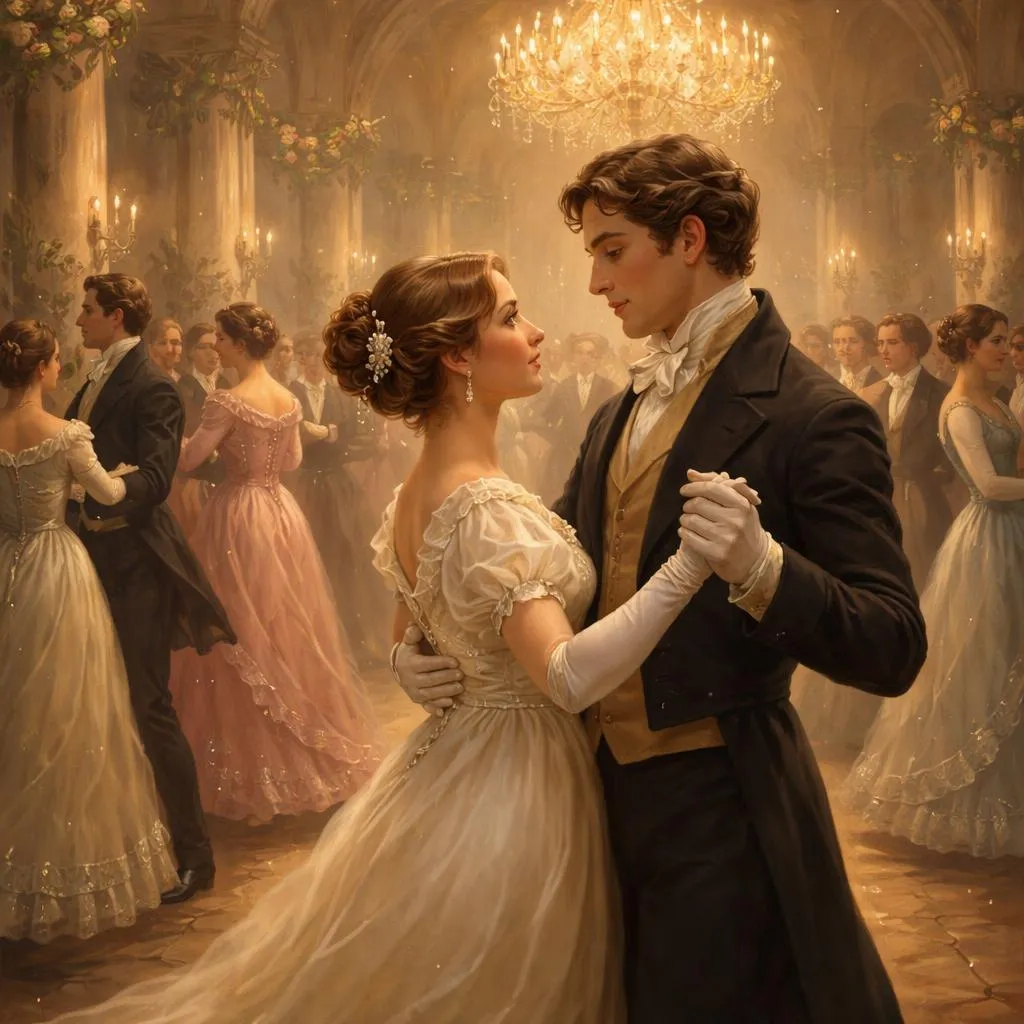

‘Now, Miss Grey,’ exclaimed Miss Murray, immediately I entered the schoolroom, after having taken off my outdoor garments, upon returning from my four weeks’ recreation, ‘Now—shut the door, and sit down, and I’ll tell you all about the ball.’
‘No—damn it, no!’ shouted Miss Matilda. ‘Hold your tongue, can’t ye? and let me tell her about my new mare—SUCH a splendour, Miss Grey! a fine blood mare—’
‘Do be quiet, Matilda; and let me tell my news first.’
‘No, no, Rosalie; you’ll be such a damned long time over it—she shall hear me first—I’ll be hanged if she doesn’t!’
‘I’m sorry to hear, Miss Matilda, that you’ve not got rid of that shocking habit yet.’
‘Well, I can’t help it: but I’ll never say a wicked word again, if you’ll only listen to me, and tell Rosalie to hold her confounded tongue.’
Rosalie remonstrated, and I thought I should have been torn in pieces between them; but Miss Matilda having the loudest voice, her sister at length gave in, and suffered her to tell her story first: so I was doomed to hear a long account of her splendid mare, its breeding and pedigree, its paces, its action, its spirit, &c., and of her own amazing skill and courage in riding it; concluding with an assertion that she could clear a five–barred gate ‘like winking,’ that papa said she might hunt the next time the hounds met, and mamma had ordered a bright scarlet hunting–habit for her.
‘Oh, Matilda! what stories you are telling!’ exclaimed her sister.
‘Well,’ answered she, no whit abashed, ‘I know I COULD clear a five–barred gate, if I tried, and papa WILL say I may hunt, and mamma WILL order the habit when I ask it.’
‘Well, now get along,’ replied Miss Murray; ‘and do, dear Matilda, try to be a little more lady–like. Miss Grey, I wish you would tell her not to use such shocking words; she will call her horse a mare: it is so inconceivably shocking! and then she uses such dreadful expressions in describing it: she must have learned it from the grooms. It nearly puts me into fits when she begins.’
‘I learned it from papa, you ass! and his jolly friends,’ said the young lady, vigorously cracking a hunting–whip, which she habitually carried in her hand. ‘I’m as good judge of horseflesh as the best of ‘m.’
‘Well, now get along, you shocking girl! I really shall take a fit if you go on in such a way. And now, Miss Grey, attend to me; I’m going to tell you about the ball. You must be dying to hear about it, I know. Oh, SUCH a ball! You never saw or heard, or read, or dreamt of anything like it in all your life. The decorations, the entertainment, the supper, the music were indescribable! and then the guests! There were two noblemen, three baronets, and five titled ladies, and other ladies and gentlemen innumerable. The ladies, of course, were of no consequence to me, except to put me in a good humour with myself, by showing how ugly and awkward most of them were; and the best, mamma told me,—the most transcendent beauties among them, were nothing to me. As for me, Miss Grey—I’m so SORRY you didn’t see me! I was CHARMING—wasn’t I, Matilda?’
‘Middling.’
‘No, but I really was—at least so mamma said—and Brown and Williamson. Brown said she was sure no gentleman could set eyes on me without falling in love that minute; and so I may be allowed to be a little vain. I know you think me a shocking, conceited, frivolous girl; but then, you know, I don’t attribute it ALL to my personal attractions: I give some praise to the hairdresser, and some to my exquisitely lovely dress—you must see it to–morrow— white gauze over pink satin—and so SWEETLY made! and a necklace and bracelet of beautiful, large pearls!’
‘I have no doubt you looked very charming: but should that delight you so very much?’
‘Oh, no!—not that alone: but, then, I was so much admired; and I made so MANY conquests in that one night—you’d be astonished to hear—’
‘But what good will they do you?’
‘What good! Think of any woman asking that!’
‘Well, I should think one conquest would be enough; and too much, unless the subjugation were mutual.’
‘Oh, but you know I never agree with you on those points. Now, wait a bit, and I’ll tell you my principal admirers—those who made themselves very conspicuous that night and after: for I’ve been to two parties since. Unfortunately the two noblemen, Lord G—– and Lord F—–, were married, or I might have condescended to be particularly gracious to THEM; as it was, I did not: though Lord F—–, who hates his wife, was evidently much struck with me. He asked me to dance with him twice—he is a charming dancer, by–the–by, and so am I: you can’t think how well I did—I was astonished at myself. My lord was very complimentary too—rather too much so in fact—and I thought proper to be a little haughty and repellent; but I had the pleasure of seeing his nasty, cross wife ready to perish with spite and vexation—’
‘Oh, Miss Murray! you don’t mean to say that such a thing could really give you pleasure? However cross or—’
‘Well, I know it’s very wrong;—but never mind! I mean to be good some time—only don’t preach now, there’s a good creature. I haven’t told you half yet. Let me see. Oh! I was going to tell you how many unmistakeable admirers I had:– Sir Thomas Ashby was one,—Sir Hugh Meltham and Sir Broadley Wilson are old codgers, only fit companions for papa and mamma. Sir Thomas is young, rich, and gay; but an ugly beast, nevertheless: however, mamma says I should not mind that after a few months’ acquaintance. Then, there was Henry Meltham, Sir Hugh’s younger son; rather good–looking, and a pleasant fellow to flirt with: but BEING a younger son, that is all he is good for; then there was young Mr. Green, rich enough, but of no family, and a great stupid fellow, a mere country booby! and then, our good rector, Mr. Hatfield: an HUMBLE admirer he ought to consider himself; but I fear he has forgotten to number humility among his stock of Christian virtues.’
‘Was Mr. Hatfield at the ball?’
‘Yes, to be sure. Did you think he was too good to go?’
‘I thought be might consider it unclerical.’
‘By no means. He did not profane his cloth by dancing; but it was with difficulty he could refrain, poor man: he looked as if he were dying to ask my hand just for ONE set; and—oh! by–the–by— he’s got a new curate: that seedy old fellow Mr. Bligh has got his long–wished–for living at last, and is gone.’
‘And what is the new one like?’
‘Oh, SUCH a beast! Weston his name is. I can give you his description in three words—an insensate, ugly, stupid blockhead. That’s four, but no matter—enough of HIM now.’
Then she returned to the ball, and gave me a further account of her deportment there, and at the several parties she had since attended; and further particulars respecting Sir Thomas Ashby and Messrs. Meltham, Green, and Hatfield, and the ineffaceable impression she had wrought upon each of them.
‘Well, which of the four do you like best?’ said I, suppressing my third or fourth yawn.
‘I detest them all!’ replied she, shaking her bright ringlets in vivacious scorn.
‘That means, I suppose, “I like them all”—but which most?’
‘No, I really detest them all; but Harry Meltham is the handsomest and most amusing, and Mr. Hatfield the cleverest, Sir Thomas the wickedest, and Mr. Green the most stupid. But the one I’m to have, I suppose, if I’m doomed to have any of them, is Sir Thomas Ashby.’
‘Surely not, if he’s so wicked, and if you dislike him?’
‘Oh, I don’t mind his being wicked: he’s all the better for that; and as for disliking him—I shouldn’t greatly object to being Lady Ashby of Ashby Park, if I must marry. But if I could be always young, I would be always single. I should like to enjoy myself thoroughly, and coquet with all the world, till I am on the verge of being called an old maid; and then, to escape the infamy of that, after having made ten thousand conquests, to break all their hearts save one, by marrying some high–born, rich, indulgent husband, whom, on the other hand, fifty ladies were dying to have.’
‘Well, as long as you entertain these views, keep single by all means, and never marry at all: not even to escape the infamy of old–maidenhood.’
Введение и знакомство с автором
Этот отрывок взят из классического романа XIX века, который исследует темы социальных манер, молодости и сложностей аристократической жизни. История разворачивается в эпоху, когда социальный статус, внешность и репутация имели первостепенное значение, особенно для молодых женщин, ориентирующихся в обществе. Автор, известная своим острым умом и проницательными наблюдениями за социальной динамикой, часто изображала конфликты между личными желаниями и общественными ожиданиями. Ее работы славятся яркими характеристиками персонажей и глубокими комментариями о ролях и ограничениях, наложенных на женщин в ее эпоху.
Детальный анализ и интерпретация
Отрывок ярко передает оживленную сцену, где две сестры, мисс Мюррей и мисс Матильда, соревнуются за внимание, рассказывая о своих недавних переживаниях. Мисс Матильда хвастается своей новой лошадью и навыками верховой езды, в то время как мисс Мюррей доминирует в разговоре своим подробным рассказом о грандиозном балу, который она посетила. Их диалог многое раскрывает об их личностях: Матильда дерзкая и грубая, использует грубые выражения и демонстрирует свою физическую силу, в то время как Розали (мисс Мюррей) больше заботится о социальном статусе, внешности и романтических завоеваниях.
История подчеркивает такие темы, как соперничество, тщеславие и социальное давление, с которым сталкиваются молодые женщины, чтобы соответствовать определенным идеалам красоты и поведения. Подробное описание мисс Мюррей бала, гостей и ее поклонников подчеркивает важность социальных собраний как арен для формирования союзов, создания впечатлений и обеспечения выгодных браков.
Отношение персонажей к браку и отношениям отражает ограниченные возможности, доступные женщинам в то время. Циничный, но стратегический взгляд мисс Мюррей на любовь и брак — как на игру завоевания и социального продвижения — контрастирует с более традиционными или романтическими идеалами. Это напряжение побуждает читателей подвергнуть сомнению ценности изображенного общества и задуматься о личных издержках такого образа жизни.
Уроки и идеи для студентов
-
Понимание социального контекста: Эта история открывает окно в социальные обычаи и ожидания ушедшей эпохи. Студенты могут узнать, как исторический контекст формирует действия персонажей и общественные нормы.
-
Анализ персонажей: Противоположные личности сестер побуждают читателей критически задуматься о том, как язык, поведение и отношение раскрывают более глубокие черты и ценности.
-
Темы тщеславия и соперничества: Диалог показывает, как тщеславие и соперничество между братьями и сестрами могут влиять на отношения и самовосприятие. Студенты могут поразмышлять о последствиях этих черт в своей жизни.
-
Критическое мышление о социальных ролях: История побуждает читателей подвергнуть сомнению роли, отведенные женщинам, и важность, придаваемую внешности и социальному положению. Она поощряет размышления о гендерных ролях и общественных ожиданиях как в историческом плане, так и сегодня.
Применение в повседневной жизни и обучении
-
Социальные навыки: Изучая взаимодействие персонажей, студенты могут узнать об уважительном общении и влиянии слов и отношения на отношения.
-
Самосознание и смирение: История служит напоминанием о необходимости уравновешивать уверенность в себе со смирением и избегать высокомерия или поверхностных суждений.
-
Признательность истории и литературе: Понимание предыстории истории обогащает признательность студентов к литературе как отражению человеческой природы и общества.
-
Эмпатия и перспектива: Студенты могут практиковать эмпатию, рассматривая давление, с которым сталкиваются персонажи, и то, как это может быть связано с проблемами в их собственной социальной среде.
Развитие позитивного поведения, вдохновленного историей
-
Уважительный диалог: Поощряйте студентов терпеливо выслушивать и уважать точки зрения других, избегая перебиваний или пренебрежительных выражений.
-
Сбалансированная самооценка: Развивайте здоровое чувство собственного достоинства, которое основывается не только на внешности или внешнем одобрении.
-
Критическое осмысление: Научите студентов критически оценивать общественные нормы и развивать собственные ценности, а не слепо следовать тенденциям.
-
Социальная осведомленность: Помогите студентам осознать важность доброты и искренних отношений, а не поверхностной популярности или статуса.
Взаимодействуя с этой историей и ее темами, студенты могут развить более глубокое понимание человеческого поведения, социальной динамики и важности личной целостности в ориентации в сложных социальных мирах.
