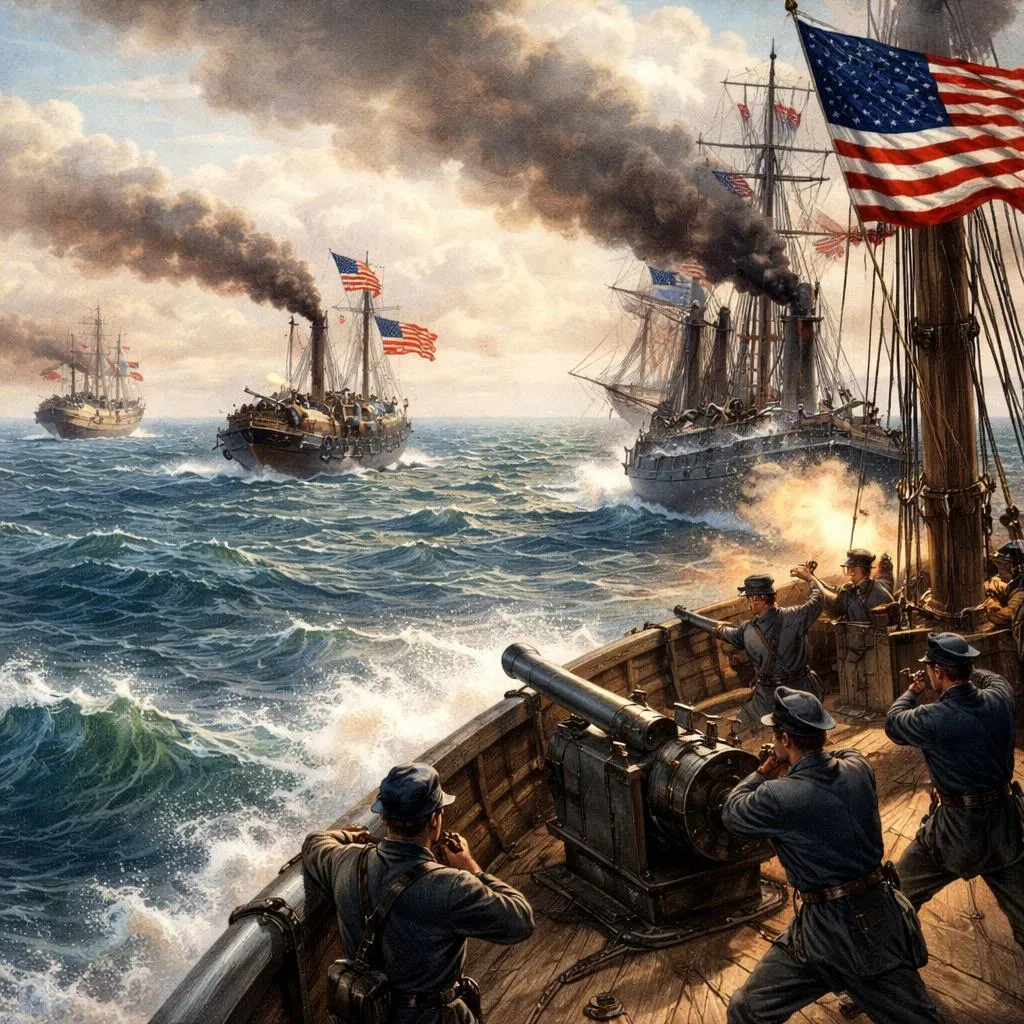

Captain Breaker had been in the main rigging with his night-glass, watching the movements of the chase; but he recognized the voice of Christy when he shouted to French to pick up the quarter-boat of the schooner, as he could no longer make out the Tallahatchie in the fog.
“Good-morning, Mr. Passford,” said he, as he met Christy when he descended from the rail. “I am glad to see you again.”
“Good-morning, Captain Breaker,” replied the lieutenant, as he took the offered hand of the commander. “I hope all is well on board, sir.”
“Entirely well, and your messenger came on board in good time, so that we were in position to get the first sight of the Trafalgar when she showed herself off Sand Island Lighthouse,” replied the captain, as he led the way to his cabin. “Mr. Ballard, keep a sharp lookout for the chase,” he added to the acting executive officer.
“Will you allow me to put on my uniform, Captain?” asked Christy. “I don’t feel quite at home on board the ship in the rigout I have worn all night.”
“Certainly; for I do not wish you to show yourself to the ship’s company while you look so little like a naval officer,” replied the captain, as he went to take another look at the darkness ahead.
The lieutenant hastened to his stateroom, and in a very short time he had washed off the smut from his face and hands, and dressed himself in his uniform, so that he looked like quite another person, Graines had gone to his room in the steerage for the same purpose, for neither of them desired to show himself as he had appeared before Captain Sullendine.
Christy hurried to the deck as soon as he had made the change, and met the commander on the quarter-deck. Lookouts were stationed aloft and on the top-gallant forecastle, and all hands were in a state of healthy excitement in view of the stirring event which was likely to transpire before the lapse of many hours; and doubtless some of the men were moved by the prospect of prize-money, not only from the proceeds of the sale of the steamer they were chasing, but from the full freight of cotton on board of the schooner, the deck load of which had been noted by some of the crew.
The schooner which had come so close aboard of the Bellevite was a mystery to all, from the captain down to the humblest seaman; but the American ensign over the Confederate flag had been observed by a few, and this settled her status. Not more than half of the seamen were aware that an expedition had left the ship at ten o’clock the evening before, and they had had no opportunity to notice the absence of the executive officer during the night; and even yet all hands had not been called, for the regular watch was enough to get the ship under way.
The commander conducted the executive officer to his own cabin, again reminding Mr. Ballard to keep a sharp lookout for the chase. Christy felt like himself again in his neat uniform, and his vigorous and well knit, as well as graceful form, did more to show off the dress than the dress did to adorn his person.
“I am very glad to see you again, Christy,” said Captain Breaker, seating himself and pointing to an arm-chair for the lieutenant, while he came down from the stately dignity of the commander of a man-of-war to the familiarity with which he treated his chief officer when they were alone. “I had no doubt that you would give a good account of yourself, as you always do. You were going on the enemy’s territory, and you were in peril all the time. Now you come off in a schooner, which appears to be loaded with cotton, and how or where you picked her up is a mystery to me;” and the commander indulged in a laugh at the oddity of the young officer’s reappearance. “Your messenger reported that the Trafalgar would sail at three o’clock in the morning, and I judge that she left at about that hour.”
“Within ten minutes of it, and probably made an arrangement with the commandant of the fort to that effect,” added Christy. “But they do not call her the Trafalgar now; though Weeks was not aware of the fact when I sent him on board. She is now the Tallahatchie, though I noticed that some in the vicinity of the fort still called her by her old name.”
“Never mind the name; she will answer our purpose as well under one appellation as another. When I asked your messenger about you and the other six men of your party, he was unable to give me any information in regard to your movements; and he could not tell me how you had ascertained the hour at which the steamer was to sail,” continued the captain.
“Graines and myself separated from the party as soon as we landed on the point; and we had obtained our information before we joined them again on the shore of Mobile Bay, sir. At the same time we had learned all about the West Wind”—
“The what?” interposed the commander.
“I mean the schooner West Wind, the one from which we came on board of the Bellevite, which was to be towed out by the Tallahatchie, and which was towed out by her till we on board of her cast off the towline.”
“Perhaps you had better narrate the events of your expedition seriatim, for all you say in this disconnected manner only thickens the mystery,” said the commander: and he knew that his officer had an excellent command of the English language, and could make a verbal report in a very attractive and telling style, though perhaps his fatherly interest in the young man had something to do with the matter.
Christy began his narrative with the departure from the ship, passing lightly over the minor details till he came to the meeting with the deserters from the West Wind, bivouacking in the hollow. He described the drinking bout which followed, in which he and Graines had pretended to join, stating the information he had obtained from them. He rehearsed a portion of Captain Sullendine’s speech, adding that most of his auditors were the seamen from the Bellevite, though he had sent four of them back to the ship before he reached the shore.
He detailed his interview with the master of the West Wind, explaining how he had shipped the new crew with him. The scenes in the cabin were described in full; in fact, every incident of any importance which had transpired during the night was related. The commander was deeply interested, and listened without comment to the narrative up to the moment when the narrator had come on board of the Bellevite. He was not sparing in his praise of the engineer, and separated what he had said and done as far as he could from his own words and actions.
The commander then questioned him in regard to the armament of the Tallahatchie, and he repeated the meagre information he had obtained from Bokes. Some conversation concerning Armstrong guns followed; but both of them were well posted in regard to this long-range piece. Christy read the satisfaction with which the captain heard his statements on his face.
A knock at the door of the cabin disturbed the conference, and the lieutenant was directed to open the door. The shaking and straining of the ship had for some time indicated that Paul Vapoor was fully alive to the importance of getting the Bellevite’s best speed out of her on the present occasion; and he did not intrust the duty to his subordinates. Christy opened the cabin door, and Midshipman Walters asked for the commander, and was admitted.
“Mr. Ballard directs me to inform you, sir, that we are gaining on the chase,” said the young officer. “The fog has lifted again, and we can make her out very clearly. The Holyoke has abandoned the chase, and appears to be headed for the schooner that came to on the starboard of the ship.”
“Tell Mr. Ballard to keep the ship as she is, headed for the Tallahatchie,” replied Captain Breaker.
“The Tallahatchie, sir?” queried the midshipman.
“Formerly the Trafalgar,” added the commander.
The young officer touched his cap and retired.
“This Captain Sullendine is still secured in his stateroom on board of the West Wind, is he?” asked the captain, rising from his arm-chair.
“He was when I left the schooner, sir,” replied Christy. “French, the captain of the forecastle, is in charge of the vessel, with orders to anchor her a couple of miles to the eastward of the lighthouse. I have already commended French to your attention, Captain, as a faithful and reliable man, and I think he deserves promotion.”
“Your recommendation will go a great way to procure it for him," added the commander with a significant smile.
“He is a thorough seaman, has been the mate of a large coaster, and would have become master of her if his patriotic duty had not led him to ship in the navy.”
“He is a resolute and brave fellow in action, as I have had occasion to observe, and I shall remember him. When you are writing to your father it would be well for you to mention him; and the thing will be done at your request if not at mine.”
“It certainly would not be done without your indorsement, for my father will not indulge in any favoritism aside from real merit," protested the lieutenant, with some warmth.
“You are quite right, Christy. We must go on deck now,” added Captain Breaker, as he moved towards the door. “You have been up all night, my boy; it will be some hours before we come within reach of the chase, and you can turn in and get a little sleep before anything stirring takes place on board.”
The excitement which had animated the young officer during the night had subsided with the rendering of his report, and the responsibility of a command no longer rested upon him, and for the first time since he embarked in the whaleboat, he began to feel tired and sleepy. He went on deck with the commander, and took a survey, first of the chase, then of the Holyoke, and finally of the West Wind.
Captain Breaker thought the Tallahatchie was about five miles distant. Seen through the glass, for the fog had all blown away, and the daylight had begun to obscure the stars, the steamer seemed to be doing her best. The Holyoke was headed to the eastward, evidently intending to chase the West Wind, for she could not yet make out her flags, indicating that she was already a prize. She need not have troubled herself to pursue the schooner if she had known the facts in regard to her, for she was entitled to a share of the prize as a member of the blockading fleet at the time of her capture. But she could prevent her from being retaken by any boat expedition sent from the shore, as her lonely position where the Bellevite had been for several days might tempt some enterprising Confederate officer to do.
Although the last heaving of the log showed twenty knots, it was a quiet time of the deck of the Bellevite, and all the excitement on board was confined to the engine and fire rooms. With sundry gapes Christy had taken in the situation, and then he concluded to avail himself of the commander’s permission to retire to his stateroom, where he was soon in a sound slumber.
Just before, Captain Breaker had retired to his cabin, where he had a chart of the Gulf of Mexico spread out on his table. Assuming the point where the Tallahatchie had changed her course to the south-west, he drew a line in that direction, and realized that the chase could not go clear of the Passes of the Mississippi River; and she was likely to sight some Federal steamer in that locality.
As the daylight increased the weather improved so far as the fog was concerned and it promised to be a clear day, for the stars had not been obscured at any time during the night. The only alternative the commander could see for the chase, as he studied the chart, was to go to the southward before he could sight the Pass à l’Outre. He was so confident that this must be his course, that he decided to take advantage of the situation, and he went on deck at once, where he ordered the officer of the deck to make the course south south-west.
Введение и представление автора
Этот отрывок взят из классической военно-морской приключенческой истории, которая передает напряжение и волнение морских сражений эпохи паровых кораблей и парусных шхун. Действие истории разворачивается на фоне Гражданской войны в Америке, времени, когда военно-морские блокады и смелые экспедиции имели решающее значение для военных действий. Автор, чей детальный повествовательный стиль и яркие описания оживляют морской мир, был известен своей способностью сочетать историческую точность с захватывающим повествованием. Его работы часто подчеркивают темы храбрости, верности и стратегического мышления, что делает их неизменными фаворитами среди юных читателей и любителей истории.
Детальный анализ истории и ее значение
Центральное место в отрывке занимают капитан Брейкер и лейтенант Кристи, которые участвуют в военно-морской погоне с высокими ставками с участием шхуны «Tallahatchie» (ранее «Trafalgar») и других судов. Повествование разворачивается с сочетанием саспенса, стратегии и взаимодействия персонажей, иллюстрируя сложности военно-морской войны и важность лидерства и быстрого принятия решений.
В этой истории выделяются несколько ключевых элементов:
-
Лидерство и ответственность: Капитан Брейкер является примером спокойного и решительного лидерства, уравновешивая необходимость бдительности с заботой о своем экипаже. Превращение лейтенанта Кристи из уставшей, замаскированной фигуры в уверенного офицера в форме символизирует восстановление порядка и власти.
-
Мужество и находчивость: Смелое проникновение Кристи на вражескую территорию и его способность собирать важную информацию демонстрируют мужество и изобретательность, качества, необходимые для успеха в сложных ситуациях.
-
Командная работа и доверие: Взаимодействие между офицерами и членами экипажа отражает важность доверия и сотрудничества в достижении общих целей, особенно в опасных условиях.
-
Исторический контекст: История дает представление о военно-морских операциях во время Гражданской войны, таких как блокады, стимулы в виде призовых денег и использование как паровых, так и парусных судов.
Уроки и вдохновение для студентов
Студенты могут многому научиться из этой истории, не только об истории, но и о характере и ценностях:
-
Устойчивость в невзгодах: Настойчивость Кристи, несмотря на опасность и усталость, учит ценности устойчивости и решимости при столкновении с трудностями.
-
Сила подготовки: Тщательное планирование и готовность экипажа капитана Брейкера подчеркивают, как подготовка и внимание к деталям приводят к успеху.
-
Честность и заслуги: Рекомендация о повышении в должности, основанная на заслугах, а не на фаворитизме, подчеркивает важность справедливости и завоевания уважения благодаря упорному труду и способностям.
-
Стратегическое мышление: Использование командиром карт и предвидение действий противника поощряет критическое мышление и навыки планирования.
Применение духа истории в повседневной жизни
-
В учебе: Студенты могут подражать любопытству и преданности Кристи, тщательно готовясь к учебе и смело решая сложные предметы.
-
В социальных ситуациях: Акцент истории на доверии и командной работе может вдохновить студентов на построение прочных, поддерживающих отношений со сверстниками и учителями.
-
В личностном росте: Темы мужества и честности побуждают молодых людей отстаивать то, что правильно, и действовать ответственно даже под давлением.
-
В лидерстве: Будь то школьные проекты или общественная деятельность, студенты могут практиковать лидерство, оставаясь спокойными, справедливыми и поощряя сотрудничество между членами группы.
Развитие положительных качеств из истории
-
Храбрость: Столкновение со страхами и уверенное вступление в новые роли, как это делает Кристи, может помочь студентам вырасти в уверенности в себе.
-
Дисциплина: Сохранение сосредоточенности и самообладания, как показывают офицеры, является ключом к достижению целей.
-
Эмпатия и поддержка: Признание и оценка вклада других, как это делает капитан Брейкер с Френчем, создает позитивную и инклюзивную среду.
-
Адаптируемость: Готовность менять планы и реагировать на новую информацию, как это делает экипаж, корректируя свой курс, является важным жизненным навыком.
Заключение
Эта военно-морская приключенческая история — больше, чем просто захватывающая история о морских погонях и военной стратегии; это богатый источник уроков о мужестве, лидерстве и честности. Изучая ее персонажей и темы, студенты могут получить вдохновение, чтобы столкнуться со своими собственными проблемами с решимостью и справедливостью. История побуждает юных читателей развивать качества, которые пригодятся им в школе, дружбе и будущей карьере, что делает ее ценным дополнением к любой образовательной программе.
