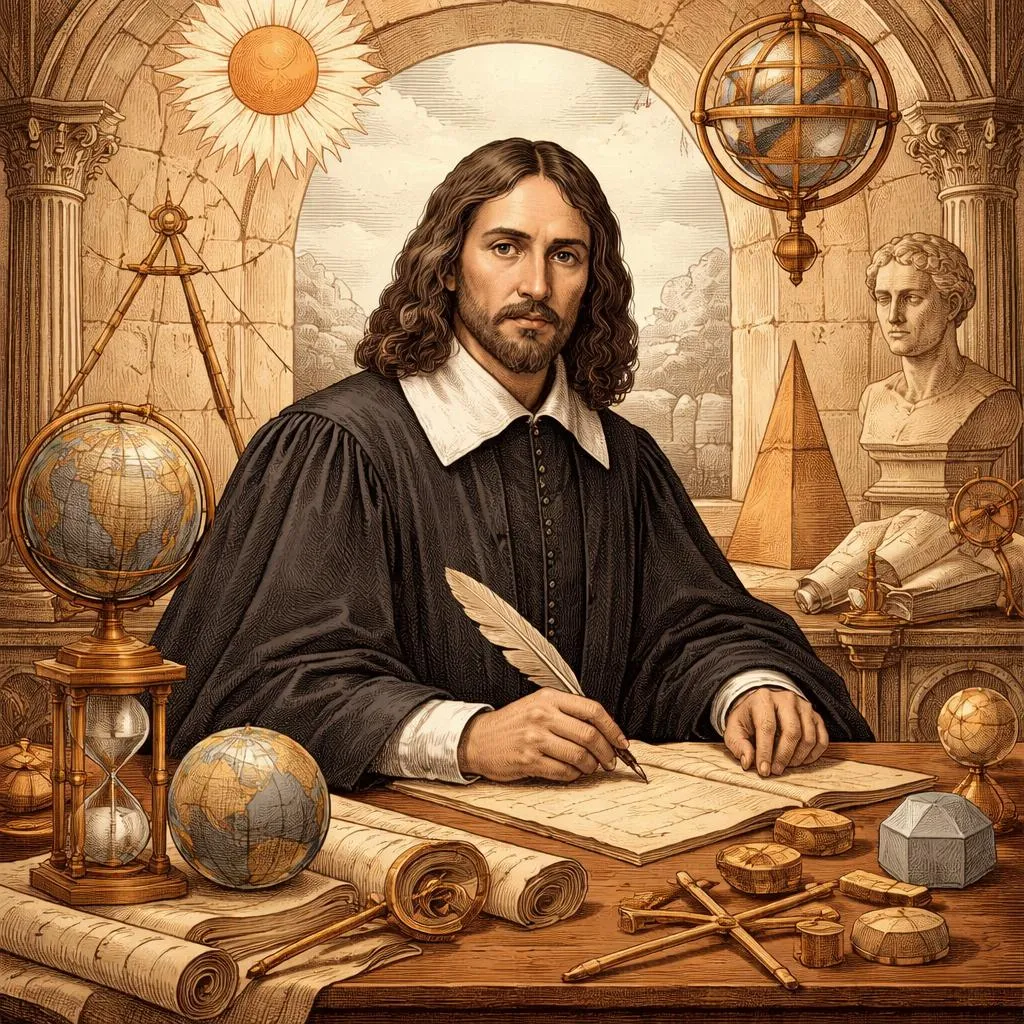

Isaac Barrow was born in London in 1630, and died at Cambridge in 1677. He went to school first at Charterhouse (where he was so troublesome that his father was heard to pray that if it pleased God to take any of his children he could best spare Isaac), and subsequently to Felstead. He completed his education at Trinity College, Cambridge; after taking his degree in 1648, he was elected to a fellowship in 1649; he then resided for a few years in college, but in 1655 he was driven out by the persecution of the Independents. He spent the next four years in the East of Europe, and after many adventures returned to England in 1659. He was ordained the next year, and appointed to the professorship of Greek at Cambridge. In 1662 he was made professor of geometry at Gresham College, and in 1663 was selected as the first occupier of the Lucasian chair at Cambridge. He resigned the latter to his pupil Newton in 1669, whose superior abilities he recognized and frankly acknowledged. For the remainder of his life he devoted himself to the study of divinity. He was appointed master of Trinity College in 1672, and held the post until his death.
He is described as "low in stature, lean, and of a pale complexion," slovenly in his dress, and an inveterate smoker. He was noted for his strength and courage, and once when travelling in the East he saved the ship by his own prowess from capture by pirates. A ready and caustic wit made him a favourite of Charles II., and induced the courtiers to respect even if they did not appreciate him. He wrote with a sustained and somewhat stately eloquence, and with his blameless life and scrupulous conscientiousness was an impressive personage of the time.
His earliest work was a complete edition of the Elements of Euclid, which he issued in Latin in 1655, and in English in 1660; in 1657 he published an edition of the Data. His lectures, delivered in 1664, 1665, and 1666, were published in 1683 under the title Lectiones Mathematicae; these are mostly on the metaphysical basis for mathematical truths. His lectures for 1667 were published in the same year, and suggest the analysis by which Archimedes was led to his chief results. In 1669 he issued his Lectiones Opticae et Geometricae. It is said in the preface that Newton revised and corrected these lectures, adding matter of his own, but it seems probable from Newton's remarks in the fluxional controversy that the additions were confined to the parts which dealt with optics. This, which is his most important work in mathematics, was republished with a few minor alterations in 1674. In 1675 he published an edition with numerous comments of the first four books of the Conics of Apollonius, and of the extant works of Archimedes and Theodosius.
In the optical lectures many problems connected with the reflexion and refraction of light are treated with ingenuity. The geometrical focus of a point seen by reflexion or refraction is defined; and it is explained that the image of an object is the locus of the geometrical foci of every point on it. Barrow also worked out a few of the easier properties of thin lenses, and considerably simplified the Cartesian explanation of the rainbow.
The geometrical lectures contain some new ways of determining the areas and tangents of curves. The most celebrated of these is the method given for the determination of tangents to curves, and this is sufficiently important to require a detailed notice, because it illustrates the way in which Barrow, Hudde and Sluze were working on the lines suggested by Fermat towards the methods of the differential calculus.
Fermat had observed that the tangent at a point P on a curve was determined if one other point besides P on it were known; hence, if the length of the subtangent MT could be found (thus determining the point T), then the line TP would be the required tangent. Now Barrow remarked that if the abscissa and ordinate at a point Q adjacent to P were drawn, he got a small triangle PQR (which he called the differential triangle, because its sides PR and PQ were the differences of the abscissae and ordinates of P and Q), so that
TM : MP = QR : RP.
To find QR : RP he supposed that x, y were the co-ordinates of P, and x - e, y - a those of Q (Barrow actually used p for x and m for y, but I alter these to agree with modern practice). Substituting the co-ordinates of Q in the equation of the curve, and neglecting the squares and higher powers of e and a as compared with their first powers, he obtained e : a. The ratio a/e was subsequently (in accordance with a suggestion made by Sluze) termed the angular coefficient of the tangent at the point. Barrow applied this method to the curves (i) x² (x² + y²) = r²y²;(ii) x³ + y³ = r³; (iii) x³ + y³ = rxy, called la galande; (iv) y = (r - x) tan πx/2r, the quadratrix; and (v) y = r tan πx/2r. It will be sufficient here if I take as an illustration the simpler case of the parabola y² = px. Using the notation given above, we have for the point P, y² = px; and for the point Q, (y - a)² = p(x - e). Subtracting we get 2ay - a² = pe. But, if a be an infinitesimal quantity, a² must be infinitely smaller and therefore may be neglected when compared with the quantities 2ay and pe. Hence 2ay = pe, that is, e : a = 2y : p. Therefore TP : y = e : a = 2y : p. Hence TM = 2y²/p = 2x. This is exactly the procedure of the differential calculus, except that there we have a rule by which we can get the ratio a/e or dy/dx directly without the labour of going through a calculation similar to the above for every separate case.
Введение и представление автора
Исаак Барроу был выдающимся математиком и теологом XVII века. Родившийся в Лондоне в 1630 году, он жил во времена великих научных открытий и интеллектуальных изменений. Барроу был не просто ученым, но и отважным авантюристом, известным своей силой и остроумием. Несмотря на несколько беспорядочную молодость, он стал одним из ведущих математиков своей эпохи, занимая престижные академические должности в Кембриджском университете. Работы Барроу заложили важные основы для исчисления, раздела математики, который позже был развит его знаменитым учеником, Исааком Ньютоном.
Жизненная история Барроу учит нас настойчивости, интеллектуальному любопытству и важности признания и поощрения таланта в других. Его решение уйти с престижной кафедры Лукаса в пользу Ньютона показывает смирение и приверженность продвижению знаний, выходящую за рамки личных амбиций.
Подробное объяснение и значимость
Вышеизложенный текст описывает вклад Барроу в математику, особенно в геометрию и оптику. Он работал над задачами, связанными с отражением и преломлением света, объясняя, как формируются изображения через линзы — тема, которая до сих пор является фундаментальной в физике и оптике. Его лекции по геометрии представили новые методы нахождения касательных к кривым, что является ключевым понятием в исчислении.
Подход Барроу к касательным включал то, что мы сейчас называем «дифференциальным треугольником», хитрый геометрический инструмент, который помогал ему приближать наклоны кривых до формального развития исчисления. Этот метод стал ступенькой к мощным методам, которые Ньютон и Лейбниц позже формализовали. Работа Барроу над коническими сечениями и его комментарии к древним математикам, таким как Аполлоний и Архимед, также помогли сохранить и продвинуть классические математические знания.
Что могут узнать студенты
-
Исторический контекст математики: Понимание работы Барроу помогает студентам оценить, как математические идеи развиваются со временем. Это показывает, что исчисление, предмет, который часто считают сложным, разрабатывался шаг за шагом многими мыслителями, опирающимися на открытия друг друга.
-
Междисциплинарное обучение: Барроу сочетал свои интересы в математике, теологии и философии, демонстрируя ценность широкого образования и взаимосвязанность различных областей.
-
Критическое мышление и решение проблем: Метод Барроу анализа кривых и света учит студентов подходить к проблемам творчески и логически, разбивая сложные идеи на более простые части.
-
Смирение и наставничество: Признание Барроу превосходного таланта Ньютона и его готовность уступить место — это мощный урок смирения и важности поддержки роста других.
Применение в жизни и обучении
-
В школе: Студенты могут применять пример Барроу, проявляя любопытство и настойчивость в учебе, особенно в сложных предметах, таких как математика и естественные науки. Изучение истории, стоящей за концепциями, может сделать их более интересными и легкими для понимания.
-
В социальных условиях: История Барроу поощряет уважение к талантам других и важность наставничества. Помощь одноклассникам и признание их сильных сторон могут создать позитивное учебное сообщество.
-
В личностном росте: Жизнь Барроу показывает, что ранние ошибки или трудности не определяют будущее человека. При усилиях и самоотверженности каждый может достичь великих целей.
Как развивать положительные черты из истории Барроу
-
Любопытство: Всегда задавайте вопросы и стремитесь понять, как все работает, как Барроу исследовал природу света и кривых.
-
Смелость: Не бойтесь сталкиваться с вызовами или новым опытом, как это делал Барроу, путешествуя и противостоя пиратам.
-
Смирение: Признавайте, когда у других есть лучшие идеи, и будьте готовы учиться у них.
-
Добросовестность: Стремитесь к честности и тщательной работе, как это делал Барроу в своей научной и личной жизни.
Размышления и признательность
Чтение об Исааке Барроу может вдохновить студентов ценить как знания, так и характер. Его сочетание интеллектуального блеска и личного мужества делает его образцом для подражания не только для начинающих ученых и математиков, но и для всех, кто хочет расти как вдумчивая, уважительная и смелая личность. Изучая его жизнь и работу, молодые ученики могут увидеть, как преданность учебе и доброта к другим идут рука об руку в оказании значимого влияния на мир.
