
What Is the Rhyme hickory dickory dock?
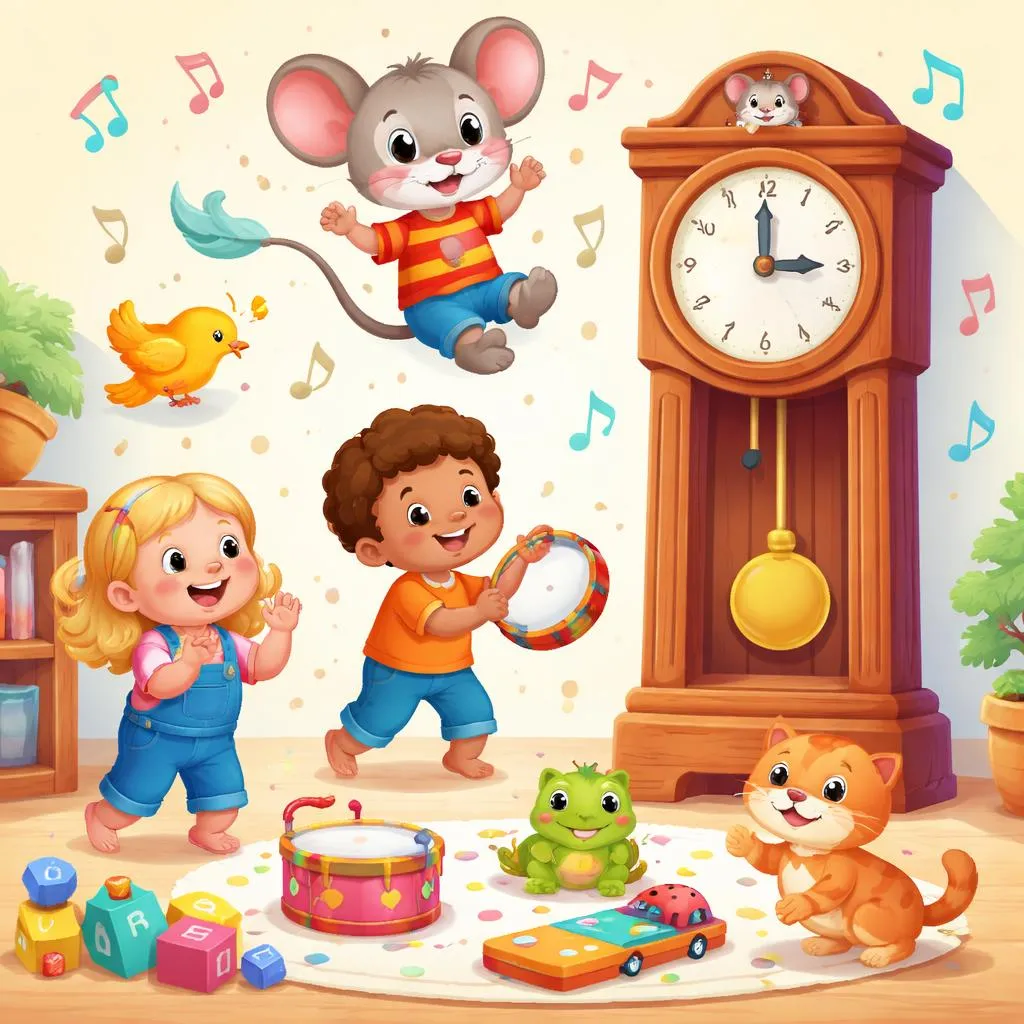
The nursery rhyme “hickory dickory dock” is a classic English song. It tells a short and playful story about a mouse and a clock. The rhyme uses rhythm, repetition, and simple words. These features make it ideal for early English learning.
This rhyme appears in many classrooms and homes. It helps build listening skills and pronunciation. It also supports early reading and speaking practice.
The Lyrics of hickory dickory dock
Hickory, dickory, dock, The mouse ran up the clock. The clock struck one, The mouse ran down, Hickory, dickory, dock.
Some versions include extra verses. These verses describe the clock striking two, three, or four. Each verse keeps the same rhythm and pattern. This repetition supports memory and confidence.
Vocabulary Learning with hickory dickory dock
This rhyme introduces useful everyday words. “Mouse” names an animal. “Clock” names a common object. “Run” shows an action. “Up” and “down” show direction.
The word “struck” shows an action of the clock. This word can connect to other meanings in English. For example, “strike” can mean hit or start. This builds deeper vocabulary knowledge.
The playful words “hickory” and “dickory” are nonsense words. They add rhythm and fun. These words show that English songs can include playful sounds. This encourages curiosity about language.
Phonics Points in hickory dickory dock
This rhyme supports phonics through rhyme and rhythm. The words “dock” and “clock” share the same ending sound. This helps practice the short vowel sound in “o” and the final consonant sounds.
The words “one” and “down” do not rhyme perfectly. This contrast helps notice different vowel sounds.
The repeated rhythm helps stress patterns. “Hickory, dickory, dock” has a strong beat. Clapping to this beat supports phonemic awareness and syllable recognition.
Consonant sounds like /m/ in “mouse” and /k/ in “clock” are clear and easy to hear. These sounds support early pronunciation practice.
Grammar Patterns in hickory dickory dock
This rhyme uses simple past tense verbs. “Ran” and “struck” show actions that already happened. This introduces past tense in a natural context.
The sentence structure is short and clear. “The mouse ran up the clock” shows subject, verb, and preposition. This pattern supports basic sentence building.
Prepositions like “up” and “down” show direction. These words connect actions with space. This supports spatial language development.
Articles like “the” appear before nouns. This supports grammar awareness and sentence fluency.
Learning Activities with hickory dickory dock
Acting out the rhyme supports movement and comprehension. Pretending to be a mouse and climbing an imaginary clock builds understanding of verbs and directions.
Drawing activities support creativity. Drawing a clock, a mouse, and a tower builds connections between words and images.
Story extension activities encourage imagination. Adding a new verse about another animal or another time on the clock supports storytelling skills.
Clock-building crafts connect language with real-world concepts. Making a paper clock and moving the hands while singing supports time vocabulary.
Printable Materials for hickory dickory dock
Printable lyric sheets support reading practice. Highlighting words like “mouse,” “clock,” and “run” supports sight word recognition.
Picture cards with the mouse, clock, and actions help connect words and images. These cards support vocabulary recall.
Sequencing cards with events from the rhyme support comprehension. Ordering “mouse ran up,” “clock struck one,” and “mouse ran down” supports narrative skills.
Coloring pages with the rhyme theme add a creative element. Coloring while listening to the rhyme supports multisensory learning.
Educational Games with hickory dickory dock
A rhythm game can involve clapping or tapping to the beat. This supports listening and timing skills.
A guessing game can describe the mouse or the clock with adjectives. Others guess the object. This builds descriptive language.
A time game can ask about clock numbers. For example, “The clock struck one. What comes after one?” This integrates math and language.
A word matching game can pair words with pictures. This supports early reading skills and word recognition.
Listening and Speaking Practice
Listening to different versions of the rhyme supports comprehension of accents and tempo. Slow and fast versions help adjust listening skills.
Speaking practice includes chanting, singing, and repeating lines. Clear repetition supports pronunciation and fluency.
Pair speaking activities encourage turn-taking. One person says a line, and another person repeats it. This supports conversational rhythm.
Reading Practice with hickory dickory dock
Reading the lyrics in print supports word recognition. Tracking words while singing supports print awareness.
Highlighting rhyming words like “dock” and “clock” builds phonological awareness.
Shared reading activities encourage pointing to words while reading aloud. This supports early literacy skills.
Writing Practice with hickory dickory dock
Writing simple sentences about the rhyme supports early writing. Sentences like “The mouse runs” or “The clock is big” build confidence.
Creating new verses supports creativity and grammar practice. For example, “The cat ran up the clock” introduces new vocabulary.
Drawing and labeling activities connect writing with art. Labeling “mouse,” “clock,” and “tower” supports word recall.
Cross-Curricular Connections
Math connections include learning about time and numbers on a clock. Counting numbers on the clock face supports number recognition.
Science connections include learning about mice as animals. Discussing where mice live and what they eat builds content knowledge.
Art connections include drawing clocks and designing imaginative towers. This supports fine motor skills and creativity.
Music connections include rhythm, beat, and melody. Exploring tempo and instruments supports musical awareness.
Supporting Different Learning Styles
Visual learners benefit from pictures, charts, and videos of the rhyme.
Auditory learners benefit from repeated listening and singing.
Kinesthetic learners benefit from acting, jumping, and moving with the rhyme.
Combining these styles supports inclusive learning environments.
Digital Tools for hickory dickory dock
Interactive apps show animated mice and clocks. Tapping words plays sounds and animations. This supports engagement and pronunciation.
Online karaoke versions highlight words while singing. This supports reading and fluency.
Recording tools allow practice with singing and speaking. Listening to recordings supports self-awareness and improvement.
Building a Daily Routine with hickory dickory dock
Start with a greeting song and warm-up rhythm. Introduce the rhyme with pictures and gestures. Practice singing and acting out the rhyme. Add reading and writing tasks with simple sentences.
This routine supports balanced language development and keeps learning fun.
Expanding Vocabulary Networks
The word “clock” connects to time, numbers, hours, and minutes. The word “mouse” connects to animals, pets, and habitats. The word “run” connects to movement verbs like jump, walk, and climb.
Building these networks deepens understanding and supports long-term retention.
Simple Assessment Ideas
Listening checks include identifying words in the rhyme. Speaking checks include repeating lines clearly. Reading checks include pointing to words in the lyrics. Writing checks include simple sentences or drawings with labels.
These checks guide progress and support individualized learning.
The playful rhythm of hickory dickory dock creates a joyful entry into English. The rhyme builds listening, speaking, reading, and writing skills in a natural way. Through songs, actions, stories, and creative tasks, language learning becomes meaningful and memorable.