
What Is “tools”?
When I teach English to children, I love to start with real-life words. One useful word is tools.
Tools are things we use to help us do work. A tool can help us build, fix, measure, or create. People use tools at home, at school, and at work.
When we say a tool, we talk about one item. When we say tools, we talk about many items.
For children, tools are everywhere. A pencil is a tool for writing. Scissors are tools for cutting. A ruler is a tool for measuring.
So, tools are helpers. They make tasks easier and safer.
Meaning and Explanation of Tools
Let me explain the word tools in simple English.
A tool is something we use with our hands. We use it to do a job. Without tools, work is hard.
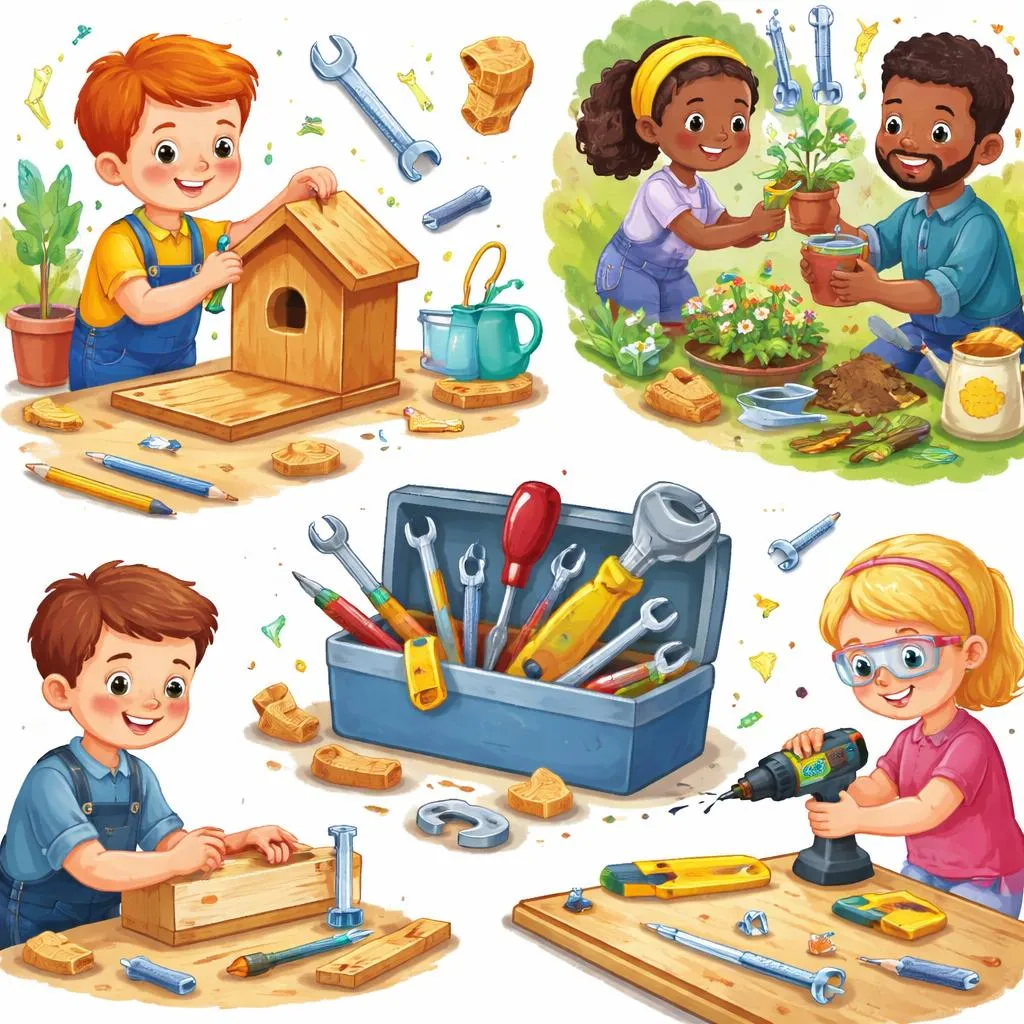
Think about building a birdhouse. You need a hammer to hit nails. You need a saw to cut wood. These are tools.
In the classroom, tools help us learn. Books are learning tools. Markers are drawing tools. Computers are digital tools.
So, tools are not only for builders. They are for students, teachers, and families too.
When children learn the word tools, they learn how language connects to life. This makes English learning meaningful and fun.
Categories of Tools
When I teach vocabulary, I like to group words. Grouping helps children remember.
Let us look at some common categories of tools.
Tools for Building and Fixing
These tools help people build and repair things. A hammer helps hit nails. A screwdriver helps turn screws. A wrench helps tighten bolts.
These tools often stay in a toolbox. Parents and builders use them often.
Tools for School
School tools help us learn. A pencil helps us write. An eraser helps us correct mistakes. A ruler helps us draw straight lines.
Even a calculator is a math tool. A dictionary is a language tool.
Tools for Art and Creativity
Art tools help us express ideas. Crayons help us color. Paintbrushes help us paint. Clay tools help us shape clay.
These tools help children show their feelings and imagination.
Digital Tools
Today, we use digital tools every day. A tablet can be a learning tool. A computer helps us research. Educational apps are learning tools too.
When I teach children, I call these “smart tools.”
By learning categories, children see that tools exist in many places.
Tools in Daily Life Examples
Children learn best with examples. So I always give real-life situations.
In the kitchen, a spoon is a tool. A knife is a tool for cutting food. A whisk is a tool for mixing.
In the garden, a shovel is a tool. A rake is a tool for leaves. A watering can is a tool for plants.
At home, a remote control is a tool for TV. A vacuum cleaner is a cleaning tool.
In school, a whiteboard marker is a teaching tool. A projector is a classroom tool.
When children hear these examples, they understand that tools are part of daily life. They also learn how English words describe the world around them.
Printable Flashcards for Tools
Flashcards are powerful teaching tools. I often use them in class and at home.
You can make flashcards with pictures and words. On one side, draw or print a picture of a tool. On the other side, write the word.
For example, you can make cards for hammer, pencil, scissors, ruler, and brush. Show the picture and say the word aloud. Ask children to repeat the word.
Parents can play a matching game with flashcards. Match the word card with the picture card.
Teachers can use flashcards for group games. Show a card and ask, “What is this tool?”
Flashcards help children see, hear, and say new words. This builds strong memory and confidence.
Learning Activities with Tools Vocabulary
When I teach, I like active learning. Children learn best when they move and play.
Classroom Tool Hunt
I ask students to look around the classroom. They find tools they can see. They say the names in English.
For example, “This is a pencil.” “This is a ruler.” “This is a computer.”
This activity makes vocabulary real.
Home Tool Talk
Parents can do this at home. Walk around the house with your child. Point to tools and name them.
“This is a spoon.” “This is a remote control.” “This is a toothbrush.”
Children feel proud when they know the words.
Drawing My Favorite Tool
Ask children to draw their favorite tool. They can draw a pencil, a hammer, or a tablet. Then they can write a simple sentence.
“My favorite tool is a pencil.” “This tool helps me write.”
This activity connects language, art, and thinking.
Educational Games About Tools
Games make learning joyful. I often use simple games to teach tools.
Guess the Tool
Describe a tool without naming it. Say, “This tool helps you cut paper.” Children guess, “Scissors!”
This game builds listening and thinking skills.
Tool Charades
One child acts like using a tool. Others guess the word. For example, pretend to hammer a nail. Children shout, “Hammer!”
This game helps with speaking and movement.
Tool Bingo
Make a bingo board with pictures of tools. Call out the words. Children mark the pictures.
This game works well for classrooms and families.
How Tools Help Us Learn English
Tools are not only objects. They also help us learn language.
A book is a reading tool. A notebook is a writing tool. A language app is a speaking tool.
When I teach, I tell children that English itself is a tool. English helps us talk to people around the world. It helps us read stories and watch videos.
So, tools help us do things. Language is one of the most powerful tools we have.
Teaching Tips for Parents and Teachers
As a teacher, I want to share some simple tips.
Use real objects when teaching tools. Show a pencil, not just a picture.
Repeat the words many times. Children need repetition.
Use short sentences. “This is a hammer.” “It is a tool.”
Ask questions. “What tools do you use at school?” “What tools do you use at home?”
Encourage children to speak. Praise them when they try.
Learning should feel safe and fun.
Simple Sentences with Tools
Children need simple examples. Here are some easy sentences I use in class.
“I use tools.” “This tool is a pencil.” “I like my tools.” “Tools help me learn.”
Parents and teachers can practice these sentences with children. Say them slowly and clearly.
Mini Story About Tools
Stories make words memorable. Let me share a short classroom-style story.
Tom is a little builder. He loves his tools. He has a hammer and a screwdriver. He builds a small house for his toy bear. His teacher says, “Good job, Tom. Your tools helped you.”
Stories help children connect emotions with words.
Why Learning About Tools Matters
Some people think tools are just objects. But tools teach important ideas.
Tools teach problem-solving. Tools teach responsibility. Tools teach creativity.
When children learn the word tools, they learn more than vocabulary. They learn how humans shape the world.
This builds curiosity and confidence.
Printable Practice Ideas
Teachers and parents can create simple worksheets.
Write the names of tools under pictures. Circle the tools in a picture of a room. Draw a tool and label it.
These activities support reading and writing skills.
Encouraging Curiosity About Tools
I always encourage children to ask questions.
“What is this tool?” “How does this tool work?” “Who uses this tool?”
Curiosity leads to learning. Learning leads to growth.
As an English teacher, I see tools as more than vocabulary. Tools connect language to life. Tools help children understand their world.
When children learn this word, they gain practical knowledge and language skills. Parents and teachers can use real objects, games, and stories. This makes learning English natural and exciting.
Let us continue to explore tools in daily life. Let us use tools to learn, create, and grow together.