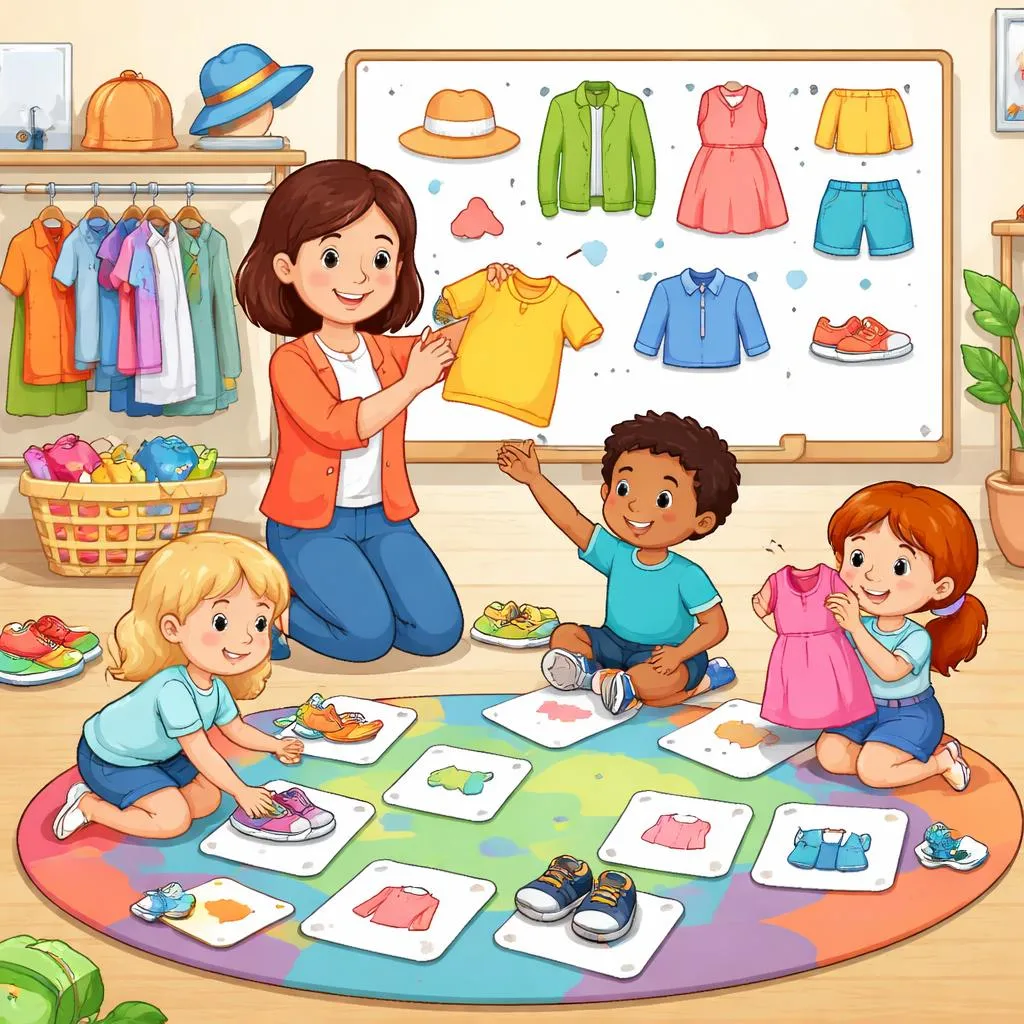

What is vocabulary clothes?
Vocabulary clothes refers to words that describe clothing and accessories in English. Teachers introduce clothing words early because they connect with daily life and self-care routines.
Clothing vocabulary supports communication about weather, routines, shopping, and personal style. It also supports social language and descriptive speaking.
In early English lessons, vocabulary clothes builds concrete noun knowledge. These words are easy to show with real objects, pictures, or classroom materials.
This topic also connects with culture, seasons, and daily habits. It fits well in preschool, primary school, and beginner ESL contexts.
Meaning and explanation
Vocabulary clothes includes names of garments, accessories, and materials. These words describe what people wear on different parts of the body.
Clothes protect the body and express identity and mood. Language lessons use clothing to teach nouns, adjectives, and basic verbs.
Teachers explain that clothes can change by season, culture, and activity. This explanation connects language learning with real-world knowledge.
Common clothing words include shirt, pants, dress, shoes, hat, and jacket. Each word connects to a visible object that supports visual learning.
Clothing vocabulary also supports descriptive language with colors and sizes. For example, “a red dress” or “big shoes.”
Categories or lists
Teachers organize vocabulary clothes into clear categories. This structure helps memory and conceptual understanding.
Top wear includes shirt, T-shirt, sweater, blouse, and jacket. These items cover the upper body.
Bottom wear includes pants, jeans, shorts, skirt, and leggings. These items cover the lower body.
Footwear includes shoes, boots, sandals, and socks. These items protect the feet.
Accessories include hat, scarf, gloves, belt, and sunglasses. These items add style or protection.
Special clothing includes uniform, pajamas, swimsuit, and coat. These items relate to activities and weather.
Teachers can introduce each category in separate lessons. This reduces cognitive load and supports spaced learning.
Daily life examples
Vocabulary clothes connects naturally with daily routines and conversations. Teachers use real-life examples to build functional language.
In the morning, people wear a shirt and pants. At school, people wear uniforms or casual clothes.
In winter, people wear coats, scarves, and gloves. In summer, people wear shorts, T-shirts, and hats.
At the beach, people wear swimsuits and sandals. At night, people wear pajamas.
Simple sentence models support daily communication. “I wear a blue shirt.” “She wears shoes.” “He wears a hat.”
Teachers can connect clothing vocabulary with weather lessons. For example, “It is cold. We wear a coat.”
This integration supports cross-curricular learning and real-world application.
Printable flashcards
Printable flashcards support structured vocabulary practice. Teachers often use flashcards for drills, games, and assessment.
Flashcards can show pictures of clothes with English words. This supports word recognition and visual memory.
Cards can include singular and plural forms. For example, shoe and shoes, sock and socks.
Teachers can use flashcards for matching tasks and memory games. They also support phonics practice and pronunciation drills.
Printable flashcards help classroom instruction and home review. They also support differentiated learning and individual pacing.
Learning activities or games
Teachers design interactive activities to teach vocabulary clothes effectively. These activities integrate listening, speaking, reading, and movement.
Dress-up demonstration Teachers bring real clothes and model wearing items. Learners hear and repeat words in context.
Clothing drawing and labeling Learners draw a person and label clothes. This integrates art, writing, and vocabulary.
Weather and clothes matching Teachers show weather pictures and match clothes. This builds functional language and reasoning.
Role-play clothing shop Learners pretend to buy clothes using simple phrases. This builds communicative competence and social language.
Color and clothes sentences Teachers model sentences like “I wear a red hat.” This integrates adjectives and nouns.
Clothing sorting activity Learners sort clothes into categories such as top wear and footwear. This builds classification skills and vocabulary depth.
Song and movement practice Teachers use songs about clothes and actions. Movement reinforces comprehension and memory.
Classroom survey Learners ask classmates about favorite clothes. Results can be shared in simple sentences.
These activities align with communicative language teaching and multisensory learning. They also promote engagement and long-term retention.
Vocabulary clothes provides a rich foundation for early English learning. It connects language with daily routines, culture, and personal expression.
Through structured teaching, visual materials, and interactive classroom activities, clothing vocabulary becomes meaningful and easy to use. This topic supports vocabulary growth, sentence building, and confident communication in real-life contexts, which strengthens overall language proficiency and classroom participation.