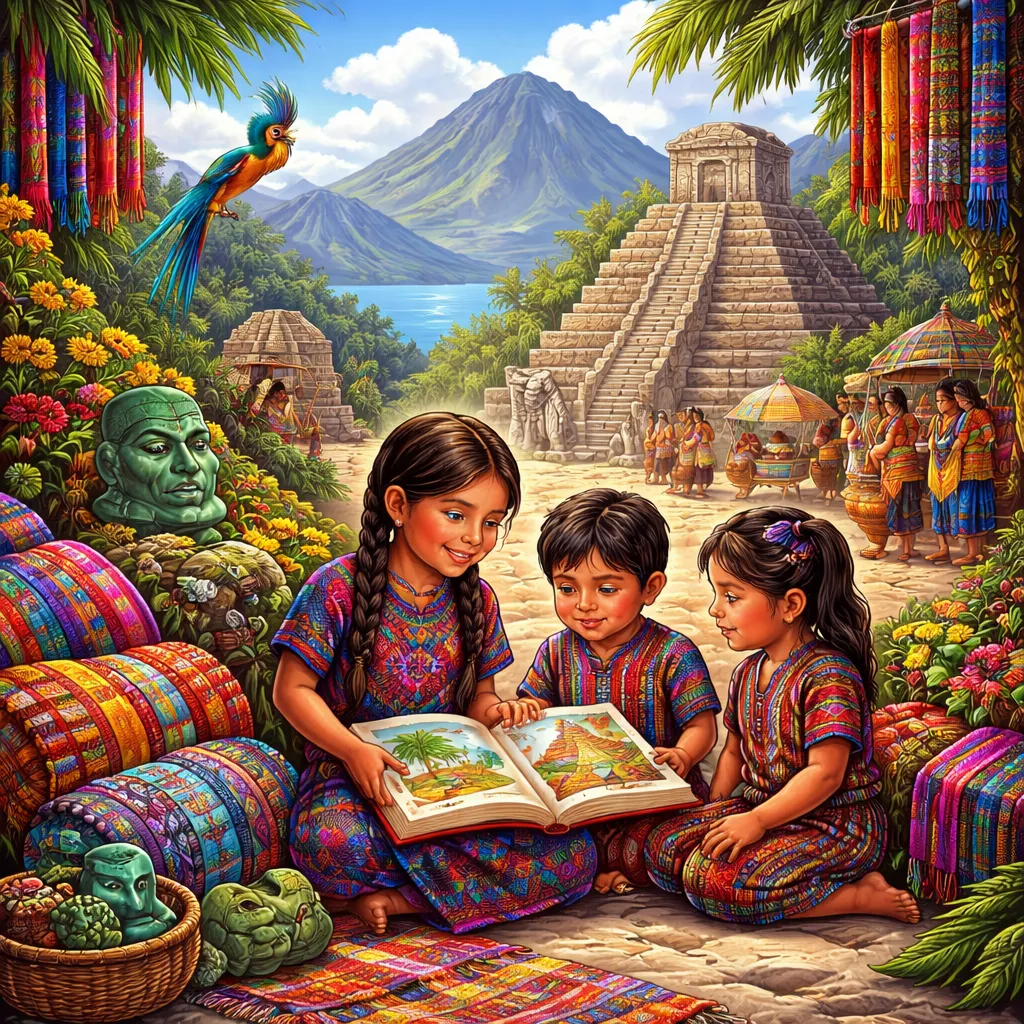

A Friendly Hello and First Impressions
?Hola! (OH-lah). This is the warm, musical "Hello" in Spanish. ?Gracias! (GRAH-see-ahs). This is a sincere "Thank you". People say it with a smile. Learning reading about Guatemala starts with these friendly, welcoming words.
Guatemala is in Central America. Its shape looks like a tilted, bumpy rectangle. The rectangle points towards the Caribbean Sea. The country is in North America. Mexico, Belize, Honduras, and El Salvador are its neighbors. The Pacific Ocean is to the south. The land is a stunning mix of volcanoes, rainforests, and lakes. It is a country of incredible natural beauty.
People call it the "Land of Eternal Spring". The central highlands have perfect spring weather all year. Another nickname is the "Heart of the Mayan World". The ancient Maya civilization flourished here. Are you ready to climb an ancient pyramid?
Deep Dive into Culture and Stories
Echoes of History
A powerful ancient civilization ruled here. They were the Maya. They built great cities. They were advanced in math and astronomy. They created a complex calendar. Their story is a key part of learning reading about Guatemala. It is a story of ancient genius.
A modern hero is Rigoberta Mench迆 Tum. She is a Maya K'iche' woman. She fought for indigenous rights. She won the Nobel Peace Prize in 1992. She told the world about the suffering of her people. Her story is about courage and justice. It is a key part of learning reading about Guatemala today.
A Gift of Taste and Number
Guatemala gave the world two great gifts. The first is chocolate. The ancient Maya drank a bitter cacao drink. They considered it sacred. Now, people everywhere love chocolate. The second gift is the concept of zero. The Maya used a shell shape for zero in their calendar. This was a big mathematical step. These gifts show ancient innovation.
A Land of Fire and Water
Guatemala's geography is dramatic. A chain of volcanoes runs through the south. Some volcanoes are still active. The central highlands are cool and green. The north has the lowland rainforest of Pet谷n. The Pacific coast is hot. The Caribbean coast is humid. The landscape changes from snowy peaks to steamy jungle.
The climate varies with altitude. The highlands are mild. The coasts are hot. The environment shapes life. In the highlands, people grow coffee, corn, and vegetables. On the coast, they grow sugarcane and bananas. Traditional Maya houses are made of adobe. They have thatched roofs. The main exports are clothing, coffee, and bananas.
A special animal is the quetzal. It is the national bird. It has brilliant green feathers and a long tail. The ancient Maya considered it sacred. The national animal is the spider monkey. It is playful and smart. The national flower is the monja blanca orchid. It is white and rare. The ceiba tree is sacred. It is the national tree.
Landmarks of Stone and Faith
Visit Tikal. It is a giant ancient Mayan city. It is in the rainforest of Pet谷n. Tall stone temples rise above the trees. You can hear howler monkeys roar. A fun legend says the temples are giants. The giants turned to stone. The site is a UNESCO wonder. It is a window to an ancient world.
See Lake Atitl芍n. It is a deep, blue lake. It is surrounded by three volcanoes. Maya villages dot the shoreline. The water is calm and clear. A local story says the lake has no bottom. It is connected to the sea. The lake is breathtakingly beautiful.
Another wonder is Antigua Guatemala. It is a colonial city. It is a UNESCO site. The streets are made of cobblestone. Colorful ruins of old churches stand. The city is full of flowers. A fun story says the city moves. It was rebuilt three times after earthquakes. The city is a living museum.
Festivals of Color and Tradition
The biggest festival is Semana Santa. This is Holy Week. It happens the week before Easter. The most famous celebration is in Antigua. People create elaborate "alfombras". These are carpets made of colored sawdust and flowers. They line the streets. Religious processions walk over them.
The processions carry heavy wooden floats. The floats have statues of Jesus and Mary. Hundreds of people carry them. The air smells of incense. The festival is solemn, colorful, and deeply spiritual. It is a mix of Spanish and Maya traditions.
Another important day is Independence Day. It is on September 15th. It marks freedom from Spain in 1821. There is a parade in the capital. School bands march. The national flag is everywhere. The colors are blue and white. The national coat of arms is in the center. The day is full of national pride.
Food and Flavors
The national dish is Pepi芍n. It is a thick, rich stew. It is made with chicken or beef. It has a sauce of roasted tomatoes, chilies, and seeds. It is served with rice and tortillas. Families eat it for special occasions. It tastes savory, nutty, and a little spicy. It is a dish of celebration.
You must try Tamales. They are a special treat. Corn dough is filled with meat or beans. It is wrapped in a banana leaf. It is then steamed. People eat them for Christmas or holidays. A good tamal is soft, savory, and comforting. It tastes like a warm hug.
A Culture of Weaving and Resilience
Maya women are master weavers. They create beautiful "huipiles". These are traditional blouses. Each village has its own patterns and colors. The patterns tell stories. Weaving is a sacred art. This love for color and craft is a key part of learning reading about Guatemala.
The country is a leader in conservation. It protects its rainforests and Maya ruins. It also uses its volcanoes for clean geothermal energy. This shows a respect for the past and the future.
Tips for Young Explorers
Cultural Manners Matter
Guatemalans are polite and formal. Greetings are important. A handshake is common. Say "Buenos d赤as" (Good morning). Use titles like "Se?or" (Mr.) or "Se?ora" (Mrs.). This is respectful. Wait for adults to invite you to use first names.
Always ask before taking photos of people. This is especially important for Maya villagers. They may want payment. A smile and a polite question go a long way. This shows respect for their culture and privacy.
When visiting a home, bring a small gift. Flowers, sweets, or fruit are nice. Do not start eating until the host invites you. Compliment the food. Say "gracias" after the meal.
A Note on Staying Safe
Guatemala has areas with high crime. Be very careful. Only travel in tourist areas. Do not walk alone at night. Do not show expensive items. Use official taxis. Always ask your hotel for safe advice. This keeps you secure.
The sun is very strong. Use a high SPF sunscreen. Wear a hat. The tropical sun can burn you quickly. Drink lots of water. Stay hydrated.
Be careful in the ocean. Some beaches have strong currents. Only swim where it is safe. Obey warning flags. Never swim alone.
A Tasty Stop
Look for a "tostada" stand. A tostada is a crispy corn tortilla. It is topped with guacamole, beans, and cheese. It is cheap and delicious. Eat it with your hands. The tostada is crunchy, creamy, and savory. It is the perfect snack.
Healthy and Happy Travels
Drink only bottled water. This is the most important rule. Do not drink tap water. Avoid ice in drinks. Brush your teeth with bottled water. This keeps your stomach happy.
Use insect repellent. Mosquitoes can be annoying, especially in the lowlands. It helps prevent itchy bites. Wear long sleeves in the evening.
Wear comfortable walking shoes. The archaeological sites have uneven steps. The old towns have cobblestone streets. Good shoes make exploring fun and safe.
Your Invitation to Explore
Start your journey with a calendar. Look at the ancient Mayan calendar. See the complex symbols. Or, listen to Guatemalan marimba music. Hear the happy, wooden sounds. This is a wonderful way of learning reading about Guatemala.
Visit a local market. Look for Guatemalan coffee or a handwoven bracelet. Taste the rich coffee. Feel the woven threads. Imagine the hands that made it. You can also try making a simple pattern with colored paper. Weave strips together. Feel the patience it takes.
The world is a big, ancient book. Each country is a different chapter. Guatemala's chapter is about pyramids, textiles, and eternal spring. Open it with curiosity. Read about its volcanoes, villages, and vibrant culture. Your curiosity is your guide.
Guatemalan families share a pot of pepi芍n. Maya women weave together. Children fly kites on Day of the Dead. We all know these scenes. We love sharing meals. We create beautiful things. We play and remember our ancestors. Learning about Guatemala shows us this. Our global family shares the same joys of creativity and tradition. Keep exploring, one page, one country, at a time. Your adventure has just begun.