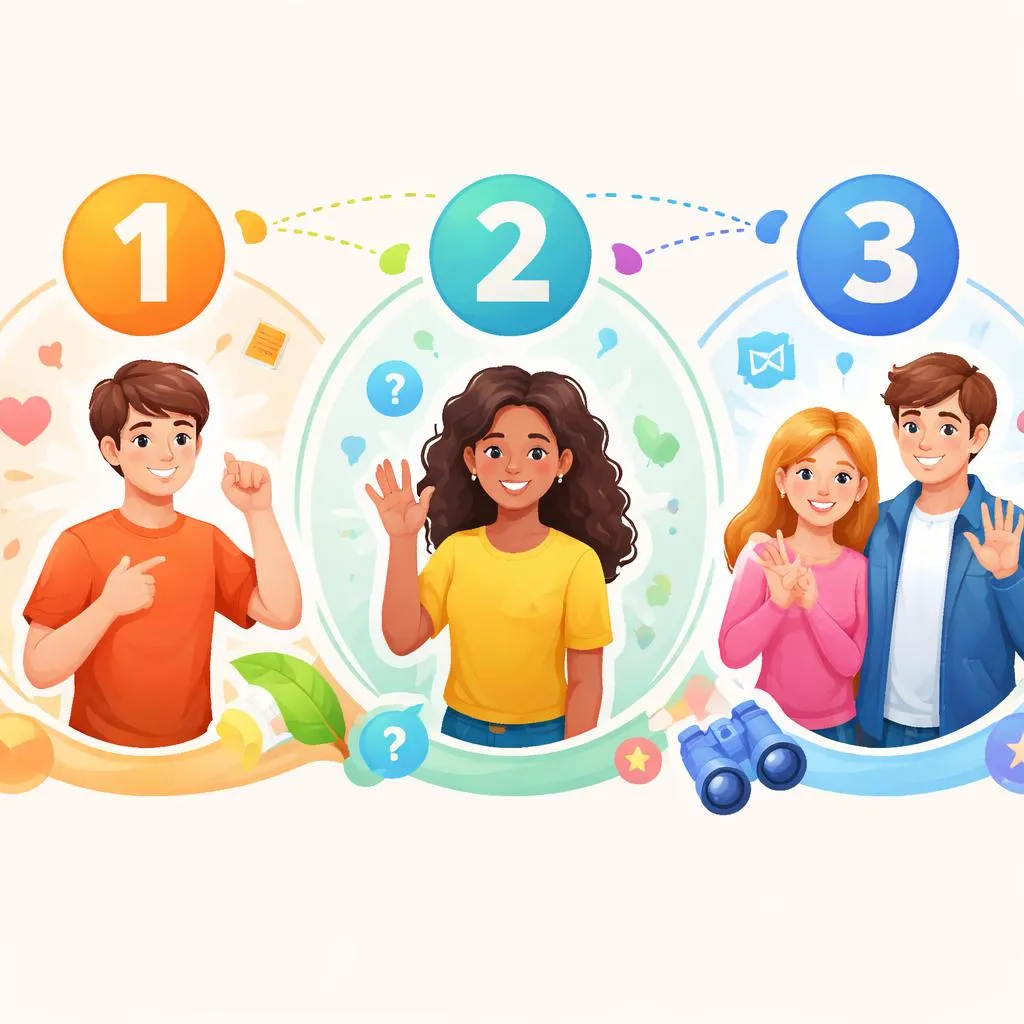

When learning English grammar, understanding 1st person, 2nd person, and 3rd person is very important. These terms describe the perspective from which a sentence is spoken or written. They are connected to pronouns and verb forms, and they help readers understand who is speaking and who is being discussed.
First Person (1st Person)
First person refers to the speaker or writer. It shows that the person speaking is talking about themselves.
Common first person pronouns include:
I me my mine we us our ours
Singular first person:
I am learning English. I like reading books.
Plural first person:
We are studying grammar. Our teacher is kind.
In writing, first person is often used in personal stories, diaries, or reflective essays. It creates a direct and personal tone because the writer includes themselves in the narrative.
Second Person (2nd Person)
Second person refers to the person being spoken to. In English, the main second person pronoun is “you.”
You can refer to one person or more than one person.
You are my friend. You should finish your homework.
Second person is commonly used in conversations, instructions, advertisements, and direct communication. For example:
You need to press this button. You will enjoy this movie.
In instructional writing, second person makes directions clear and direct.
Third Person (3rd Person)
Third person refers to someone or something that is not the speaker and not the listener.
Common third person singular pronouns:
he him his she her hers it its
Common third person plural pronouns:
they them their theirs
Examples:
He plays football. She loves music. It is raining. They are happy.
Third person is often used in storytelling, academic writing, and news reports because it creates a more neutral tone.
Verb Changes in Third Person Singular
In the present tense, verbs change in third person singular.
I play. You play. He plays.
We work. You work. She works.
Notice that “he,” “she,” and “it” usually require an -s at the end of the verb in the present simple tense.
This rule is an important part of English grammar.
First, Second, and Third Person in Writing
These perspectives are also called “point of view.”
First person: I went to the park. Second person: You walk into the room. Third person: She opened the door.
In fiction, authors choose a point of view carefully. First person feels personal. Third person allows the writer to describe many characters. Second person is less common in stories but appears in instructions and interactive writing.
Quick Comparison
First person = the speaker Second person = the listener Third person = someone else
Understanding 1st person, 2nd person, and 3rd person helps learners use pronouns correctly and form accurate sentences. It also improves reading comprehension because students can clearly identify who is performing the action in a sentence.
Subject and Object Forms
Understanding 1st person, 2nd person, and 3rd person also requires knowing the difference between subject pronouns and object pronouns.
Subject pronouns perform the action.
I see the dog. She likes music. They play chess.
Object pronouns receive the action.
The teacher helped me. I called him yesterday. She invited us to the party.
First person subject: I, we First person object: me, us
Second person subject and object: you
Third person subject: he, she, it, they Third person object: him, her, it, them
Choosing the correct form depends on the role of the pronoun in the sentence.
Possessive Forms in Different Persons
Each grammatical person also has possessive adjectives and possessive pronouns.
First person:
My book is on the table. This pen is mine. Our classroom is large. The victory was ours.
Second person:
Your idea is interesting. This seat is yours.
Third person:
His car is new. Her bag is blue. Its color is bright. Their house is beautiful. The decision was theirs.
Possessive forms show ownership and must agree with the grammatical person being used.
Reflexive Pronouns
Reflexive pronouns are also connected to grammatical person.
First person:
I taught myself English. We prepared ourselves carefully.
Second person:
You should trust yourself. You need to ask yourselves questions.
Third person:
He hurt himself. She introduced herself. They organized themselves well.
Reflexive pronouns end in -self or -selves and refer back to the subject.
First, Second, and Third Person in Different Tenses
Grammatical person affects verb forms in different tenses, especially in the present simple tense.
Present simple:
I work. You work. He works.
Only the third person singular adds -s or -es.
In past tense, verbs usually do not change by person:
I worked. She worked. They worked.
However, the verb “to be” changes:
I was. You were. He was. They were.
Understanding how verbs agree with grammatical person improves sentence accuracy.
Point of View in Literature
In literature, 1st person, 2nd person, and 3rd person determine how a story is told.
First person narration uses “I.” The narrator is part of the story.
Second person narration uses “you.” It directly addresses the reader, which creates an interactive feeling.
Third person narration uses “he,” “she,” or “they.” The narrator describes characters from outside the story.
Third person can be limited or omniscient. In third person limited, the narrator follows one character’s thoughts. In third person omniscient, the narrator knows the thoughts of all characters.
Writers choose the perspective that best fits the story’s purpose.
Academic Writing and Person Choice
In academic writing, third person is often preferred because it sounds objective and formal.
First person: I believe the results are important. Third person: The results are significant.
However, some modern academic styles allow first person when describing research methods:
In this study, we analyzed the data carefully.
Choosing the correct grammatical person depends on context and writing style.
Common Mistakes
Learners often confuse subject and object forms.
Incorrect: Me and John went to school. Correct: John and I went to school.
Incorrect: She gave the book to I. Correct: She gave the book to me.
Another common mistake is forgetting the -s in third person singular:
Incorrect: He play soccer. Correct: He plays soccer.
Paying attention to grammatical person helps avoid these errors.
Why Grammatical Person Matters
Understanding 1st person, 2nd person, and 3rd person strengthens grammar, writing clarity, and communication. It helps speakers choose correct pronouns, adjust verb forms, and control narrative perspective.
Whether writing a story, giving instructions, or composing an academic essay, recognizing grammatical person allows for more precise and confident English use.