
The English language has a long history.
It did not begin in one place only.
It developed over many centuries.
It changed many times.
English belongs to the Indo-European language family.
Within that family, it is part of the Germanic branch.
Early Germanic Roots
English began with Germanic tribes.
These tribes lived in northern Europe.
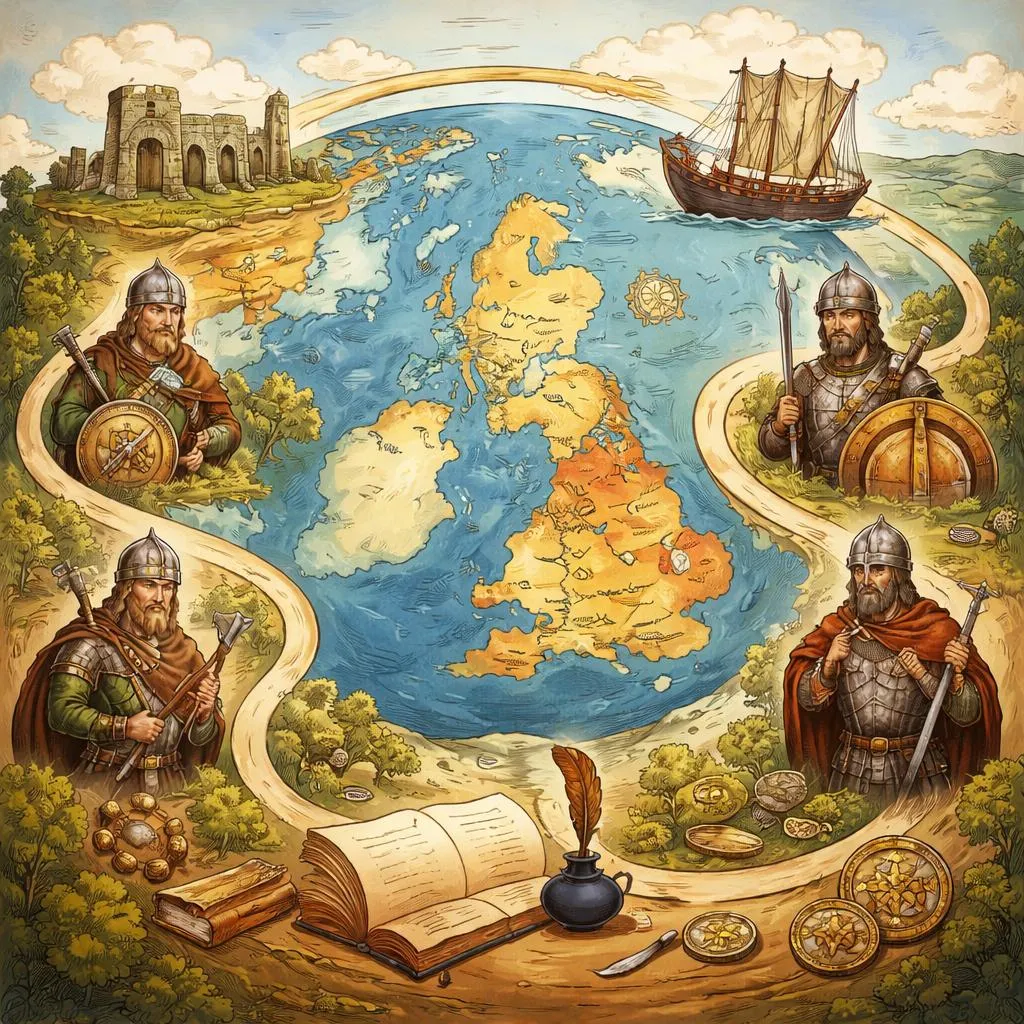
Groups such as the Angles, Saxons, and Jutes moved to Britain in the 5th century.
They came from areas that are now Germany and Denmark.
The name “England” comes from the Angles.
Their language became Old English.
Old English looked very different from modern English.
Many basic words come from this period.
House
Water
Mother
Father
Strong Germanic roots shaped early vocabulary.
Grammar was more complex than today.
Word endings changed meaning.
Old English Period
Old English was spoken from about 450 to 1100.
It had many inflections.
It used different word forms for case and gender.
One famous Old English text is Beowulf.
Old English does not look like modern English.
It is difficult for modern readers.
Over time, pronunciation changed.
Grammar became simpler.
Contact with other languages influenced development.
Norse Influence
During the Viking Age, Norse speakers from Scandinavia settled in parts of Britain.
Their language was Old Norse.
Old Norse and Old English were related.
Because they were similar, many words mixed.
Sky
Egg
Window
They
Them
Their
These words come from Norse influence.
Pronouns changed because of contact.
Vocabulary expanded.
Language simplified.
Norman Conquest and French Influence
In 1066, the Normans invaded England.
They spoke a form of French.
After the conquest, French became the language of government and law.
English continued among common people.
For centuries, both languages existed together.
Many French words entered English.
Government
Court
Justice
Beauty
Language
French influence changed vocabulary.
It affected spelling.
It affected pronunciation.
English became richer in synonyms.
Middle English Period
From about 1100 to 1500, English entered the Middle English period.
Grammar became simpler.
Word endings reduced.
Word order became more important.
One famous writer of this period was Geoffrey Chaucer.
His work shows early Middle English.
English absorbed many French words.
It continued to change.
Spelling was not standardized.
Early Modern English
From 1500 to 1700, English entered a new stage.
Printing helped standardize spelling.
The Great Vowel Shift changed pronunciation.
Vowels became longer and clearer.
William Shakespeare wrote during this time.
His works added many new words.
Creative expression expanded vocabulary.
Exploration brought new words from around the world.
English grew rapidly.
Modern English
Modern English developed after 1700.
Colonial expansion spread English globally.
Contact with many cultures added new vocabulary.
English borrowed words from Spanish, Hindi, Arabic, and many other languages.
Today English is spoken worldwide.
It is used in science.
It is used in business.
It is used online.
Grammar is simpler than Old English.
Vocabulary is very large.
Extended Historical Sentence
The English language originated from the Germanic dialects brought to Britain by the Angles, Saxons, and Jutes in the fifth century, evolved through significant contact with Old Norse during the Viking settlements, underwent major vocabulary expansion after the Norman Conquest introduced French influence, and continued to transform through phonetic shifts, literary development, printing technology, and global expansion into the diverse and widely spoken modern language used today.
Language Family Connection
English belongs to the Indo-European family.
It is related to German.
It is related to Dutch.
It shares distant roots with Spanish and French.
Language families show shared history.
They show shared structure.
English continues to change.
It continues to grow.
Understanding where English came from helps explain its spelling, vocabulary diversity, and mixed grammatical patterns that reflect centuries of cultural contact and historical transformation.
Latin Influence on English
Latin influenced English in many ways, especially through religion, education, science, and law, because Latin was the language of the Roman Church and later the language of scholarship across Europe for many centuries.
Even before the Norman Conquest, some Latin words entered early English through contact with the Roman Empire.
Later, Latin entered again through Christianity.
Words such as altar, school, candle, and priest came from Latin.
During the Renaissance, scholars borrowed directly from Latin.
Words such as data, radius, formula, and species entered English academic vocabulary.
Latin roots remain visible in modern English.
Many scientific terms are based on Latin.
Medical vocabulary often uses Latin structure.
Legal language reflects Latin tradition.
Latin influence explains why English contains both simple Germanic words and longer academic words with Latin origin.
Greek Contributions
Greek also contributed to English vocabulary, especially in science, philosophy, medicine, and technology, because many early scientific discoveries and academic traditions were recorded in Greek.
Words such as biology, geography, telephone, and democracy come from Greek roots.
The word alphabet itself comes from the first two Greek letters.
Academic English often uses Greek prefixes and suffixes.
Understanding Greek roots helps decode meaning.
It supports vocabulary growth.
It strengthens reading comprehension.
Greek and Latin together form a large part of advanced English vocabulary.
The Role of the Printing Press
The introduction of the printing press to England in the late fifteenth century helped stabilize English spelling and grammar, because printed books required consistency and encouraged writers to follow similar patterns rather than regional variation.
William Caxton introduced printing to England.
Printed texts reduced variation.
Standard spelling slowly developed.
London dialect gained influence.
Written English became more uniform.
Printing strengthened literacy.
It supported education.
It preserved language forms.
Standardization shaped Modern English.
The Great Vowel Shift
One of the most important sound changes in English history was the Great Vowel Shift, which occurred between the fifteenth and seventeenth centuries and dramatically altered the pronunciation of long vowels while leaving spelling largely unchanged.
Before the shift, vowels were pronounced differently.
After the shift, pronunciation changed.
Spelling did not fully adjust.
This explains irregular spelling patterns.
The word “time” once sounded different.
The word “house” changed pronunciation.
Sound change created modern pronunciation.
Spelling preserves history.
English and Global Expansion
From the seventeenth century onward, English spread beyond Britain through trade, exploration, and colonization, and as it reached North America, Africa, Asia, and Australia, it absorbed vocabulary from many local languages while also developing regional varieties.
In North America, English mixed with Indigenous languages.
In India, English absorbed words such as bungalow and shampoo.
From Spanish influence in the Americas, words like canyon and ranch entered English.
From Arabic, words like algebra and coffee entered through trade and scholarship.
English became flexible.
It borrowed freely.
It adapted easily.
Global contact increased diversity.
Development of American English
When English speakers settled in North America, the language began to develop its own patterns of pronunciation, vocabulary, and spelling, leading to distinctions between British English and American English over time.
American English kept some older pronunciations.
It created new vocabulary.
Spelling reforms simplified certain words.
Color instead of colour.
Center instead of centre.
Vocabulary differences appeared.
Truck instead of lorry.
Apartment instead of flat.
Despite differences, mutual understanding remains strong.
Both forms share the same historical roots.
English as a Global Language
Today English functions as a global language because it is widely used in international communication, science, aviation, technology, diplomacy, and media, allowing speakers from different linguistic backgrounds to use it as a shared means of interaction.
It is taught in schools worldwide.
It is used in international business.
It dominates much of the internet.
It appears in global entertainment.
English continues to change.
New words enter regularly.
Technology creates new vocabulary.
Social media influences expression.
Global usage increases variation.
Language Change Over Time
English has never remained static, and its history demonstrates that language evolves naturally through contact, innovation, simplification, borrowing, and social change, which explains why modern English looks very different from Old English while still preserving traces of its Germanic foundation.
Grammar simplified over centuries.
Case endings disappeared.
Word order became fixed.
Vocabulary expanded.
Pronunciation shifted.
Spelling stabilized but kept older forms.
Change continues today.
New slang appears.
Digital communication shapes usage.
Language reflects society.
Extended Historical Analysis Sentence
The English language developed from the Germanic dialects brought to Britain in the fifth century, transformed through interaction with Old Norse during Viking settlement, expanded dramatically after the Norman Conquest introduced extensive French vocabulary, absorbed classical influence from Latin and Greek during the Renaissance, underwent significant phonological restructuring during the Great Vowel Shift, and spread globally through trade, colonization, and technological advancement into a diverse, adaptable, and internationally influential language.
Historical Layers Within Modern English
Modern English contains layers of history within its vocabulary and structure, because simple everyday words often reflect its Germanic origins while more formal or academic words reveal French, Latin, or Greek influence accumulated across centuries of cultural contact.
Ask is Germanic.
Question is French.
Freedom is Germanic.
Liberty is French.
This dual vocabulary creates nuance.
It creates stylistic choice.
It enriches expression.
English history lives inside its words.
Understanding where English came from provides insight into its mixed spelling patterns, large vocabulary, flexible structure, and global role as a language shaped by migration, conquest, scholarship, trade, and continuous adaptation across more than fifteen hundred years of development.