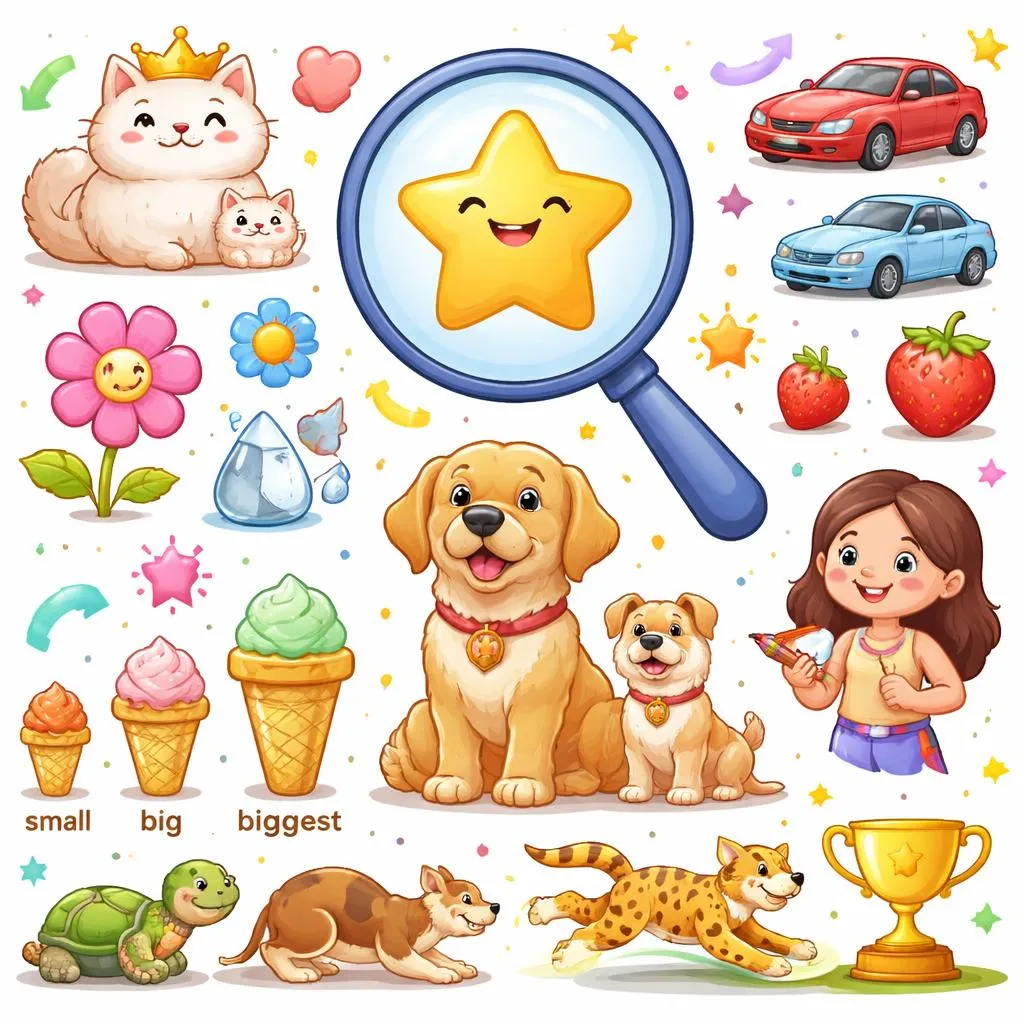

Adjectives describe nouns.
They give more information.
They tell about size.
They tell about color.
They tell about feeling.
They tell about quality.
Superlatives show the highest degree.
They compare three or more things.
Grammar changes form to show degree.
Degree shows comparison level.
What Is an Adjective?
An adjective is a describing word.
It modifies a noun.
It answers questions like what kind, which one, or how many because adjectives provide detail that limits or qualifies the meaning of a noun in a sentence.
A tall building.
A blue sky.
A happy child.
Adjectives usually come before nouns.
They can follow linking verbs.
The sky is blue.
The child feels happy.
Position affects structure.
Structure affects clarity.
What Is a Superlative?
A superlative shows the highest level.
It compares more than two items.
It often ends in “-est.”
It sometimes uses “most” because English forms superlatives differently depending on syllable length and word structure.
Tall → tallest
Small → smallest
Fast → fastest
Beautiful → most beautiful
Important → most important
Superlatives highlight extremes.
Extremes create emphasis.
How Do We Form Superlatives?
Short adjectives add “-est.”
Long adjectives use “most.”
Two-syllable adjectives may vary because pronunciation and spelling patterns influence superlative formation rules in English morphology.
Happy → happiest
Busy → busiest
Simple → simplest
Careful → most careful
Modern → most modern
Spelling sometimes changes.
“Y” becomes “i.”
Double consonants may appear.
Rules guide formation.
What Is the Difference Between Comparative and Superlative?
Comparative compares two items.
Superlative compares three or more because degree of comparison has three levels in English grammar: positive, comparative, and superlative.
Tall → taller → tallest
Cold → colder → coldest
Interesting → more interesting → most interesting
Comparatives often use “-er” or “more.”
Superlatives use “-est” or “most.”
Degree increases step by step.
Grammar marks difference clearly.
Irregular Adjectives
Some adjectives change form completely.
They do not follow regular pattern because irregular forms developed historically and must be memorized.
Good → better → best
Bad → worse → worst
Far → farther/further → farthest/furthest
Little → less → least
Many → more → most
Irregular forms require practice.
Memory supports accuracy.
Usage strengthens familiarity.
Superlatives in Sentences
She is the tallest student.
This is the most exciting game.
That was the best day.
The superlative often uses “the” because English requires the definite article before superlative adjectives when identifying a specific extreme within a group.
The fastest runner won.
The smallest house sold first.
Article use is important.
Grammar requires structure.
Adjectives After Linking Verbs
Adjectives can follow verbs like be, seem, feel, become because linking verbs connect subject with description rather than showing action.
The weather is cold.
She seems happy.
The task became difficult.
Superlatives can also follow linking verbs.
This is the easiest test.
That was the most challenging project.
Linking verbs connect subject and adjective.
Understanding function improves grammar control.
Linguistic Explanation Sentence
Adjectives in English function as modifiers that describe or qualify nouns, while superlatives represent the highest degree within a comparison set and are morphologically formed through suffixation or the addition of “most,” reflecting the grammatical system of degree marking within English descriptive syntax.
Why Are Adjectives and Superlatives Important?
They make language clear.
They add detail.
They express comparison because communication often requires evaluation of size, quality, importance, or intensity among multiple items.
They improve descriptive writing.
They enhance spoken clarity.
Strong understanding of adjectives and superlatives supports accurate comparison, strengthens descriptive ability, and develops overall grammatical competence in English communication.
How Do Adjectives Function in Different Sentence Positions?
Adjectives often come before nouns.
They also appear after linking verbs.
They sometimes appear after indefinite pronouns because English allows certain adjective placements depending on syntactic environment.
Something interesting happened.
Nothing unusual occurred.
The room is quiet.
The quiet room feels calm.
Position changes emphasis.
Grammar controls order.
Correct placement improves clarity.
Order of Adjectives in English
English follows a pattern.
Opinion comes first.
Size follows.
Age comes next.
Shape appears after age.
Color follows shape.
Origin comes later.
Material appears near the noun.
Purpose comes last because adjective order reflects conventional semantic hierarchy in English syntax.
A beautiful small old round wooden table.
A lovely red Italian leather bag.
Native speakers follow this order naturally.
Learning pattern improves fluency.
Practice strengthens intuition.
Superlatives in Long Descriptions
Superlatives often appear with groups.
They compare many items.
They emphasize one extreme because superlative structure identifies a single entity with the highest or lowest degree within a defined category.
She is the smartest student in the class.
That was the most exciting movie of the year.
This is the least expensive option available.
Prepositional phrases often follow.
The group must be clear.
Clarity defines comparison.
Double Comparatives and Incorrect Forms
Incorrect forms sometimes appear.
People may say “more better.”
This is incorrect because English does not allow double comparison marking within the same adjective form.
Correct: better.
Incorrect: more better.
Correct: most beautiful.
Incorrect: beautifullest.
Understanding structure prevents error.
Grammar rules maintain consistency.
Accuracy supports professionalism.
Superlatives With Adverbs
Adverbs also form superlatives.
They describe verbs.
They may use “most” because many adverbs do not take “-est” endings in standard English morphology.
Quickly → most quickly
Carefully → most carefully
Well → best
She runs the fastest.
He answered the most carefully.
Degree applies to action.
Comparison extends beyond nouns.
Grammar system remains parallel.
Negative Superlatives
Least is the negative form.
It shows lowest degree.
It uses “least” before long adjectives because English expresses minimum comparison through analytic structure.
Least important
Least interesting
Least expensive
This is the least difficult task.
Negative comparison clarifies evaluation.
Opposites balance meaning.
Superlatives Without a Clear Group
Sometimes the group is implied.
Context defines comparison.
The group may be understood because shared knowledge allows omission of explicit comparison set in discourse.
This is the best.
She is the strongest.
Listeners infer the group.
Shared context supports understanding.
Communication relies on shared knowledge.
Adjectives With “Too” and “Enough”
Adjectives combine with modifiers.
“Too” shows excess.
“Enough” shows sufficiency because these words modify degree rather than comparison between items.
Too cold
Too expensive
Warm enough
Tall enough
Structure differs from superlatives.
Meaning focuses on limit.
Degree and comparison interact differently.
Comparative and Superlative in Academic Writing
Academic writing uses comparison carefully.
It avoids exaggeration.
It prefers precise measurement because formal contexts often require evidence-based evaluation rather than emotional intensity.
More effective method
Most reliable source
Least significant factor
Neutral tone increases credibility.
Objective comparison strengthens argument.
Vocabulary choice reflects discipline.
Extended Linguistic Explanation Sentence
Within English grammar, adjectives operate as modifiers that encode semantic attributes of nouns, while superlatives represent the maximal or minimal degree along a scale of comparison, formed either morphologically through suffixation or analytically through the use of “most” and “least,” demonstrating the language’s systematic approach to gradability, evaluation, and hierarchical description.
Why Mastering Adjectives and Superlatives Matters
Clear description improves communication.
Accurate comparison prevents misunderstanding.
Correct form shows grammatical control because degree marking is essential for expressing evaluation, preference, measurement, and distinction in both spoken and written English.
Strong grammar builds confidence.
Varied adjectives enrich expression.
Understanding superlatives strengthens analytical thinking.
Mastery of adjectives and superlatives enhances descriptive precision, supports academic clarity, improves professional writing, and develops the ability to compare ideas, objects, and experiences effectively within diverse communicative contexts.