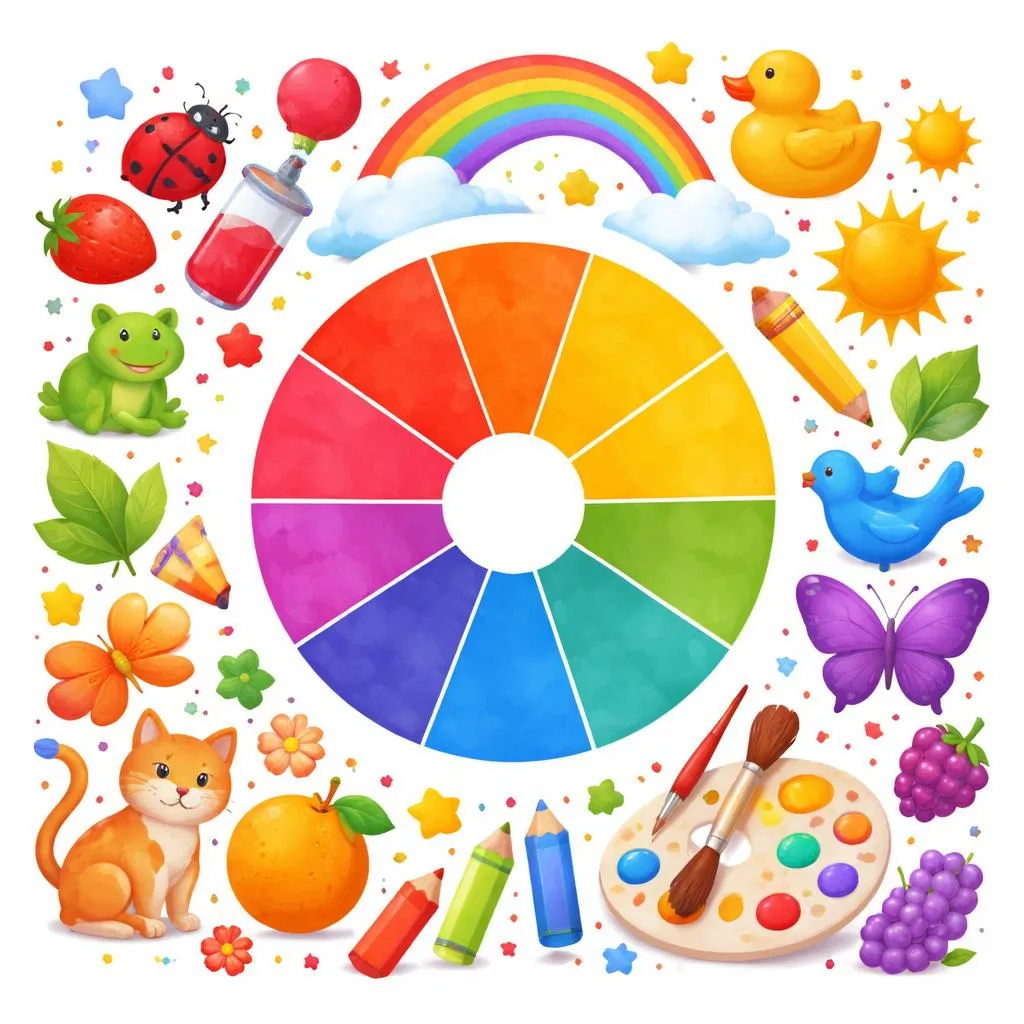

Color words are words used to describe the color of people, places, objects, and ideas. They help make language more vivid and detailed. Instead of saying “a car,” a speaker can say “a red car” or “a blue car,” which creates a clearer picture in the listener’s mind.
Color words are adjectives. They describe nouns.
A green tree. A yellow sun. A black cat.
Adding color makes sentences more interesting and specific.
Basic Color Words
Some color words are considered basic colors in English. These are usually learned first.
Red Blue Yellow Green Orange Purple Pink Brown Black White Gray
These basic color words are used every day in speech and writing.
The sky is blue. The grass is green. She wore a pink dress.
Color words often appear before the noun, but they can also appear after linking verbs.
The apple is red. The snow looks white.
Light and Dark Colors
Color words can change by adding light or dark.
Light blue Dark green Light brown Dark gray
These phrases help describe shades more clearly.
The room has light yellow walls. He bought a dark blue jacket.
This small change adds detail and accuracy.
Bright and Pale Colors
Other descriptive words can modify color words.
Bright red Pale pink Deep purple Soft blue
These combinations create more precise images.
The sunset was bright orange. She painted the room pale green.
Color words combined with descriptive adjectives create stronger descriptions.
Color Words in Nature
Many color words are connected to nature.
Sky blue Leaf green Ocean blue Snow white Rose red
Nature often inspires color vocabulary. Observing the natural world helps learners remember color words easily.
The ocean looks deep blue. The leaves turn orange in autumn.
Seasonal changes also bring new color descriptions.
Color Words in Daily Life
Color words appear in clothing, food, and everyday objects.
A red apple. A golden sandwich. A silver watch. A white shirt.
Color helps identify and describe objects clearly.
In shopping or travel situations, color words are especially useful.
I would like the black shoes. She prefers the purple bag.
These phrases show how practical color vocabulary can be.
Figurative Use of Color Words
Color words are not always literal. Sometimes they express emotion or meaning.
Feeling blue means feeling sad. Seeing red can mean feeling angry. Green with envy describes jealousy.
These expressions use color in a symbolic way.
Understanding these figurative meanings improves reading comprehension and conversation skills.
Comparing Colors
Color words can also use comparative forms when describing differences.
This blue is darker than that one. Her dress is brighter than mine.
Although the color word itself does not usually change form, descriptive words around it can show comparison.
Why Learning Color Words Is Important
Color words make language clearer and more expressive. They help describe the world with precision and creativity.
They are simple to learn but powerful in communication.
Using color words correctly improves vocabulary, supports descriptive writing, and strengthens everyday conversation skills.
Shades and Tones of Color Words
Color words can become more detailed when speakers describe shades and tones. A shade is a darker version of a color. A tint is a lighter version. Tone can describe how strong or soft a color feels.
Navy blue is darker than regular blue. Baby blue is lighter and softer. Forest green feels deep and rich. Mint green feels light and fresh.
These small differences create very clear pictures in the mind. Instead of simply saying “blue,” adding a shade makes the description stronger and more exact.
The walls were painted navy blue. She chose a soft lavender scarf.
Precise color words improve descriptive writing.
Color Words from Objects
Many English color words come from objects in daily life.
Gold Silver Bronze Ivory Coral Peach Olive Turquoise
These words originally describe materials or natural items, but they are also used as colors.
She wore a silver dress. The room had ivory curtains. He bought an olive jacket.
Using object-based color words makes language more vivid and modern.
Color Words and Culture
Colors can have different meanings in different cultures. In some places, white represents purity. In others, it may represent mourning. Red can symbolize love, danger, celebration, or luck depending on cultural context.
Because of this, color words carry emotional meaning in addition to visual meaning.
A red heart often represents love. A black sky may suggest danger or mystery. A golden crown suggests royalty or success.
Understanding cultural meaning helps learners interpret literature, media, and conversations more accurately.
Color Words as Nouns
Although color words are usually adjectives, they can also function as nouns.
Blue is my favorite color. She prefers green. Black goes well with everything.
In these sentences, the color word stands alone as the subject or object. The word “color” is understood but not repeated.
This flexibility makes color vocabulary very useful in conversation.
Color Words in Idioms and Expressions
English contains many expressions that use color words.
White lie refers to a small, harmless lie. Black and white describes something very clear or simple. In the red means losing money. In the black means making money.
These phrases do not describe actual color. They express ideas.
Learning these expressions improves listening and reading skills because they appear often in news, business, and daily speech.
Color Words in Art and Design
In art, color words are essential. Artists describe warm colors and cool colors.
Warm colors include red, orange, and yellow. Cool colors include blue, green, and purple.
Warm colors often feel energetic. Cool colors often feel calm.
Interior design also depends on color vocabulary.
Soft gray walls create a peaceful feeling. Bright yellow decorations create energy.
Clear color descriptions help communicate creative ideas.
Color Words and Comparison
Speakers sometimes compare colors using “more” or descriptive words.
This red is deeper than that one. Her blue is brighter than mine. The sunset looked more orange than pink.
Color comparison adds detail to observation and discussion.
Even in simple daily conversation, comparison appears naturally.
The darker blue looks better. The lighter green feels softer.
Expanding Color Vocabulary
Basic colors are only the beginning. English contains hundreds of color words. Learning more advanced shades increases expressive power.
Crimson Scarlet Beige Maroon Teal Indigo
Each word describes a slightly different shade.
A crimson dress looks deeper than a simple red dress. A beige wall feels softer than a bright white wall.
Expanding color vocabulary strengthens descriptive ability in writing and speech.
Why Color Words Matter in Communication
Color words add detail, emotion, and clarity. They help describe clothing, nature, art, feelings, and ideas. They can be literal or symbolic. They can function as adjectives or nouns. They appear in idioms and cultural expressions.
Strong vocabulary in color words improves reading, writing, speaking, and listening skills. Even simple conversations become more engaging when precise color descriptions are used.
Color words may seem basic, but they are powerful tools in English communication.
What Are Inuit Words for Snow?
Tags: Inuit Language, Snow Vocabulary, Arctic Culture, Eskimo–Aleut Languages, Language And Environment
Many people say that Inuit languages have hundreds of words for snow. This idea is popular, but it is often misunderstood. The truth is more interesting and more complex.
Inuit languages belong to the Eskimo–Aleut languages family. They are spoken in Arctic regions such as northern Canada and Greenland. One well-known variety is Inuktitut.
These languages are rich in word-building. They use long words made from smaller parts. Because of this structure, many snow-related expressions can be formed.
Why Are There So Many Snow Terms?
Snow is an important part of life in Arctic regions. It affects travel, hunting, safety, and daily routines. When something is important in daily life, language often develops detailed vocabulary for it.
English also has different snow words:
Snow Snowflake Snowstorm Blizzard Slush Powder
Similarly, Inuit languages have many specific snow terms because small differences matter in the environment.
Examples of Snow-Related Words
In Inuktitut, some commonly cited snow-related words include:
Aput – snow on the ground Qanik – falling snow Piqsirpoq – drifting snow Matsaaruti – wet snow suitable for packing
These words show how the language can describe snow conditions precisely. For people living in Arctic climates, knowing the difference between falling snow and drifting snow is practical and necessary.
Word Formation in Inuit Languages
Inuit languages are often described as polysynthetic. This means many small meaningful parts combine to create long words. Instead of using many separate words, speakers build one long word that carries detailed meaning.
Because of this structure, speakers can create new snow-related terms by adding suffixes and descriptive elements. This does not always mean there are hundreds of completely separate root words. It means the language is flexible and descriptive.
The Popular Myth
The idea that Inuit languages have “hundreds of words for snow” became popular in the twentieth century. Linguists later explained that the number depends on how words are counted.
If every form and variation is counted separately, the number becomes very large. If only root words are counted, the number is smaller.
The important point is not the exact number. The important point is that the language reflects the environment.
Language and Environment
All languages reflect what is important in daily life.
English has many words for technology. Medical fields have many words for body parts and diseases. Cooking vocabulary expands in cultures with rich food traditions.
In Arctic communities, snow conditions are part of daily survival. Therefore, snow vocabulary becomes detailed and practical.
Language grows where attention is focused.
Respecting Cultural Context
It is important to speak respectfully about Inuit languages. They are complex and fully developed linguistic systems, not just collections of unusual vocabulary. They have grammar, poetry, storytelling traditions, and oral history.
The discussion about snow words should highlight linguistic richness rather than exaggeration.
Understanding Inuit snow vocabulary encourages learners to think about how language connects to environment and culture.
What Can Be Learned from This?
The topic of Inuit words for snow shows how vocabulary expands to meet real needs. It also reminds learners to question simplified language myths.
Languages adapt. Vocabulary grows with experience. Environment shapes expression.
Instead of focusing only on numbers, it is more meaningful to appreciate how language captures the world around its speakers.