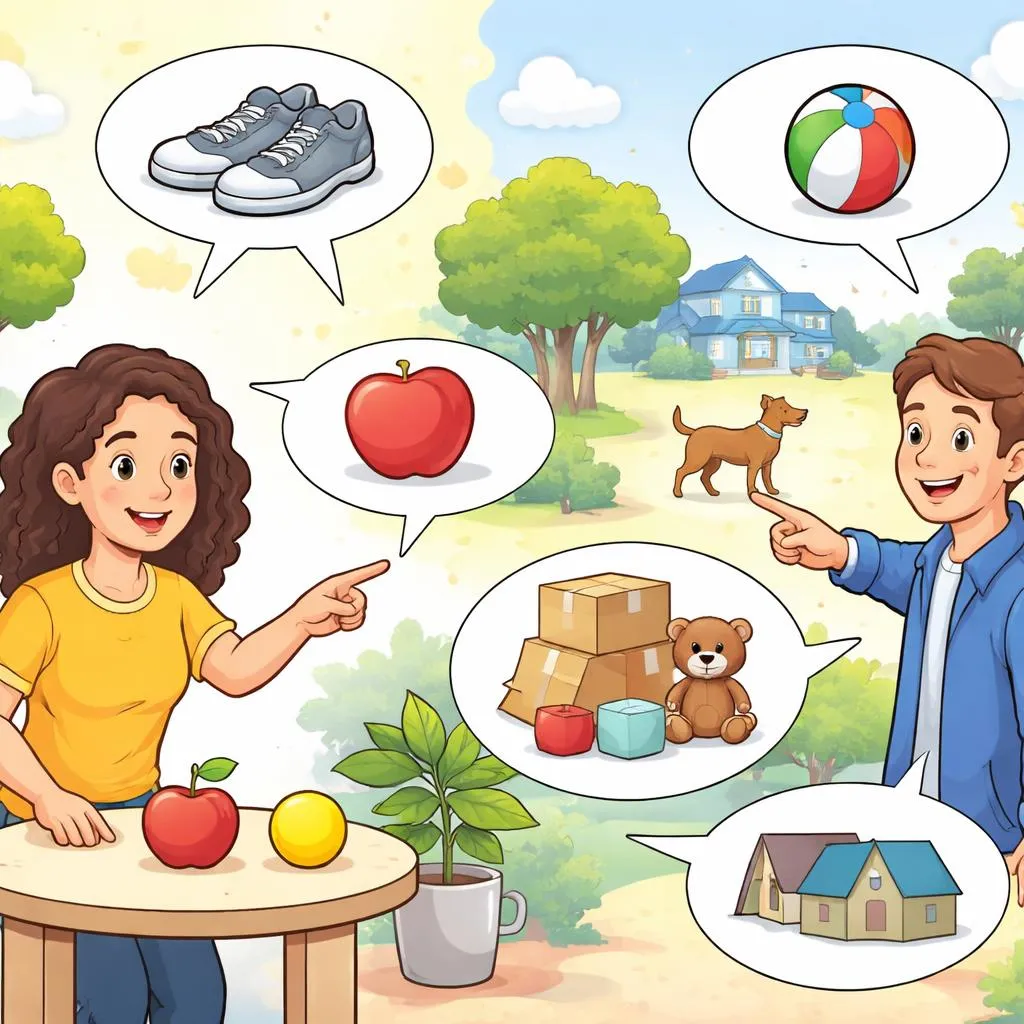

Demonstratives are words used to point to specific people or things. In English, the main demonstratives are:
this that these those
These words help show distance and number. They are very common in daily conversation and writing.
This and That (Singular Demonstratives)
“This” and “that” are singular. They refer to one person or one thing.
This is used for something near the speaker. That is used for something farther away.
This book is interesting. That house is very old.
If an object is in your hand, you usually say “this.” If the object is across the room, you usually say “that.”
Distance can be physical or emotional.
This idea makes sense. That memory is important to me.
These and Those (Plural Demonstratives)
“These” and “those” are plural. They refer to more than one person or thing.
These are used for things near the speaker. Those are used for things farther away.
These apples are fresh. Those mountains are beautiful.
Notice that plural nouns follow “these” and “those.”
Demonstrative Pronouns
Demonstratives can function as pronouns. In this case, they replace a noun.
This is my favorite. That looks delicious. These are expensive. Those belong to us.
The noun is not repeated because the demonstrative already refers to it.
Demonstrative Adjectives
Demonstratives can also function as adjectives. In this role, they describe a noun.
This car is new. That movie was exciting. These shoes are comfortable. Those buildings are tall.
When used as adjectives, they are placed before the noun.
Agreement with Nouns
Demonstratives must agree in number with the noun.
Correct: This book. Incorrect: This books.
Correct: These books. Incorrect: These book.
Singular nouns go with this or that. Plural nouns go with these or those.
Demonstratives in Questions
Demonstratives are often used in questions.
What is this? Who is that? Are these yours? Do you like those?
They help speakers identify objects or people.
Demonstratives in Conversation
Demonstratives are very common in spoken English because people often refer to objects around them.
This is amazing. That sounds great. These are my friends. Those were the days.
They make communication clear and direct.
Why Demonstratives Matter
Understanding demonstratives improves clarity in communication. They help speakers point out specific items, avoid repetition, and express distance.
Mastering this, that, these, and those is an essential step in building strong English grammar skills.
Demonstratives and Distance in Time
Demonstratives do not only show physical distance. They can also show distance in time.
“This” and “these” often refer to something happening now or very soon.
This week is busy. These days feel colder.
“That” and “those” often refer to something in the past or something more distant in time.
That day changed my life. Those years were unforgettable.
In these examples, the distance is not physical. It is emotional or temporal distance. The speaker feels closer to the present moment and farther from the past.
Demonstratives and Emotional Distance
Speakers sometimes choose demonstratives to show feelings.
This wonderful opportunity means a lot to me. That terrible mistake caused many problems.
Even if the situation is not physically near or far, the word choice can suggest emotional closeness or separation. “This” often feels more connected and immediate. “That” can feel more distant or detached.
For example:
I love this song. I remember that song.
The first sentence feels more present and personal.
Demonstratives in Comparisons
Demonstratives are often used when comparing two things.
This book is more interesting than that one. These shoes are cheaper than those.
In comparison sentences, “one” or “ones” is sometimes used to avoid repeating the noun.
I prefer this one. Those ones are better.
This structure helps sentences sound natural and avoids repetition.
Demonstratives in Academic and Formal Writing
In formal writing, demonstratives are sometimes used carefully to refer back to ideas.
The experiment produced unexpected results. This suggests that further research is needed.
In this case, “this” refers to the whole previous sentence. It summarizes the idea. Writers must be careful to make the reference clear.
Unclear reference:
The company changed its policy. This caused confusion.
What does “this” refer to exactly? The policy or the change? To avoid confusion, writers sometimes add a noun:
This change caused confusion.
Adding a noun after the demonstrative improves clarity.
Demonstratives in Spoken English
In conversation, demonstratives are extremely common. Speakers often point to objects while speaking.
Pass me that, please. Try these. They’re fresh.
Body language and tone support meaning. A gesture can clarify what “this” or “that” refers to.
Because of this, demonstratives are usually easy to understand in face-to-face communication.
Common Learner Mistakes
One common mistake is mixing singular and plural forms.
Incorrect: This apples are sweet. Correct: These apples are sweet.
Another mistake is overusing “that” when “this” would be more natural.
If something is in your hand, “this” is correct.
Incorrect: That pen in my hand is new. Correct: This pen in my hand is new.
Paying attention to number and distance helps avoid errors.
Demonstratives in Relative Structures
Demonstratives sometimes appear in more complex sentences.
This is the reason that I called you. Those who work hard will succeed.
In the second example, “those” refers to a group of people. It functions almost like a noun phrase.
Understanding this structure expands vocabulary and grammar flexibility.
Demonstratives in Different Contexts
In everyday life:
This tastes delicious. That looks expensive.
In storytelling:
That night was unforgettable. These moments define our lives.
In presentations:
This chart shows the results. Those figures represent last year’s data.
Demonstratives adapt easily to many contexts.
Why Mastering Demonstratives Is Important
Demonstratives help speakers point, compare, connect ideas, and avoid repetition. They create clarity in both speech and writing. Because they appear frequently in daily communication, mastering “this,” “that,” “these,” and “those” builds a strong grammatical foundation.
Understanding how demonstratives show number, distance, time, and emotion allows learners to communicate more precisely and confidently in English.