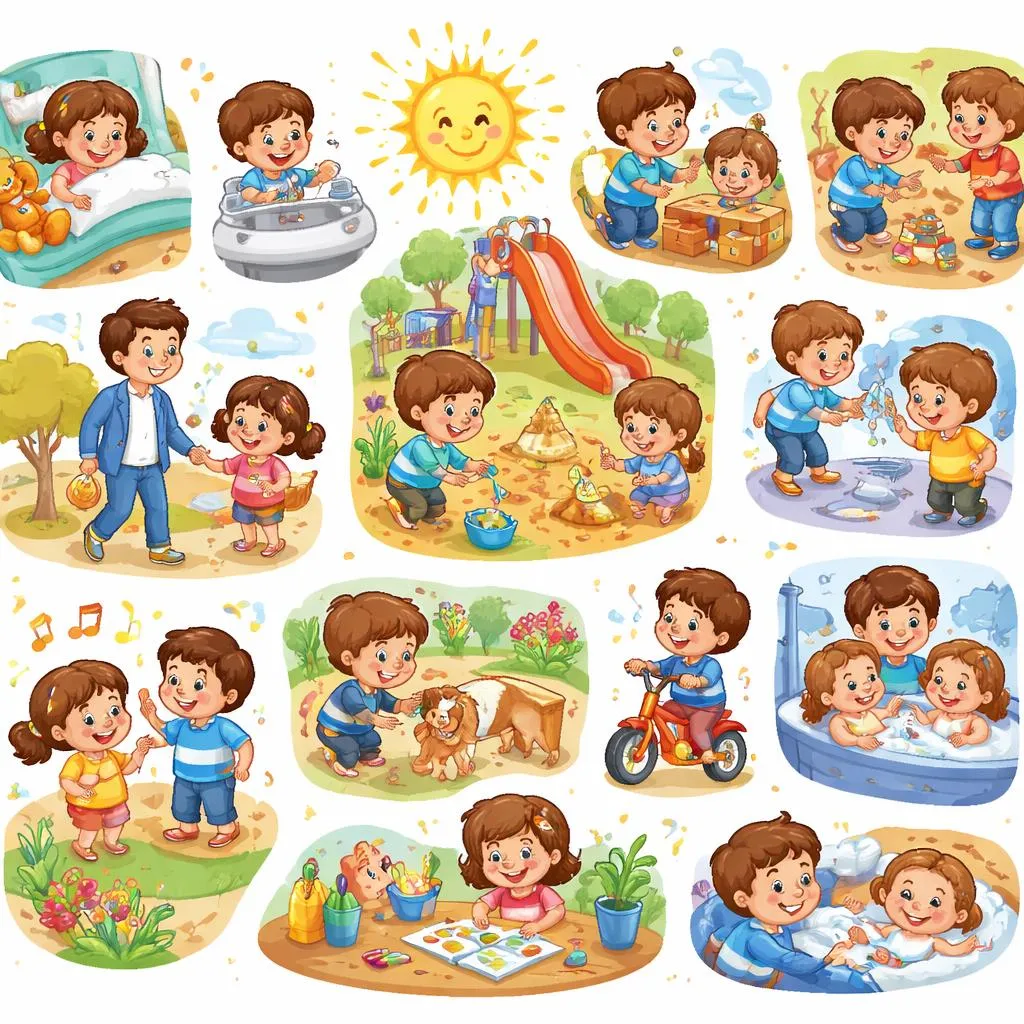

Hello, little friend! Do you have a favorite thing you do every day? Maybe you brush your teeth every morning. You eat lunch every noon. You sleep in your bed every night. These are your daily rhythms! The words we use for these everyday actions are in the simple present tense. The simple present is for things we do often, always, or as a fact. It is not for right this second. It is for your habits and true things! Today, we will find the must-know simple present verbs for 3-year-olds. Meet our guide, Day-Day. Day-Day is a little robot with a very regular routine! He will show us simple present actions at home, the playground, school, and in his cozy charging corner. Let's learn about daily rhythms!
What Is the Simple Present? The simple present tense talks about regular things. It tells about habits. Things you do again and again. It tells about facts. Things that are always true. It tells about things you like or need. At home, you brush your teeth every day. "Brush" is simple present. At the playground, you go there often. "Go" is simple present. At school, you listen to your teacher. "Listen" is simple present. In nature, the sun rises in the east. "Rises" is a fact. "Day-Day charges his battery every night." This is his habit. Learning these simple present verbs helps you talk about your life.
Why Talk About Daily Rhythms? The simple present is your routine voice! It helps your ears listen. You understand stories about what characters always do. It helps your mouth speak. You can tell people about your day. "I eat cereal. I play with blocks." It helps your eyes read. You will see simple facts in books. "Cats purr." It helps your hand write. You can write lists of things you do. The simple present makes you a great storyteller of your own life.
What Does the Simple Present Tell Us? The simple present has three big jobs. Let's see them all.
First, it tells about HABITS. These are your regular actions. "I wake up at seven. I wash my face. I get dressed." "We visit the park on Tuesday."
Next, it tells about FACTS. These are always true things. "Water is wet. The sky is blue. Birds have wings. Two and two make four."
Here, it tells about LIKES and NEEDS. These are your feelings and wants. "I like ice cream. She loves her mom. He needs a nap. They want a cookie."
It can also tell about SCHEDULES. "The bus comes at eight. School starts at nine."
How Can You Find the Simple Present? Finding the simple present is easy! Listen for time clue words. Words like "every day", "always", "usually", "often", "sometimes", "never". These words love the simple present! Ask this question: "Is this something that happens regularly?" If yes, it is probably simple present. Look at the verb. For I, you, we, they, it looks plain: "I eat." For he, she, it, it often has an 's' at the end: "He eats." "She runs." "Day-Day beeps." That 's' sound is a big clue for he/she/it facts.
How Do We Use the Simple Present? Using the simple present is about patterns. Here is the main formula. For I, You, We, They: use the verb plain. I eat. You play. We sing. They jump. For He, She, It: add an 's' to the verb. He eats. She plays. It sings. The dog runs. For the verb "to be", it is special: I am, You are, He/She/It is, We are, They are. "I am happy." "She is three." For negatives, use "do not" or "does not". I do not like spinach. He does not like broccoli.
Let's Fix Some Rhythm Mix-Ups! Sometimes we mix up the simple present with the "right now" tense. Let's practice. A common mix-up is forgetting the 's' for he/she/it. A child might say "He eat cereal." This is missing the 's'. The right way is "He eats cereal." Remember the rule: He, She, It = verb with an 's'! Another mix-up is using the "-ing" form for habits. Someone might say "I am eating cereal every day." This sounds funny for a habit. For a regular action, use the simple present: "I eat cereal every day." Save "I am eating" for right this minute.
Can You Be a Habit Detective? You are great with rhythms! Let's play a game. Be a "Habit Detective" at home. Watch your family for five minutes. What habits do you see? Say them in simple present. "Dad drinks coffee. Mom reads a book. My sister draws. The dog sleeps." Perfect! Here is a harder challenge. Think about your favorite animal. What are three facts about it? Use "It" and a verb with 's'. "A frog jumps. It eats bugs. It says 'ribbit'." You are using the must-know simple present for facts!
Your Big List of 40 Must-Know Simple Present Verbs Ready for the big rhythm list? Here are forty key verbs in the simple present form. Practice with Day-Day! For I/You/We/They: have, eat, drink, like, love, want, need, see, hear, play, go, come, walk, run, jump, sleep, wake, wash, brush, put, get, take, give, share, help, read, draw, sing, talk, say, make, do, know, think, feel, look, sit, stand, work, be. Now, see how they change for He/She/It: has, eats, drinks, likes, loves, wants, needs, sees, hears, plays, goes, comes, walks, runs, jumps, sleeps, wakes, washes, brushes, puts, gets, takes, gives, shares, helps, reads, draws, sings, talks, says, makes, does, knows, thinks, feels, looks, sits, stands, works, is. These are your must-know simple present verbs. Start with "like", "play", "eat", "go".
Talking About Your Wonderful World You did it! You know the simple present tense. It is for daily rhythms, facts, and likes. It is not for action right now. It is for action always or often. You know the special rule for he, she, and it. You know how to find it and use it. Day-Day uses the simple present to explain his daily routine. Now you can too! You can tell everyone about your habits. You can share amazing facts. You can say what you love. Your words will describe your stable, wonderful world.
Here is what you can learn from our rhythm adventure. You will know what the simple present tense is for. You will understand its three main jobs. You can spot time words that go with it. You can use the correct form for I, you, he, she, it, we, they. You have a big list of verbs for your daily life.
Now, let's do some life practice! Your mission is today. Describe your bedtime routine to your grown-up. Use the simple present. Say: "I brush my teeth. I put on my pajamas. I read a book. I go to sleep." You just used four simple present verbs! Keep sharing the story of your daily rhythms. Have fun, little storyteller!