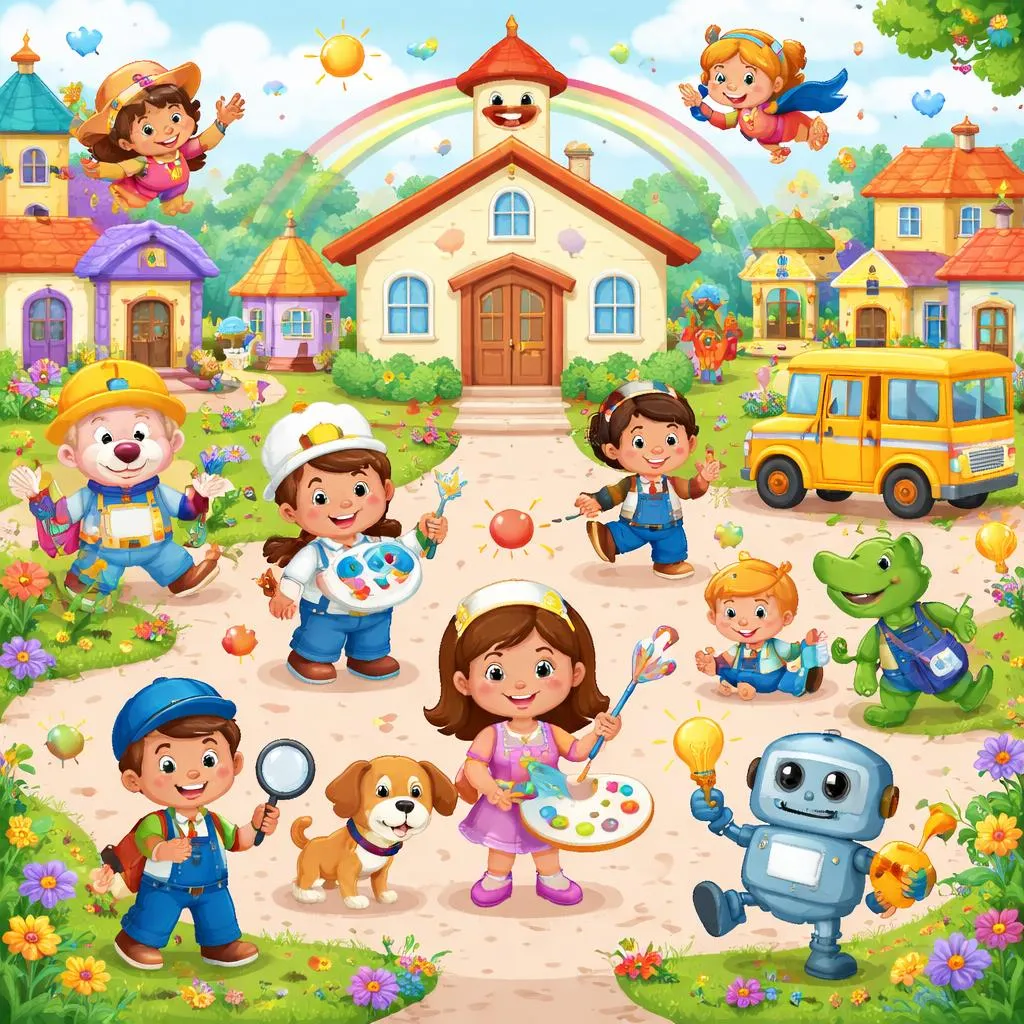

Hello, little word builder! Welcome to Word Town! In Word Town, every word has a very important job. These jobs are called the parts of speech. Just like a firefighter puts out fires and a baker bakes bread, each part of speech does a special job in a sentence. Today, we will meet sixty of the most important workers in Word Town! Our guide is Mayor Murphy, a friendly moose who knows everyone's job. Mayor Murphy will show us around the home, the playground, the school, and the park in Word Town. Let's get to work!
What Are the Parts of Speech? The parts of speech are the different jobs that words can have. Think of a sentence like a busy street. Nouns are the buildings and people. Verbs are the cars and buses moving. Adjectives are the paint and signs that describe the buildings. Every word is a worker doing its job to make the sentence clear and complete. Knowing these jobs helps you build amazing sentences. When you know a word's job, you know where to put it and how to use it. It is the most important tool for building your language.
Why Know the Word Workers? Knowing the parts of speech gives you superpowers! It helps your ears listen. You can understand how a sentence is built. It helps your mouth speak. You can choose the perfect word for the job. It helps your eyes read. You will see how authors use different words to create stories. It helps your hand write. You can build strong, clear sentences that share your wonderful ideas. Being the boss of Word Town makes you a confident talker, reader, and writer.
Who Are the Main Workers in Word Town? Word Town has eight main teams of workers. Each team has a special name and job. Let's meet the team captains.
First, the Naming Team: NOUNS. These workers are people, places, animals, and things. They are the main things in a sentence. "dog", "home", "Lily", "toy".
Next, the Action Team: VERBS. These workers show action or a state of being. They make things happen. "run", "is", "think", "sleep".
Here, the Describing Team: ADJECTIVES. These workers describe nouns. They tell us what kind, how many, or which one. "big", "three", "blue", "happy".
The How Team: ADVERBS. These workers describe verbs, adjectives, or other adverbs. They tell how, when, or where. "quickly", "yesterday", "here".
The Replacing Team: PRONOUNS. These workers take the place of a noun. "I", "you", "he", "she", "it", "we", "they".
The Position Team: PREPOSITIONS. These workers show the relationship between a noun and another word. They tell about place, time, or direction. "in", "on", "under", "to".
The Connecting Team: CONJUNCTIONS. These workers connect words, phrases, or sentences. "and", "but", "or", "because".
The Feeling Team: INTERJECTIONS. These workers show strong feeling or surprise. They often stand alone. "Wow!", "Ouch!", "Hi!"
These are the eight main parts of speech. Let's meet some of the star workers in each team.
How Can You Tell What Job a Word Has? You can ask a word about its job! It's like a costume. Ask a simple question. For a noun, ask "Can I point to it? Is it a person, place, or thing?" For a verb, ask "Can I do it? Is it an action or a state?" For an adjective, ask "What kind? Which one? How many?" For an adverb, ask "How? When? Where?" For a pronoun, ask "Is it replacing a noun's name?" For a preposition, ask "Does it show where or when something is?" For a conjunction, ask "Is it connecting two things?" For an interjection, ask "Does it show a sudden feeling?" Mayor Murphy says, "When in doubt, look at the word's job in the sentence!"
How Do We Put the Workers Together? The workers follow a plan. A simple sentence often needs a Noun Worker and a Verb Worker. "Birds sing." You can add an Adjective Worker to describe the noun. "Happy birds sing." You can add an Adverb Worker to describe the verb. "Happy birds sing loudly." Prepositions often work with nouns. "The birds are in the tree." Conjunctions join two parts. "Birds sing and squirrels run." Start with the main workers: the noun and the verb. Then add helpers to make your sentence more interesting.
Let's Fix Some Work Mix-Ups. Sometimes a word tries to do the wrong job. Let's fix that. A common mix-up is using an adjective where an adverb is needed. "He runs quick." is a mix-up. The word "quick" is an adjective. It describes a noun. We need an adverb to describe the verb "runs". The right way is "He runs quickly." Another mix-up is using the wrong pronoun. "Me and my friend plays." is mixed up. Try the sentence with just the pronoun. You wouldn't say "Me plays." The right way is "My friend and I play." Also, don't forget that every sentence needs a verb worker! "The big, red ball." is just a noun with adjectives. We need a verb: "The big, red ball bounces."
Can You Be the Mayor of Word Town? You are a great leader! Let's play a game. The "Word Worker Sort" game. I will say a list of words. You tell me their job. "Apple, jump, happy, quickly." You say: "Noun, verb, adjective, adverb!" Great! Here is a harder challenge. Take a simple sentence and see how many different workers you can add. Start with "The cat sat." Add an adjective: "The fluffy cat sat." Add an adverb: "The fluffy cat sat quietly." Add a prepositional phrase: "The fluffy cat sat quietly on the mat." You are the mayor of that sentence!
Your Word Town Directory of 60 Key Workers. Ready to meet the workers? Here are sixty key parts of speech, organized by their team. Mayor Murphy will introduce them with examples from all over Word Town.
The Naming Team (Nouns) – People, Places, Things, Animals. Home Workers: mom, dad, baby, sister, brother, house, kitchen, bed, toy, cup. Playground Workers: friend, swing, slide, ball, sandbox, park, ladder, game, fun, shout. School Workers: teacher, student, book, pencil, desk, classroom, rule, lesson, number, letter. Nature & Animal Workers: sun, tree, flower, dog, cat, bird, water, sky, grass, bear.
The Action Team (Verbs) – What You Do or Are. Home Actions: eat, drink, sleep, wash, help, love, cook, clean, read, hug. Playground Actions: run, jump, play, climb, push, throw, catch, laugh, share, slide. School Actions: learn, write, draw, listen, ask, answer, raise, count, spell, color. Nature Actions: grow, fly, swim, bark, meow, bloom, rain, shine, fall, hop.
The Describing Team (Adjectives) – What Kind? big, small, happy, sad, red, blue, fast, slow, hot, cold, soft, hard, tall, short, yummy, clean, dirty, new, old, good.
The How Team (Adverbs) – How? When? Where? quickly, slowly, loudly, quietly, now, later, here, there, very, always.
The Replacing Team (Pronouns) – Instead of a Name. I, you, he, she, it, we, they, me, him, her, us, them, my, your, this, that.
The Position Team (Prepositions) – Where? in, on, under, over, by, with, to, from, at, for.
The Connecting Team (Conjunctions) – Joining Words. and, but, or, because, so.
The Feeling Team (Interjections) – Wow! Wow! Ouch! Hi! Bye! Yeah! Oops! Hooray! Shh! Please! Thanks!
These sixty words are your key parts of speech. You have met the most important workers in Word Town. Know their jobs and use them well.
Building Your Own Wonderful Word Town. You did it! You have met the key parts of speech. You know that every word has a job. You know the eight main teams: nouns, verbs, adjectives, adverbs, pronouns, prepositions, conjunctions, and interjections. You can ask questions to figure out a word's job. You know how to put them together to build sentences. Mayor Murphy is proud of you. Now you are the mayor of your own sentences! You can build stories, ask questions, and share your ideas with the world.
Here is what you can learn from our tour of Word Town. You will know the eight parts of speech and their jobs. You can identify a word's part of speech by the job it does in a sentence. You can use nouns and verbs to build a simple sentence. You can add adjectives and adverbs to make your sentences more interesting. You have a directory of sixty essential words from each part of speech.
Now, let's do some life practice! Your mission is today. Be the mayor of your next conversation. Listen for the different word workers. When you talk, try to use at least one noun, one verb, and one adjective. Tell your grown-up: "I see a big, yellow bus. It is going quickly." You just used a noun, two adjectives, a verb, and an adverb! Keep building your Word Town one sentence at a time. Have fun, little word mayor!