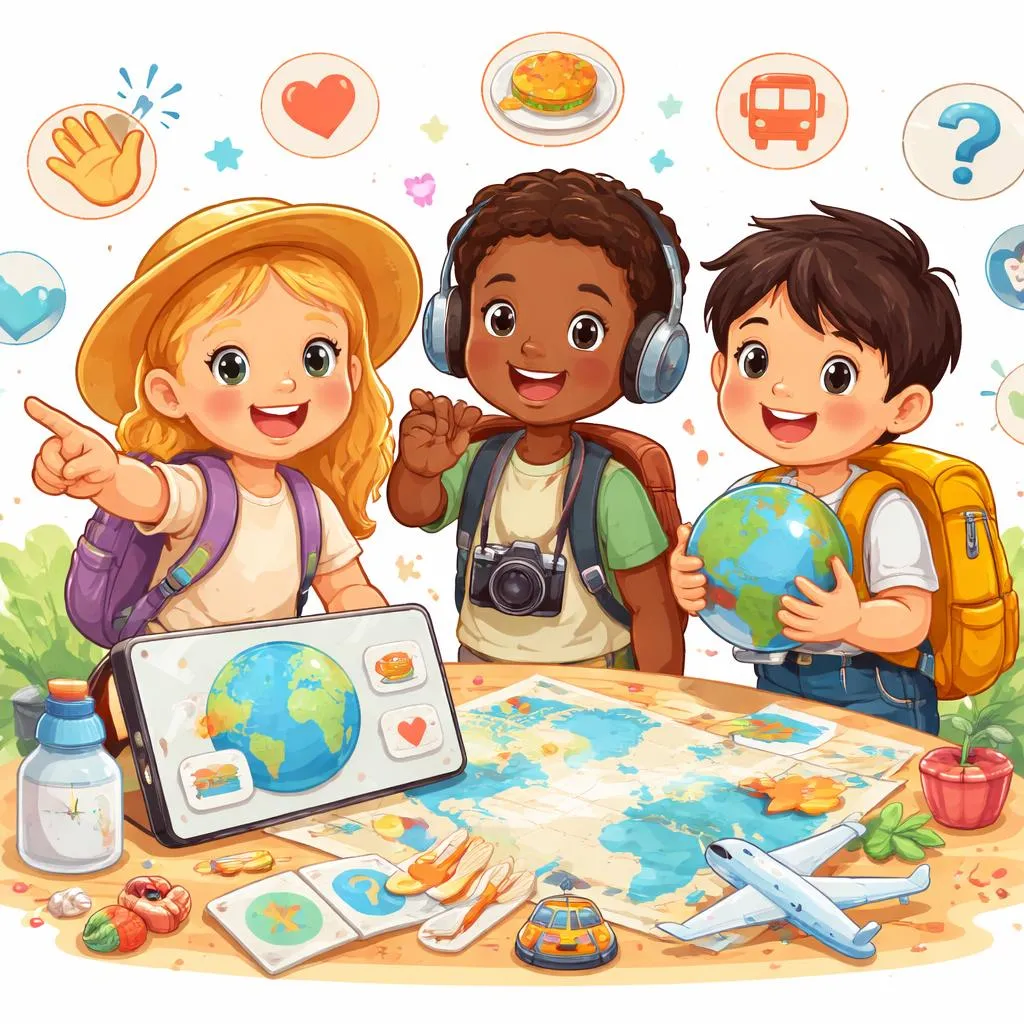

Hello, little travelers and friendly helpers. Are you excited about going on a trip? Maybe to the beach, a big city, or to see family far away. When we travel, knowing a few special words can make everything more fun. Today, we are going to learn about basic phrases for tourists. These are simple, helpful sentences. They are like magic keys. They help you talk to new people, ask for what you need, and have a great adventure. Let us learn these basic phrases for tourists together. Pack your word-suitcase. We are ready to go.
What is basic phrases for tourists?
Basic phrases for tourists are groups of words. People use these words when they visit a new place. A tourist is a person who travels for fun. So, these phrases help tourists do everyday things. They help you say hello nicely. They help you ask for directions. They help you order food. They are simple and polite. Learning the basic phrases for tourists makes you feel brave. You can talk to people even in a new country. You do not need to know all the English words. You just need to know the most important basic phrases for tourists. They are your travel friends.
Meaning and explanation
The meaning of learning basic phrases for tourists is about being independent and kind. Let us explain. When you are a guest in a new place, it is good to be polite. Using polite phrases shows respect. It also helps you get what you need quickly. The explanation is simple. These phrases solve common problems. If you are lost, you can ask, "Can you help me, please?" If you are thirsty, you can say, "One water, please." The basic phrases for tourists are designed for clear talking. They use simple grammar. They use common words. Short and clear is best. Learning them means you are preparing for a fun trip. It is like learning the rules of a new game before you start playing. This makes the whole trip smoother and happier for everyone.
Categories or lists
We can sort the basic phrases for tourists into smart groups. This makes them easy to learn. One very important group is Greetings and Polite Words. Hello. Good morning. Please. Thank you. You're welcome. Excuse me. Sorry. Goodbye. Another group is Asking for Directions and Help. Where is the bathroom? Where is the train station? How do I get to the park? Can you help me, please? I am lost.
A big group is Shopping and Food. How much is this? I would like a hamburger, please. Can I have the menu? Do you take credit cards? Can I have the bill, please? We also need Emergency and Important Phrases. Help! I need a doctor. Where is the police station? Call an ambulance, please. My name is [Your Name].
Another useful list is Transportation Phrases. A ticket to London, please. Which platform for the train? Does this bus go to the city center? Is this seat taken? Learning basic phrases for tourists by category helps your brain. You can think, "I need to buy a drink, that's the 'Shopping' group." This way, you find the right phrase fast.
Daily life examples
Let us imagine you are using these basic phrases for tourists on a real trip. Here are some scenes. First, at the airport. You arrive with your family. You need to find the baggage claim. You can ask a worker, "Excuse me, where is the baggage claim?" Later, you are hungry. You see a café. You say, "I would like a bottle of water and an apple, please." You pay and say, "Thank you." These simple basic phrases for tourists get you what you need right away.
Second, imagine you are in a hotel. You go to the front desk. You need an extra towel. You say, "Hello. Can I have an extra towel, please?" The person says, "Of course." You say, "Thank you very much." Later, you are in the city. You want to go to the zoo. You ask someone, "Excuse me, how do I get to the zoo?" They give you directions. You say, "Thank you for your help."
Third, picture a fun day at a museum or park. You want to buy a souvenir. You pick a postcard. You ask, "How much is this postcard?" You pay. You say, "Have a nice day." You get lost in the big park. You see a family. You ask politely, "Can you help me? I am looking for the big fountain." They point the way. You are safe and happy. Using basic phrases for tourists in these pretend scenes makes you ready for the real thing.
Printable flashcards
Printable flashcards are a perfect way to practice basic phrases for tourists. How to make them. You can make "Situation Cards." On one side, draw a simple picture. Draw a person with a question mark at a train station. On the other side, write the useful phrase: "Excuse me, which platform for the train to London?" Make many cards for different situations: a restaurant, a shop, a street.
Another idea is "Phrase Matching Cards." One card has a picture of someone saying "Thank you." The matching card has the words "You're welcome." This teaches polite conversations. How to use the cards. Play a memory game. Turn all phrase cards picture-side down. Find a situation and its matching phrase. Play "Travel Role-Play." Pick a situation card. You and a friend act out the scene using the phrase on the back. You can also sort the cards by category. Put all the "Greeting" cards together. All the "Asking for Help" cards together. Printable flashcards make learning basic phrases for tourists visual and interactive. You can take them on a car trip and practice.
Learning activities or games
Learning basic phrases for tourists should be an exciting game. Let us play some. First, "Airport Adventure Role-Play." Set up your room as an airport. Have a check-in desk (a table), a security area, and a café. One person is the airport worker. Others are tourists. The tourists must use the correct basic phrases for tourists to get their boarding pass ("Hello, I have a ticket to Paris."), go through security, and buy a snack at the café. This is a full, fun drama game.
Second, play "Tourist Phrase Bingo." Make bingo cards with pictures of tourist needs: a toilet, a taxi, a menu, a map, a train. The caller holds up a card with a phrase written on it. "Where can I find a taxi?" Players must find the matching picture (the taxi) on their bingo card and mark it. They must also repeat the phrase. First to get a line wins.
Third, the "Sightseeing Scavenger Hunt." Hide small objects or pictures around your house or yard that represent tourist sights: a small toy for the "Eiffel Tower," a red cup for a "London bus." Give each child a list of the "sights" to find. To "visit" each sight, they must say a specific tourist phrase to the adult there. "Excuse me, is this the way to the Eiffel Tower?" Only after saying the phrase correctly can they collect the item. This combines movement, speaking, and fun.
For a craft, make a "Phrase Passport." Take a small notebook. Each page is for a different phrase. Write the phrase in English. Draw a small picture. You can even get a "stamp" (use a fun ink stamp or sticker) on the page when you practice the phrase correctly ten times. Fill your passport with phrases. For a quiet listening game, play "Is that Right?" Record yourself or use an app to say some phrases. Some are polite and correct. Some are rude or incorrect. "Give me water!" vs. "Can I have some water, please?" Kids give a thumbs up or down. This teaches the importance of polite basic phrases for tourists. Play these games and you will be a confident, polite traveler ready for any adventure.