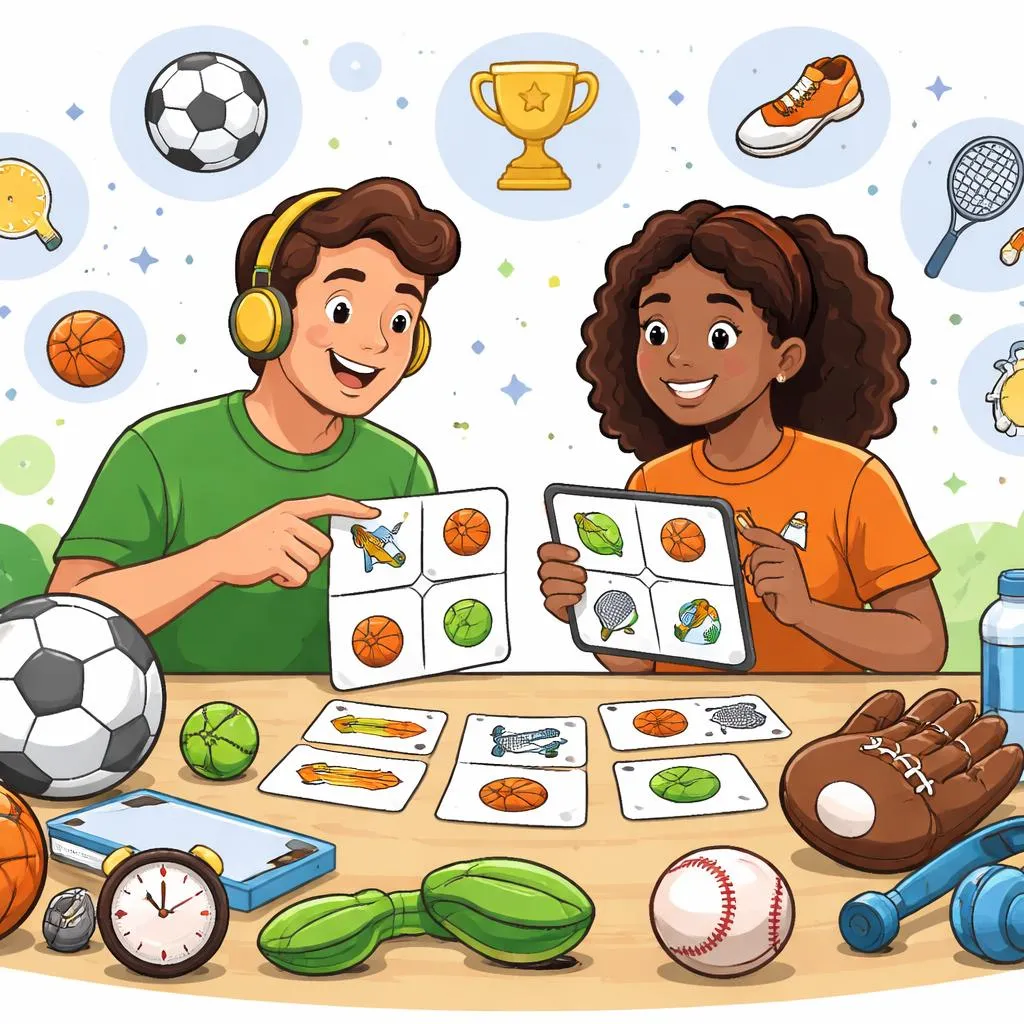

Hello, young athletes! Welcome to our special lesson today. We explore the world of games and competition. We learn a list sports vocabulary that helps us talk about our favorite activities.
Sports are activities people do for fun and exercise. Some sports use balls. Some use water or ice. Some use special equipment. Knowing the names helps us describe what we like to play and watch.
Let us put on our sports shoes. Let us get ready to learn. We will discover many different sports and how to talk about them in English.
What are Sports? Sports are physical activities that people do for enjoyment or competition. They often have rules. They sometimes have teams. People play sports to stay healthy and have fun.
Some sports are individual. One person plays alone. Swimming and running are individual sports. Some sports are team sports. Many people play together. Soccer and basketball are team sports.
Sports can happen in different places. Some are outdoors in the sun. Some are indoors in gyms. Some are on water. Some are on ice. Each sport has its own special place to play.
Learning the names of sports helps children talk about their interests. They can say "I like soccer" or "My brother plays tennis." These sentences are useful in daily conversation.
Meaning and Explanation When we talk about a list sports, we mean all the different names for physical activities. Each sport has its own name. Some names are easy like run. Some are harder like badminton.
Sports names are nouns. They name the activity. Soccer is a noun. Basketball is a noun. Swimming is a noun made from a verb.
Some sports use the verb play. Play soccer, play tennis, play basketball. Some sports use the verb go. Go swimming, go skiing, go fishing. Some sports use the verb do. Do yoga, do gymnastics, do karate.
Knowing which verb to use is important. English speakers say play soccer, not do soccer. They say go swimming, not play swimming. Learning these patterns helps sound natural.
Categories or Lists Let us look at a list sports organized by category. This makes them easier to remember.
Ball Sports These sports use a ball of some kind. Soccer - played with feet Basketball - thrown through a hoop Tennis - hit with rackets Baseball - hit with a bat Volleyball - hit over a net Golf - hit into holes Football - thrown and carried Table tennis - played on a table Handball - thrown with hands Rugby - carried and passed
Water Sports These sports happen in or on water. Swimming - moving through water Diving - jumping into water Surfing - riding waves Water polo - ball game in water Rowing - boats with oars Sailing - boats with sails Kayaking - small boats Fishing - catching fish
Winter Sports These sports need snow or ice. Skiing - sliding on snow Snowboarding - one board on snow Ice skating - blades on ice Ice hockey - game on ice with sticks Figure skating - dancing on ice Bobsled - racing in a sled Curling - sliding stones on ice
Athletics Sports These are running, jumping, and throwing events. Running - moving fast Jumping - leaping into air Long jump - jumping far High jump - jumping high Throwing - throwing objects Javelin - throwing a spear Discus - throwing a plate Shot put - throwing a heavy ball
Gymnastics and Dance These sports need flexibility and grace. Gymnastics - flips and balances Dance - moving to music Ballet - formal dance Cheerleading - cheers and stunts
Martial Arts These are fighting sports from different cultures. Karate - from Japan Judo - throwing sport Taekwondo - from Korea Kung fu - from China Boxing - fighting with gloves Wrestling - grappling sport
Racket Sports These use rackets to hit something. Tennis - most common Badminton - uses a shuttlecock Squash - played in a court Racquetball - similar to squash
Target Sports These aim at something. Archery - shooting arrows Shooting - shooting guns Bowling - rolling a ball at pins
Extreme Sports These are exciting and sometimes dangerous. Skateboarding - on a board with wheels BMX - bicycle stunts Rock climbing - climbing walls Parkour - running and jumping over obstacles
Equestrian Sports These involve horses. Horse riding - sitting on a horse Show jumping - jumping over fences Dressage - horse dancing
Daily Life Examples Let us see how a list sports appears in daily life. These examples show real conversations.
On Monday, a child says "I play soccer after school." They use play because soccer is a ball sport.
On Tuesday, a family goes to the pool. "We go swimming on Tuesday evenings." They use go because swimming ends in -ing.
On Wednesday, someone watches television. "My favorite sport is basketball. I watch it every week." They use is to name the sport.
On Thursday, a friend asks "Do you do karate?" They use do because karate is a martial art.
On Friday, children discuss weekend plans. "Let's play tennis on Saturday." "I want to go fishing with my dad."
On Saturday, a grandparent says "I did gymnastics when I was young." They use did in the past tense.
On Sunday, a family watches winter sports on TV. "Look at the skiers! They go so fast." "I want to try snowboarding someday."
Printable Flashcards Flashcards are a wonderful way to learn a list sports. Here are ideas for making them.
Make a card for each sport. On one side, write the name. Soccer, basketball, swimming, tennis, skiing.
On the other side, draw a simple picture. For soccer, draw a ball. For swimming, draw a person in water. For skiing, draw a person on skis.
Make another set of cards with the verbs. Play, go, do. Practice matching each sport to the correct verb. Soccer goes with play. Swimming goes with go. Karate goes with do.
Make cards with equipment. Ball, racket, bat, skis, board, net. Match equipment to sports. Ball goes with many sports. Racket goes with tennis. Skis go with skiing.
Use these cards for practice. Look at the picture and say the sport name. Look at the word and imagine the sport. Practice until you know them all.
Learning Activities or Games Let us play some games to learn a list sports. These activities make vocabulary stick in memory.
Activity 1: Sports Charades Act out a sport without speaking. Pretend to swing a tennis racket. Pretend to kick a soccer ball. Pretend to swim. Others guess the sport name. This builds vocabulary and movement skills.
Activity 2: Sports Bingo Make bingo cards with pictures of different sports. Call out the sport names. Players cover the matching picture. The first to cover a row shouts "Sports!" This builds listening and recognition.
Activity 3: Verb Sort Game Make three signs. Play, Go, Do. Give children sport cards. They place each card under the correct verb. Soccer under Play. Swimming under Go. Karate under Do. This teaches which verb to use.
Activity 4: Sports Equipment Match Gather pictures of sports equipment. A ball, a racket, a bat, skis, a net. Also have pictures of sports. Children match each piece of equipment to the sport that uses it.
Activity 5: Favorite Sport Graph Ask each child their favorite sport. Make a graph showing the results. Count how many like soccer, how many like swimming, etc. This combines math with vocabulary.
Activity 6: Sports Interview Children interview each other using sports questions. What is your favorite sport? Do you play any sports? Can you swim? They record answers and share with the class.
Activity 7: Sports Drawing Give each child paper and crayons. They draw themselves playing their favorite sport. Then they present to the class. "I like soccer. I am kicking the ball." This builds speaking skills.
Activity 8: Sports Memory Game Make pairs of cards with sport pictures. Lay them face down. Players take turns flipping two cards. If they match, they keep the pair and say the sport name. If not, they flip them back.
Activity 9: Sports Word Search Create a word search with sport names hidden in a grid. Children find and circle the words. This builds reading and spelling skills.
Activity 10: Sports Pictionary One child draws a sport on the board. Others guess what it is. The drawer cannot speak or write words. This builds creativity and vocabulary.
Activity 11: Sports Song Sing a simple song about sports to a familiar tune. "Soccer, basketball, tennis too. Swimming, running, what do you do? Baseball, volleyball, skiing fun. Sports are great for everyone!" Repetition helps memory.
Activity 12: Sports Categories Game Call out a category like "water sports" or "ball sports." Children take turns naming a sport in that category. See how many they can list. This builds category knowledge.
Activity 13: Sports Story Time Write a short story together about a sports day. Use as many sport names as possible. "First we played soccer. Then we went swimming. Later we watched tennis." This builds narrative skills.
Activity 14: Sports Dice Game Make a dice with different sports on each side. Roll the dice. Whatever sport comes up, children must say a sentence about it. "I can play soccer." "I like swimming." This builds sentence skills.
Activity 15: Sports Scavenger Hunt Hide pictures of sports around the room. Children search for them. When they find one, they must say the sport name and one fact about it before collecting it.
Activity 16: Sports Concentration Place sport cards face down in a grid. Players take turns flipping two cards. If they show the same sport, they keep the pair. This builds memory and vocabulary.
Activity 17: Sports Bingo with Verbs Make bingo cards with sport pictures. Call out sentences using the correct verb. "We play this sport with a round ball." Players cover soccer. "You go to a pool to do this." Players cover swimming.
Activity 18: Sports Alphabet Game Go through the alphabet and name a sport for each letter. A is for archery. B is for basketball. C is for cricket. See how many letters the class can complete.
Activity 19: Sports Commercial Children create a short commercial for their favorite sport. They explain why people should play it. "Try soccer! It is fun. You run and kick. You play with friends." This builds persuasive language.
Activity 20: Sports Day Event Organize a classroom sports day. Set up simple stations for different sports. A soccer kicking station, a basketball shooting station, a running race. Use the sport names throughout the event.
Learning a list sports gives children words they can use every day. Sports are a common topic in conversations. Children talk about what they play and what they watch.
Knowing which verb goes with each sport makes speaking more accurate. Play for ball sports, go for -ing activities, do for martial arts and exercise. These patterns help sound like a native speaker.
Every sport has its own name, equipment, and rules. Learning them opens up conversations with other sports fans. Children can talk about their favorite teams and players.
Keep playing and learning about sports. Keep practicing the names and verbs. Sports vocabulary will become a natural part of English conversations.
Happy playing and learning, everyone