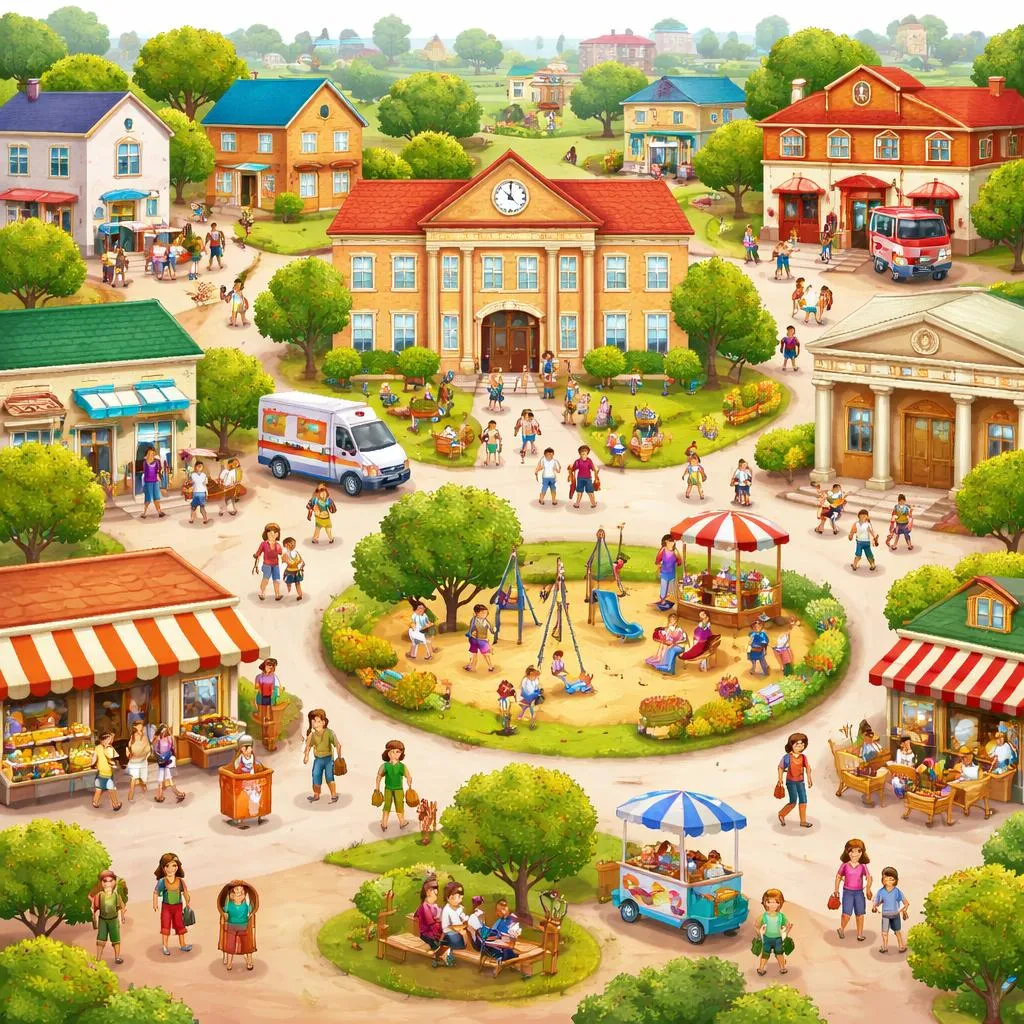

What is the Concept? Let's explore the concept of places in a town. This refers to the various buildings, locations, and public spaces that we find in most towns and cities. Learning these names helps children understand their community and how to describe where they go and what they do. It connects language directly to the real world they see every day.
Understanding places in a town is about more than just vocabulary. It builds functional language skills for giving directions, discussing errands, and sharing experiences. From the library to the post office, each place has a purpose. Learning these terms empowers children to navigate and talk about their environment with confidence.
Meaning and Explanation Each of the places in a town has a specific function and name. The meaning comes from what we do there. A school is a place for learning. A supermarket is a place to buy food. A park is a place to play and relax. These are not just buildings; they are locations tied to common activities and needs.
Learning this vocabulary involves connecting the word, the building's appearance, and its purpose. For example, a fire station is often a red building with big doors for fire trucks, and its purpose is to help in emergencies. This three-way connection (word, picture, use) makes the vocabulary meaningful and memorable.
Categories or Lists We can group places in a town into helpful categories. This makes the long list easier to learn.
Service Places: Post office, bank, library, hospital, police station.
Shopping Places: Supermarket, bakery, toy store, clothes shop.
Fun & Leisure Places: Park, playground, cinema, swimming pool, restaurant.
Transport Places: Bus station, train station, airport (for bigger towns).
Work & Learning Places: School, office buildings, factory.
Learning them by category helps organize the information in our minds, much like organizing a town into different districts.
Daily Life Examples We use the names of places in a town all the time in daily conversation. We can point them out on walks or drives: "Look, there's the library. We go there to borrow books." We discuss weekly plans: "Today, we need to go to the supermarket and the post office."
We connect them to verbs: "We read at the library." "We buy food at the supermarket." "We play at the park." We also use prepositions: "The bank is next to the bakery." "The park is behind the school." These real-life sentences show how the vocabulary is used in context.
Printable Flashcards Great printable flashcards for places in a town should have a clear, colorful picture on one side and the word on the other. For more advanced practice, the back of the card can include a simple sentence: "This is the post office. We send letters here."
Another useful printable is a "Town Map Coloring Sheet." It shows a simple street grid with outlines of buildings. Children can color them and label each one: hospital, school, park. They can then use the map to give simple directions: "Go from the school to the park." This turns vocabulary into an interactive activity.
Learning Activities and Games A wonderful activity is "Build a Model Town." Using blocks, cardboard boxes, or drawings, children work together to create a town. They must label each building they create. This project combines creativity, teamwork, and vocabulary application in a hands-on way.
Play "I Spy, Town Version." Say, "I spy with my little eye... a place where we buy bread." The child must guess "the bakery!" Then, they take a turn. This game practices listening comprehension and vocabulary recall in a fun, familiar format.
Another engaging game is "Town Bingo." Create Bingo cards with pictures of different places in a town (a park, a hospital, a school). Call out the names or give clues ("This is where a doctor works"). Players cover the correct picture. This is excellent for group recognition practice.
Mastering the names of places in a town gives children the words to describe their world and their experiences. It moves language learning out of the abstract and into the community they live in. By using maps, games, and daily conversations, this vocabulary becomes a practical, usable tool. It fosters independence, curiosity, and the ability to share stories about where they have been and what they have seen, building both language skills and community awareness.