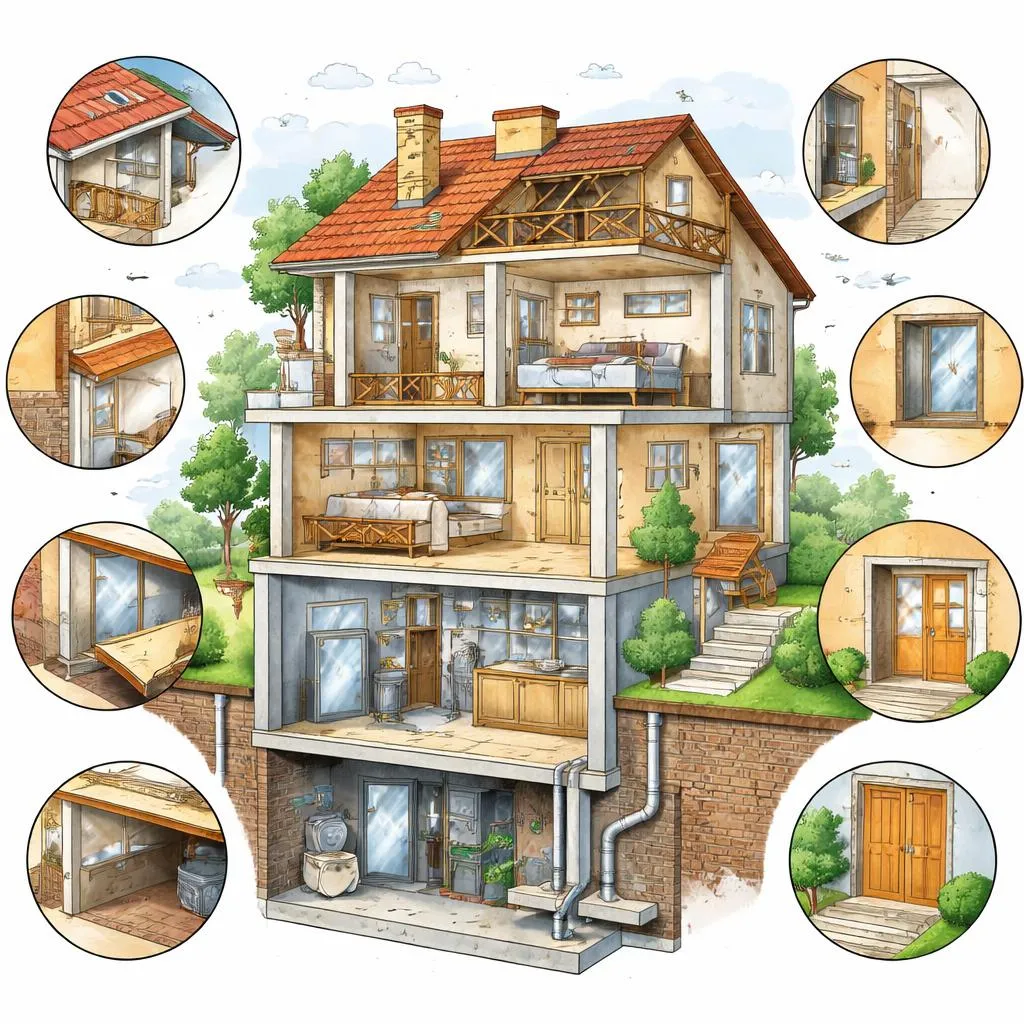

Hello, young architects! Welcome to our special lesson today. We look at the world around us. We explore the parts of a building. Every building has many parts with special names.
Buildings are everywhere. Houses, schools, shops, and offices are all buildings. They keep us safe from weather. They give us places to live, learn, and work.
Let us put on our hard hats. Let us walk around and explore. We will learn the names of every part of a building. By the end, describing buildings in English will feel natural.
What is a Building? A building is a structure with walls and a roof. People build them to live or work inside. Buildings can be small like a house. They can be very tall like a skyscraper.
Every building has basic parts that make it work. It needs a foundation to stay on the ground. It needs walls to hold up the roof. It needs doors and windows to let people in and out.
Buildings can be made of different materials. Wood, brick, stone, concrete, and glass are common. The materials depend on what the building is for and where it is built.
Learning the names of building parts helps children describe where they are. They can say "I am near the door" or "The window is open." These sentences are useful every day.
Meaning and Explanation When we talk about parts of a building, we mean all the different sections and features. Some parts are outside. Some parts are inside. Each part has a job.
The outside parts protect the building from weather. The roof keeps rain out. The walls hold everything up. The windows let in light. The doors let people enter.
The inside parts make the building useful. Rooms are spaces for different activities. Hallways connect rooms. Stairs let people go up and down. Floors are what people walk on.
Knowing these names helps children understand their environment. They learn to notice details about buildings they see every day. They can talk about their school, home, or other places.
Categories or Lists Let us look at the different parts of a building by category. We will start with the outside parts.
Outside Parts Foundation - the bottom part in the ground Walls - the vertical sides that hold up the roof Roof - the top covering that keeps rain out Chimney - the tall pipe that lets smoke out Windows - openings with glass to see through Doors - openings that let people enter Steps - stairs outside the building Porch - a covered area at the entrance Balcony - a platform on an upper floor Gutter - the channel that carries rainwater Downspout - the pipe that takes water down Siding - the outside covering of walls Brick - rectangular blocks used in walls Stone - natural rock used in building
Inside Parts Floor - the surface people walk on Ceiling - the top surface of a room Wall - the vertical surface between rooms Room - a space separated by walls Hallway - a passage connecting rooms Stairs - steps going up and down Staircase - the whole stair structure Railing - the handrail on stairs Door - opening between rooms Window - opening to outside in a wall Closet - a small storage space Cabinet - storage with shelves and doors Counter - a flat surface in kitchens Sink - basin with water for washing
Structural Parts Beam - a horizontal support Column - a vertical support pillar Joist - small beams that hold up floors Truss - a frame that supports the roof Foundation - the base in the ground Slab - a flat concrete floor on ground
Utility Parts Pipe - carries water through building Wire - carries electricity through building Outlet - place to plug in electricity Switch - turns lights on and off Radiator - heats the room Vent - opening for air to flow Duct - tube that carries air Furnace - heats the building
Roof Parts Rafter - sloping beam that holds roof Shingle - small piece that covers roof Flashing - metal that prevents leaks Skylight - window in the roof Gable - triangle part of roof at ends Eave - edge of roof that hangs over
Entry Parts Door frame - the structure around a door Door knob - handle to open door Door step - step outside the door Door mat - mat to wipe feet on Mail slot - opening for letters
Daily Life Examples Let us see how the parts of a building appear in daily life. These examples show real moments.
In the morning, someone walks out the door. They step on the front steps. They look up at the roof and chimney. They see the sun shining on the windows.
At school, children enter through the main door. They walk down the hallway. They go up the stairs to their classroom. They sit at their desks near the window.
At home, a family eats dinner in the dining room. Food comes from the kitchen through a door. They look out the window at the yard. After dinner, someone goes to the bathroom.
When it rains, water runs into the gutters. It goes down the downspouts. It flows away from the foundation. The roof keeps everything dry inside.
At night, people turn on lights using switches. They plug devices into outlets. They close the windows and lock the doors. The building keeps them safe and warm.
Printable Flashcards Flashcards are a wonderful way to learn the parts of a building. Here are ideas for making them.
Make a card for each building part. On one side, write the name. Roof, window, door, wall, floor, stairs, chimney.
On the other side, draw a simple picture. For roof, draw a triangle on top of a square. For window, draw a square with lines. For door, draw a rectangle with a circle for a knob.
Make another set of cards with categories. Outside, inside, structure, utility. Children sort the part cards into the correct category.
Make cards with materials. Brick, wood, glass, stone, concrete. Match materials to parts. Glass goes with window. Brick goes with wall. Wood goes with door.
Use these cards for practice. Look at the picture and say the part name. Look at the word and imagine what it looks like. Practice until you know them all.
Learning Activities or Games Let us play some games to learn the parts of a building. These activities make vocabulary stick in memory.
Activity 1: Build a Paper Building Give children large paper and crayons. They draw a building. They label all the parts they know. Roof, walls, door, windows, chimney. This combines art with vocabulary.
Activity 2: Building Scavenger Hunt Walk around the school or neighborhood. Look for building parts. Point to roofs, doors, windows, chimneys, gutters. Say each name when found. This connects words to real things.
Activity 3: Block Building Use building blocks to construct a building. As children build, name each part. "Now we are making the walls. Here is the door. Let's add a roof." This builds vocabulary through hands-on play.
Activity 4: Part Matching Game Make cards with pictures of building parts. Make another set with the names. Children match each picture to the correct word. This builds reading and recognition skills.
Activity 5: Where Am I? Game Describe a part without saying its name. "I am on top of the building. I keep rain out. What am I?" Children guess roof. "I let people enter. I have a knob. What am I?" Children guess door.
Activity 6: Building Bingo Make bingo cards with pictures of building parts. Call out the names. Players cover the matching picture. The first to cover a row shouts "Building!" This builds listening skills.
Activity 7: Part Sorting Game Make three signs. Outside, Inside, Structure. Give children cards with building parts. They sort each card into the correct category. Window is outside and inside? Discuss where each part belongs.
Activity 8: Drawing Dictation Give directions for drawing a building. "Draw a rectangle for the building. Add a triangle roof on top. Draw a door in the middle. Add two windows on each side." Children follow directions and compare drawings.
Activity 9: Building Memory Game Make pairs of cards with building part pictures. Lay them face down. Players take turns flipping two cards. If they match, they keep the pair and say the part name. If not, they flip them back.
Activity 10: Part Hunt at Home Children go home and look for building parts. They count how many windows, doors, rooms. They come back and share. "My house has three bedrooms and one bathroom." This connects learning to home.
Activity 11: Building Song Sing a simple song about building parts to a familiar tune. "The roof is on top, on top, on top. The roof is on top of the building. The walls go all around, around, around. The walls go all around the building." Add verses for each part.
Activity 12: Part Pictionary One child draws a building part on the board. Others guess what it is. The drawer cannot speak or write words. This builds creativity and vocabulary.
Activity 13: Building Story Time Write a short story together about a building. "Once upon a time, there was a house. It had a red roof and blue door. The windows were big. Smoke came from the chimney." Use as many part names as possible.
Activity 14: Label the Building Print a simple picture of a building with blank lines pointing to parts. Children write the correct part name on each line. This builds spelling and recognition.
Activity 15: Building Charades Act out being a part of a building. Stand straight like a wall. Reach up like a roof. Knock like a door. Open arms like windows. Others guess which part you are.
Activity 16: Part Concentration Place part cards face down in a grid. Players take turns flipping two cards. If they show the same part, they keep the pair. This builds memory and vocabulary.
Activity 17: Building Materials Match Make cards with materials and cards with parts. Children match which materials are used for which parts. Brick for walls. Glass for windows. Wood for doors. This builds knowledge about construction.
Activity 18: Part I Spy Play I Spy using building parts. "I spy with my little eye, something that lets in light." Children guess window. "I spy something you walk on." Children guess floor. This builds observation skills.
Activity 19: Building Puzzle Draw a building on cardboard and cut it into puzzle pieces along part lines. A piece for the roof, a piece for the door, pieces for windows. Children put the puzzle together and name each part.
Activity 20: Part Questionnaire Children answer questions about their own home. How many doors in your house? What color is your front door? Do you have a chimney? Do you have stairs? Share answers with the class.
Learning the parts of a building gives children words they use every day. They see these parts everywhere. At home, at school, at the store, at friends' houses. Knowing the names helps them describe their world.
Every building has similar parts even if they look different. A school has doors like a house. A store has windows like a library. The same words work for all buildings.
Keep looking at buildings with new eyes. Notice the roof, the walls, the doors, the windows. Name them in English whenever you see them. Building vocabulary will become a natural part of conversations.
Happy building and learning, everyone