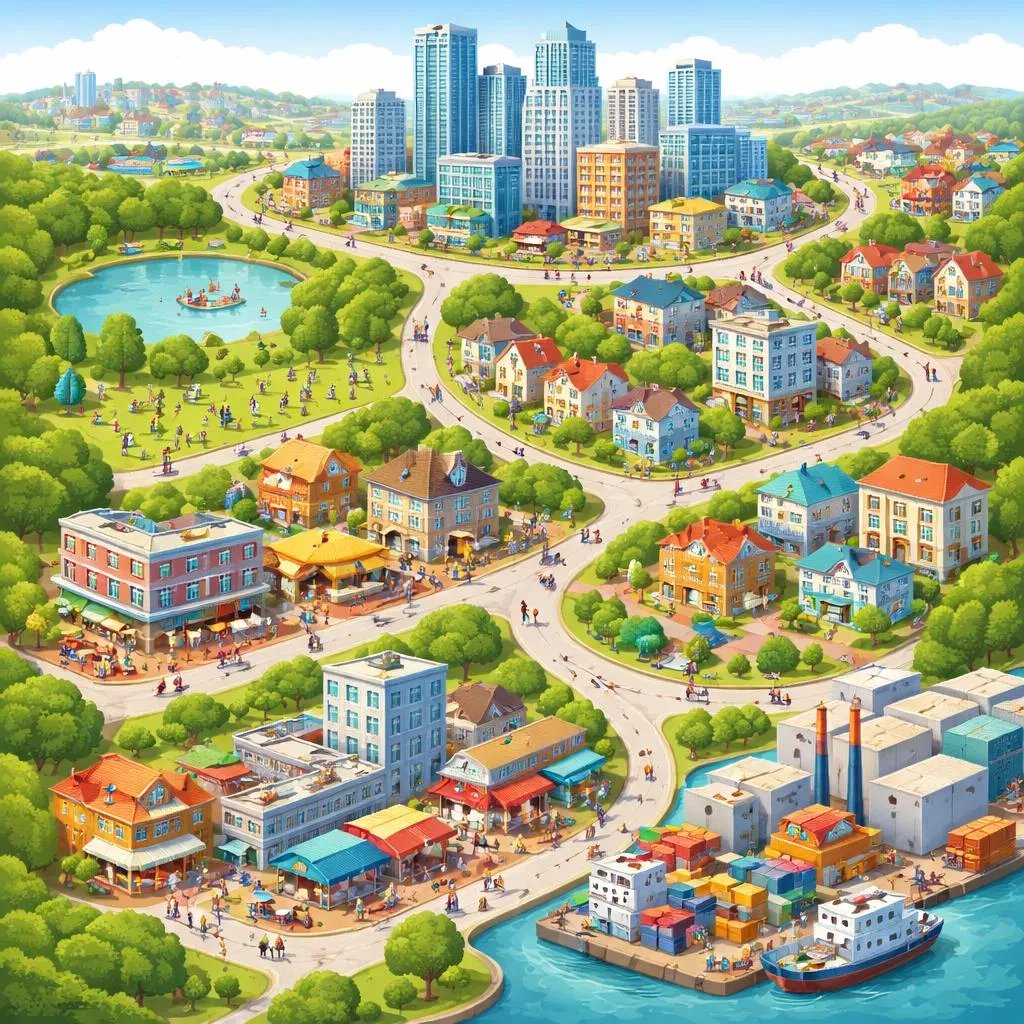

Hello, young explorers! Welcome to our English learning classroom. Today, we are going on a special adventure. We will walk through the different parts of the city.
A city is a big, exciting place to live and visit. It has many sections. Each section has its own purpose and its own special buildings. Let’s put on our walking shoes and learn the names for these places in English.
What is a City? A city is a very large town. Many, many people live there. It is a busy place with lots of buildings, streets, and cars.
We can think of a city like a big puzzle. Each piece of the puzzle is a different part. When we put all the parts together, we get the whole city. Some parts are for living. Some parts are for working. Some parts are for having fun.
Learning the names of these parts helps us give directions. It helps us understand stories. It also helps us talk about our own town.
Meaning and Explanation of City Parts When we say parts of the city, we mean the different areas or zones. Each area has a main job. For example, one area might be full of shops. Another area might be full of houses.
Think about your own town. Do you have a place with many big stores? That is a shopping district. Do you have a place with tall office buildings? That is the business district.
By learning these words, you can describe any city in the world. You can tell a friend, "I live in a quiet part," or "I like the busy part with all the restaurants."
Categories or Lists of City Parts Let’s look at the most common parts of the city. We can put them into groups to make them easier to remember.
Residential Areas (Where People Live) This is the quiet part of the city. There are many houses and apartment buildings. You might see parks here for children to play.
Neighborhood: A small community inside a city.
Suburb: The area on the edge of a city where many families live.
Commercial Areas (Where People Shop) This part of the city is for buying things and for business.
Downtown: The central or main part of a city. It is often very busy.
Shopping District: An area with many stores, shops, and malls.
Market: An open space where people sell fresh food and other goods.
Cultural and Entertainment Areas (Where People Have Fun) This is the exciting part of the city. We go here to relax and have a good time.
Theater District: An area with many theaters for plays and shows.
Old Town: The historic part of the city with old buildings and streets.
Waterfront: The part of the city next to a river, lake, or ocean.
Institutional Areas (Important Public Places) These are important buildings that help the city run.
Financial District: The part with many banks and big companies.
University District: An area with a college or university and student housing.
Daily Life Examples Let’s see how we use these parts of the city in our daily lives. Imagine a family on a Saturday.
In the morning, the family is in the residential area. They eat breakfast at home in their house. The street is quiet.
At noon, they go to the commercial area. They go to the shopping district to buy new shoes. The streets are crowded with people.
In the afternoon, they visit the cultural area. They go to the old town to see the famous church. They take many photos.
In the evening, they go to the entertainment area. They eat dinner at a restaurant near the waterfront. They watch the boats on the water.
See how they moved through different parts of the city? Each part has a different feeling.
Printable Flashcards Flashcards are a great way to remember new words. For this topic, you can make cards with the name of the city part on one side and a picture on the other.
Here are some ideas for your flashcards:
Neighborhood: Draw a picture of houses on a quiet street.
Downtown: Draw tall skyscrapers and many cars.
Market: Draw a stall with fruits and vegetables.
Park: Draw trees, grass, and a playground.
Airport: Draw a big airplane.
Hospital: Draw a building with a red cross.
You can use these cards to play a matching game with a friend. Hold up the picture, and your friend must say the name of the city part.
Learning Activities or Games Let’s play some games to practice talking about the parts of the city.
Activity 1: City Map Maker Get a big piece of paper and some crayons. Draw your own imaginary city. First, decide where the different parts will go. Where is the residential area with the houses? Draw it in one corner. Where is the downtown with all the skyscrapers? Draw it in the middle. Where is the park? Draw it next to the residential area. Don't forget to add roads to connect all the parts. When you finish, show your map to a friend or family member. Point to each part and say its name in English.
Activity 2: I Spy in the City If you are in a car or on a bus, play "I Spy" with a parent. You can say, "I spy with my little eye, something in the commercial part of the city." Your parent can guess, "Is it a store? Is it a restaurant?" You can also play with a book or a magazine. Find a picture of a busy city scene. Take turns pointing to different places and naming the city part they belong to.
Activity 3: Build a City with Blocks If you have building blocks or LEGOs, build a city on the floor. Build a row of small houses for the residential area. Build a group of tall towers for the downtown. Build a small park with green blocks. As you build, talk about what you are making. Say, "Now I am building the school. It is in the institutional area."
Great job today, everyone! You learned that a city is made of many different parts. Each part has special buildings and a special job.
Next time you go to a city, look around. Can you tell which part you are in? Are you in a busy commercial area or a quiet residential area? Keep exploring and using these new words. See you in our next English lesson