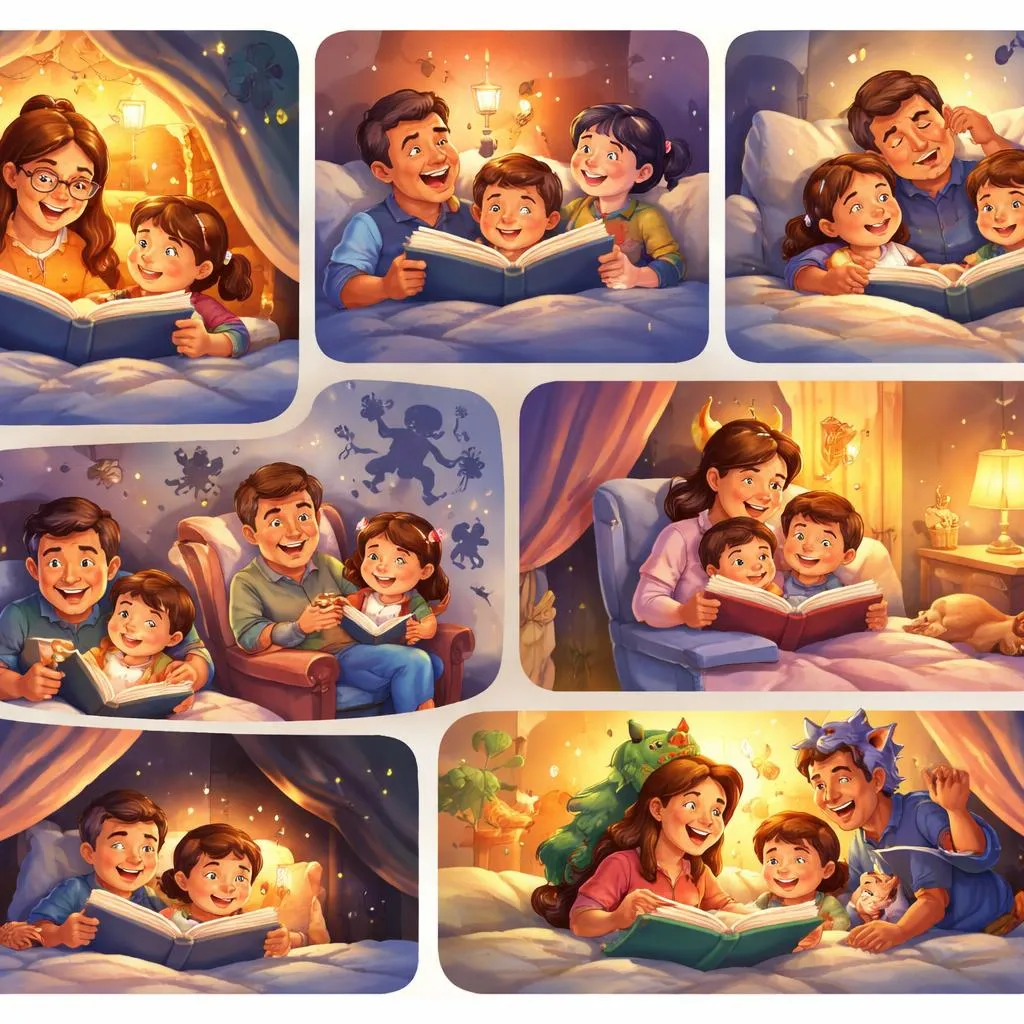

The ritual of a bedtime story is about more than the words. It’s about the shared quiet, the tone of voice, the little quirks that make it uniquely yours. The ways how bedtime stories are read tell their own story—a story of love, comfort, and sometimes, hilarious chaos. Sometimes it’s silly, sometimes it’s sleepy, but it’s always special. These are tales about the telling itself. They’re funny bedtime stories about the people (and things!) that read them. Here are three stories that celebrate the different, wonderful, and funny ways how bedtime stories are read, and the quiet magic that always follows.
Story One: The Dad Who Did Too Many Voices
Leo’s dad believed a story wasn’t just read; it was performed. He didn’t just have different voices for different characters. He had different voices for the wind, the trees, and sometimes the furniture. When it was time for a bedtime story, Leo knew he was in for a show.
Tonight’s book was about a knight. “The brave Sir Gallant rode his steed across the gloomy moors,” Dad read in his deep, heroic narrator voice. Then, for the knight, he used a brave, clear tone. “I shall find the dragon!” For the dragon, his voice became a low, rumbling growl that seemed to vibrate Leo’s bed. “Who dares enter my cave?”
It was fantastic. But Dad didn’t stop there. For the knight’s horse, he made clopping sounds with his tongue. Clop-clop-clop. For the creaky castle door, he did a long, slow Eeeeeee-rrrrk. For the knight’s sword being drawn, it was a sharp Shhhhing! Leo laughed and cheered. It was the best action movie ever, happening right in his room.
But as the story went on, something happened. Dad’s voice, from all the growling and squeaking and clopping, started to get tired. The dragon’s roar became a froggy croak. The knight’s brave shout became a whisper. “I shall… ahem… find the… dragon,” Dad rasped.
By the time the knight defeated the dragon (with a final, weak “Take that…”), Dad’s voice was almost gone. He could only read the last few pages in a soft, hoarse whisper. “And they all lived… happily ever… after,” he whispered, his voice like dry leaves.
The funny thing was, that whisper was the most soothing sound Leo had ever heard. The loud, exciting show had wound down into a gentle, raspy lullaby. The room, which had been full of roaring dragons and clacking horses, was now perfectly, deeply quiet. Leo’s own breathing slowed to match Dad’s soft, tired breaths. The exciting adventure was over. Now it was time for the quiet part. This, Leo thought as he drifted off, was his favorite part of how bedtime stories are read by Dad—a big, happy noise that always ended in the softest, sleepiest whisper in the world.
Story Two: The Tablet That Got the Hiccups
Maya’s mom was out, so Dad said they could use a story app. They chose a story about a lonely robot. The app had a nice, calm narrator’s voice. It was going smoothly. The robot was exploring a forest of metal trees. Then, Dad’s tablet did an update. In the middle of the story.
The narrator’s voice suddenly sped up, like a chipmunk. “And-the-robot-saw-a-shiny-flower-it-made-a-beeping-sound!” it squeaked at triple speed. “Whoa!” Maya said, sitting up. Dad fumbled with the tablet. He tapped the screen. The story stopped. Then it jumped back 30 seconds. The narrator’s voice returned, but now it had a deep, slow, robotic echo. “A n d. T h e. R o b o t. S a w…”
It was like the story was being told by a giant, sleepy robot with a cold. Dad tried to fix it. He tapped again. This time, the audio glitched on one word. “Saw… saw… saw… saw…” it stuttered, like a skipping record. Maya started to giggle. The lonely robot’s story had become the funniest thing she’d ever heard. Dad gave up and let it play. The glitchy, stuttering, speed-changing narrator finished the tale. The robot found a friend, and the last line, “And he was never alone again,” came out in a high-pitched squeak followed by a deep boom.
Maya was laughing so hard she had tears in her eyes. It wasn’t the calm story Mom would read. It was a crazy, technological comedy. Dad was laughing too. “Well, that was different,” he said, closing the app. The screen went dark. The laughter faded into happy, tired sighs. The room was quiet again, but it was a warm, happy quiet. Maya snuggled down. The story of how bedtime stories are read tonight was about a broken tablet, and it was perfect. The glitches and giggles had melted all the fidgets away. She closed her eyes, a smile still on her face, and let the quiet of the now-silent tablet wrap around her. The lonely robot was fine, and so was she.
Story Three: The Little Brother Who “Read” the Pictures
Sam was only three. He couldn’t read the words yet. But when his big sister, Chloe, was too busy, Sam would “read” his own bedtime story. He’d take a wordless picture book about a bear and make up the story himself. This was Sam’s way of how bedtime stories are read.
Chloe listened from her bed. Sam’s version was always unique. “Once a time,” Sam would say, pointing to the first picture. “This bear… he has a big hat. No, it’s a flower. He eats the flower. Yum.” Chloe would smile in the dark. The bear was actually looking for honey. “He walks and walks,” Sam continued, turning pages. “He sees a… a big chicken in the tree!” (It was an owl). “The chicken says… ‘Hello, Mr. Bear. Do you have a sandwich?’” The story would meander. The bear would meet a “swimming dog” (a fish) and a “rock with legs” (a turtle). There was no plot, just a series of friendly meetings and descriptions of what Sam saw. His little voice was slow and serious, pausing to think.
“Then the bear… he goes home. He has a… a cookie. The end.” Sam would close the book with a soft thump. He’d lie down, his storytelling duty complete. Chloe would listen to his breathing become slow and even. His made-up, nonsensical tale was the most calming thing she’d ever heard. It was pure, simple imagination, with no rules. It didn’t have to make sense. It just had to be, from his mind to the quiet room.
Chloe realized that this was a beautiful way how bedtime stories are read. It wasn’t about the words on the page. It was about the quiet voice in the dark, making sense of the world one silly, sleepy picture at a time. The house was still. The little reader and his listener both drifted to sleep, one with a head full of bear-shaped dreams, the other with a heart full of love for the little storyteller in the next bed.
These tales show the beautiful truth of the ritual. The ways how bedtime stories are read are as important as the stories themselves. It’s in Dad’s over-the-top performance that ends in a whisper. It’s in the glitchy tech that brings unexpected laughter. It’s in a little boy’s earnest, made-up narration. These are the unspoken chapters, the meta-stories of love and routine that happen around the printed words.
Reading together is a shared breath at the end of the day. It is a practice that says, “For these few minutes, the world is just us, this story, and the sound of my voice.” Whether the story is read by a parent, a tablet, or a preschooler, the act itself is the constant. It is the vessel that carries comfort, security, and the promise of sweet dreams. So tonight, as you share a story, remember that how bedtime stories are read is your family’s special signature. It’s a language of love, spoken in whispers, giggles, and the gentle turning of pages. Now, close the book, turn out the light, and let the quiet of the well-told tale settle over the room. Goodnight.