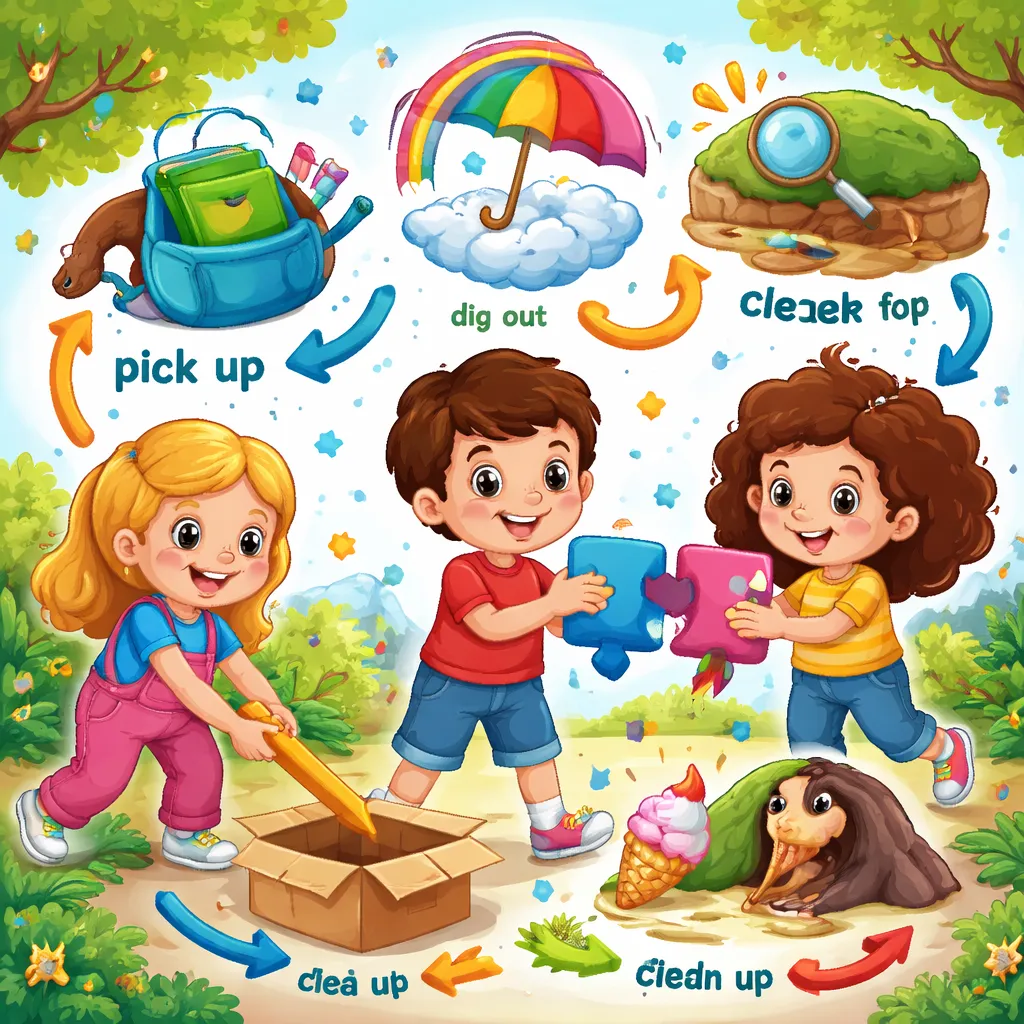

English is full of action teams! A verb teams up with a small word like 'up' or 'off' to make a new idea. We call these teams phrasal verbs. They are your "Everyday Action Teams." You use them all the time without knowing. Let's meet the most common and useful ones.
What Are These 'Everyday Action Teams'?
Phrasal verbs are two or three words that act as one verb. The meaning is often different from the original verb. They are very common in speaking. At home, you "wake up" in the morning. You "clean up" your room. At the playground, you "run around" with friends. You "give up" when you are tired. In school, you "hand in" homework. You "look up" a word in a dictionary. In nature, a bird "takes off" from a tree. Flowers "come out" in spring. These teams make your English sound natural and lively.
Why Are These Teams So Valuable?
Knowing common phrasal verbs makes you sound like a native speaker. It helps your ears, your voice, your reading eyes, and your writing hand.
First, it helps your listening. You watch a cartoon. A character says, "Hurry up!" You know it means "go faster." You catch the real meaning. Your mom might say, "Please turn down the TV." You know she wants the volume lower. You understand everyday requests and conversations easily.
Next, it makes your speaking casual and fluent. You can describe your day. "I woke up, got dressed, and went out." This sounds natural. You can give clear instructions. "Pick up your toys and put them away." Your words are clear and full of life. People understand you better.
Then, it gives you a reading superpower. You read a comic. It says, "The hero figured out the puzzle." You know 'figured out' means 'solved'. This helps you understand the story. You can read dialogue in books and understand the characters' real talk.
Finally, it makes your writing conversational and engaging. Your diary entries sound like you. Instead of writing "I returned the book," you can write "I took the book back." This uses a common phrasal verb. Your stories and dialogues become more realistic and fun to read.
Meet the Popular Action Teams
Let's group some of the most common phrasal verbs. We'll give each group a fun nickname.
First, the Morning Crew: WAKE UP, GET UP, GET DRESSED. These are for your morning routine. At home: "I wake up at 7 AM. I get up from bed. I get dressed for school."
Now, the Clean-Up Squad: CLEAN UP, TIDY UP, PUT AWAY. These are for organizing. At home: "Please clean up your room. Tidy up the table. Put your clothes away."
Next, the Switch Team: TURN ON, TURN OFF, PUT ON, TAKE OFF. These are for starting/stopping or wearing. At home: "Turn on the light. Turn off the computer." At the playground: "Put on your coat. Take off your muddy shoes."
Then, the Find-Out Friends: FIND OUT, FIGURE OUT, LOOK UP. These are for discovering information. In school: "I need to find out the answer. Can you figure out this problem? Let's look up the word online."
Also, the Social Gang: HANG OUT, GET ALONG WITH, CATCH UP WITH. These are for friendships. At the playground: "I hang out with my friends. I get along with my sister. Let's catch up after school."
Don't forget the Movement Mob: COME IN, GO OUT, COME BACK, GO AWAY. These are for moving. At home: "Come in! You can go out to play. Come back by 5 PM." In nature: "The squirrel came out of its hole."
And the School Helpers: HAND IN, HAND OUT, WRITE DOWN, CROSS OUT. In school: "Hand in your test. The teacher will hand out papers. Write down the notes. Cross out the wrong answer."
Remember, some of these teams are separable. You can say "turn the light on" or "turn on the light." But with pronouns, say "turn it on."
Your Detective Tool: How to Spot Them
Finding phrasal verbs is easy. Listen for a verb and a little word like 'up', 'down', 'in', 'out', 'on', 'off', 'away' right after it. Together, they make a new idea. Ask yourself: "Do these words together mean something different than the verb alone?" For example, 'look' is to see. 'Look up' is to search. That's a phrasal verb!
How to Use Your Action Teams Correctly
Using them is about practice. Listen to how people use them. Try to use one new phrasal verb each day. Remember, if the team is separable (like 'turn on'), you can put the object in the middle. But if the object is a pronoun (it, them), it must go in the middle: "Turn it on." If you are unsure, put the object at the end. "Please pick up the book" is always correct.
Oops! Let's Fix Common Mistakes
Everyone mixes them up. Let's fix common errors. One mistake is using the wrong small word. A child might say, "I get on the bus" (correct) but then say "I get down the bus" (wrong). The correct way is "I get off the bus."
Another mistake is translating directly. In some languages, you "open the light." In English, we say "turn on the light."
A third mistake is forgetting that the meaning is different. 'Look for' means to search. 'Look after' means to take care of. Don't confuse them. "I am looking for my keys." "I look after my baby brother."
Are You Ready for an Action Team Challenge?
Test your skills. Describe your morning using three phrasal verbs. Now, think of a chore. Use two phrasal verbs to explain it. Imagine you are teaching a new student. Use phrasal verbs like 'hand in' and 'write down'. Finally, write a short story about a lost dog. Use at least five common phrasal verbs. Be creative!
You Are Now an Action Team Pro
You have learned about common phrasal verbs. You know they are Everyday Action Teams. You met the Morning Crew, Clean-Up Squad, Switch Team, and more. You have tips to use them. You can spot them in conversations. You can even fix common mistakes. Your English is now more natural and expressive.
You can learn many things from this article. You now know that phrasal verbs are common combinations of a verb and a small word that create a new meaning. You understand that they are used constantly in everyday English. You learned groups of common phrasal verbs related to daily routines, cleaning, switching things on/off, finding information, and socializing. You saw how to identify them and use them correctly in sentences. You also know to avoid common errors like using the wrong particle or translating directly from your first language.
Now, try using your new knowledge in real life. Here are two fun ideas. First, play the "Phrasal Verb of the Day" game. Each day, pick one common phrasal verb. Try to use it correctly at least three times that day. Second, be a "Phrasal Verb Detective" at home. Listen to your family talk. Write down three phrasal verbs you hear them use. Try to use them yourself. Share your detective list with your teacher. Have fun with your new word teams!