
Opening Introduction
Leo was cleaning his room. He found a shiny penny under his bed. "Look, Dad! A coin!" he said. His dad looked. "That's not just a coin. It has a special name. It's called a penny. And it's worth one cent. We have different coins and bills, each with its own name and value. Knowing the money coins and bills names in English is your first step to becoming a smart spender and saver. Ready to learn the names of your money?" Leo held the penny carefully. He wanted to know all the names. He wondered about the paper money in his dad's wallet too. Let's open the piggy bank of knowledge together.
Core Knowledge Explanation
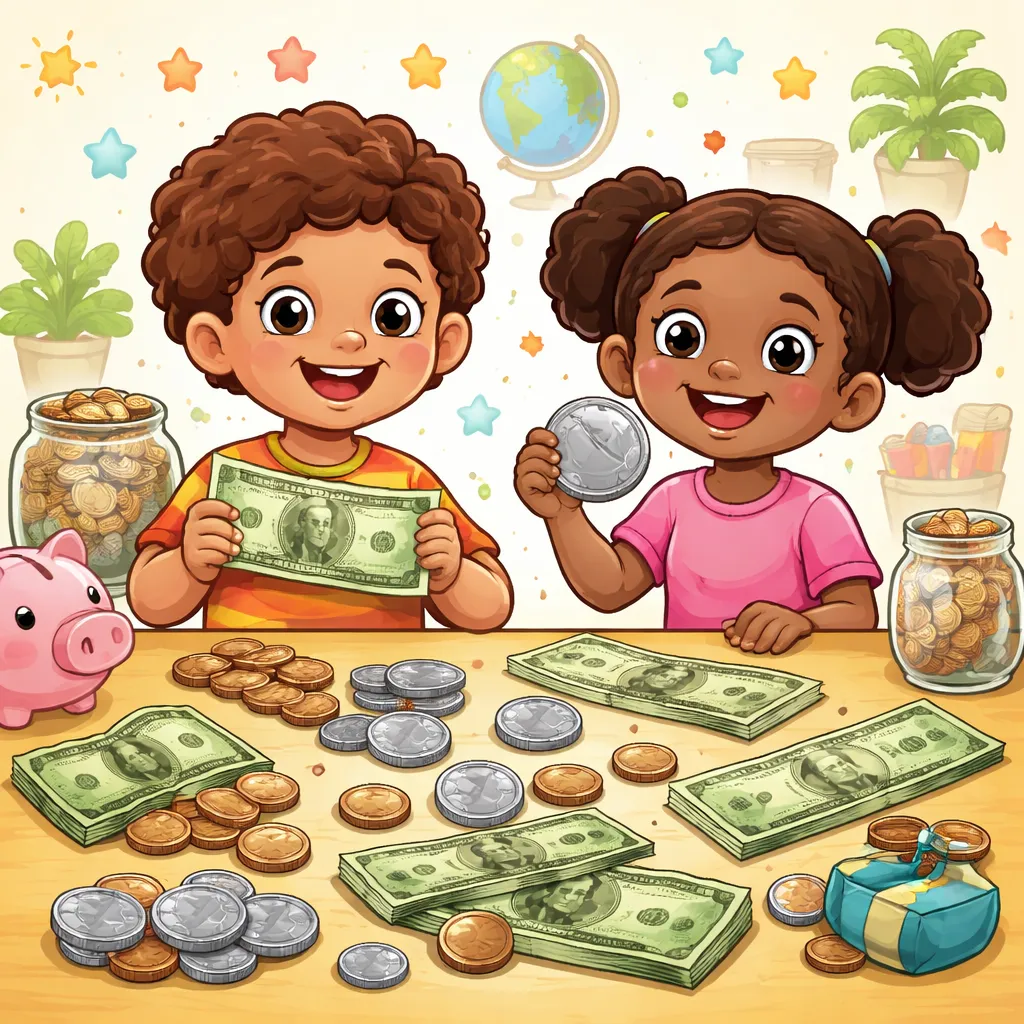
Money is what we use to buy things. In the United States, we use dollars and cents. The metal money is called coins. The paper money is called bills or notes. Learning the money coins and bills names in English is like learning the members of a money family. Let's start with the coins. Coins are worth cents. One hundred cents make one dollar. The smallest coin is the penny. A penny is brownish and has Abraham Lincoln on the front. It is worth one cent. We write 1⊿.
The next coin is the nickel. A nickel is silver and is bigger than a penny. It has Thomas Jefferson on the front. It is worth five cents. That is the same as five pennies. We write 5⊿. Then, we have the dime. The dime is the smallest silver coin. It has Franklin D. Roosevelt on the front. It is worth ten cents. That is the same as two nickels or ten pennies. We write 10⊿. The largest common coin is the quarter. A quarter is silver and has George Washington on the front. It is worth twenty-five cents. That is the same as two dimes and a nickel, or five nickels, or twenty-five pennies. We write 25⊿. Four quarters make one dollar. These are the main money coins and bills names in English for coins.
Now, let's talk about bills. Bills are paper money. They are worth dollars. The most common bill is the one-dollar bill. It is green and has George Washington on the front. We write 1. Then, the five-dollar bill. It has Abraham Lincoln on the front. We write 5. The ten-dollar bill has Alexander Hamilton on the front. We write 10. The twenty-dollar bill has Andrew Jackson on the front. We write 20. There are also fifty and one hundred dollar bills. You will see them less often. Bills have different colors and designs to help us tell them apart. Knowing the money coins and bills names in English helps you count your money and pay for things correctly.
Fun Interactive Learning
Let's play a sorting game. Ask a grown-up for a handful of mixed coins. Make sure they are clean. Now, sort them into piles. All the pennies together. All the nickels together. All the dimes together. All the quarters together. Say their names as you sort. "This is a penny. This is a nickel." Count how many of each you have. This is a great way to learn the money coins and bills names in English by touch and sight. You can do the same with play money bills.
Another fun activity is the "Pretend Store." Set up a little store with toys and snacks. Put price tags on them. For example, a toy car costs "2 quarters." A cookie costs "1 dime." Use your real coins or play money. One person is the shopkeeper. The other is the customer. The customer must say the name of the coin or bill they are using. "I will pay with two quarters." The shopkeeper must say the correct change. "Thank you. Your cookie costs one dime. Here is your cookie." This game practices the names and simple math.
You can also play "Money Match." On cards, draw a coin or write its value. On other cards, write the name. Mix them up. Match the picture of the quarter to the card that says "quarter." Match the number 25⊿ to the picture of the quarter. This helps with reading and recognition.
Expanded Learning
Money looks different in every country. In Canada, they have loonies and toonies (one and two dollar coins). In the United Kingdom, they have pounds and pence. The money coins and bills names in English you are learning are for the USA. But the idea is the same everywhere: coins for smaller amounts, bills for bigger amounts. Long ago, people traded things like shells or grain. Then, they made metal coins. Paper money came much later because it is easier to carry.
The people on the coins and bills are important Americans from history. Presidents, like Lincoln and Washington, and other leaders, like Alexander Hamilton. When you learn a coin's name, you also learn a bit of history. Knowing the money coins and bills names in English connects you to math, history, and your community. It is a very useful skill. Let's make a money chant. Chants are catchy and help you remember.
Penny, penny, one cent brown, the smallest coin in all the town! Nickel, nickel, five cents to spend, with Jefferson on the end! Dime, dime, ten cents so small, Roosevelt is on the ball! Quarter, quarter, twenty-five, for a longer money drive! Dollar bill, and five, and ten, learn the names again and again!
What You Will Learn
You are learning about currency, value, and basic economics. You are learning the money coins and bills names in English: penny (1⊿), nickel (5⊿), dime (10⊿), quarter (25⊿), one-dollar bill (1), five-dollar bill (5), ten-dollar bill (10), twenty-dollar bill (20). You are also learning words like coin, bill, cent, dollar, worth, and value.
You are learning transactional and descriptive sentences. You can say, "This is a quarter. It is worth twenty-five cents." You can ask, "Do you have change for a dollar?" You can state, "The toy costs three dollars and two quarters." You are using English to talk about prices, amounts, and making purchases. This builds practical math and language skills.
You are building foundational financial skills. You are building identification skills. You recognize different denominations. You are building counting skills. You add up cents and dollars. You are building transaction skills. You practice buying and selling. You are building historical awareness. You learn about figures on currency. You are building confidence. You can handle money wisely.
You are forming a responsible and aware habit. The habit of recognizing money's value and using the correct names. You learn that money is a tool for trade, and knowing its names is the first step to using it well. Mastering the money coins and bills names in English prepares you for real-world tasks like shopping, saving, and charitable giving.
Using What You Learned in Life
Use your new knowledge when you go shopping with your family. Help count the coins. "We need two more dimes, Mom." At a store, you can be the one to hand the money to the cashier. Say what you are giving them. "Here is five dollars." If you get an allowance, sort it into piles. Practice making different amounts. "How can I make fifty cents with coins?" Start a savings jar. Label it with your goals. This uses your money coins and bills names in English in a real way.
At school, you can use play money in math class. You can teach a friend who is still learning the names. "That's a nickel. It's bigger than a dime but worth less!" You can also set up a class store or a lemonade stand. Use your English to price items and make sales. The more you use the money coins and bills names in English, the more natural it will feel. You are becoming a money-smart kid.
Closing Encouragement
You are a money identifier. You are a value expert. You are a smart and practical learner. I am so proud of you. Learning all the coins and bills names shows you are observant and ready to take on grown-up tasks.
May you always know the value of your money and the power of your knowledge. Remember, every coin and bill has a story, and now you can read it. You are learning the language of commerce, and that is a language of independence and care.
You are knowledgeable, you are attentive, and you are ready to be a savvy saver and spender. Great work, my wonderful money master.