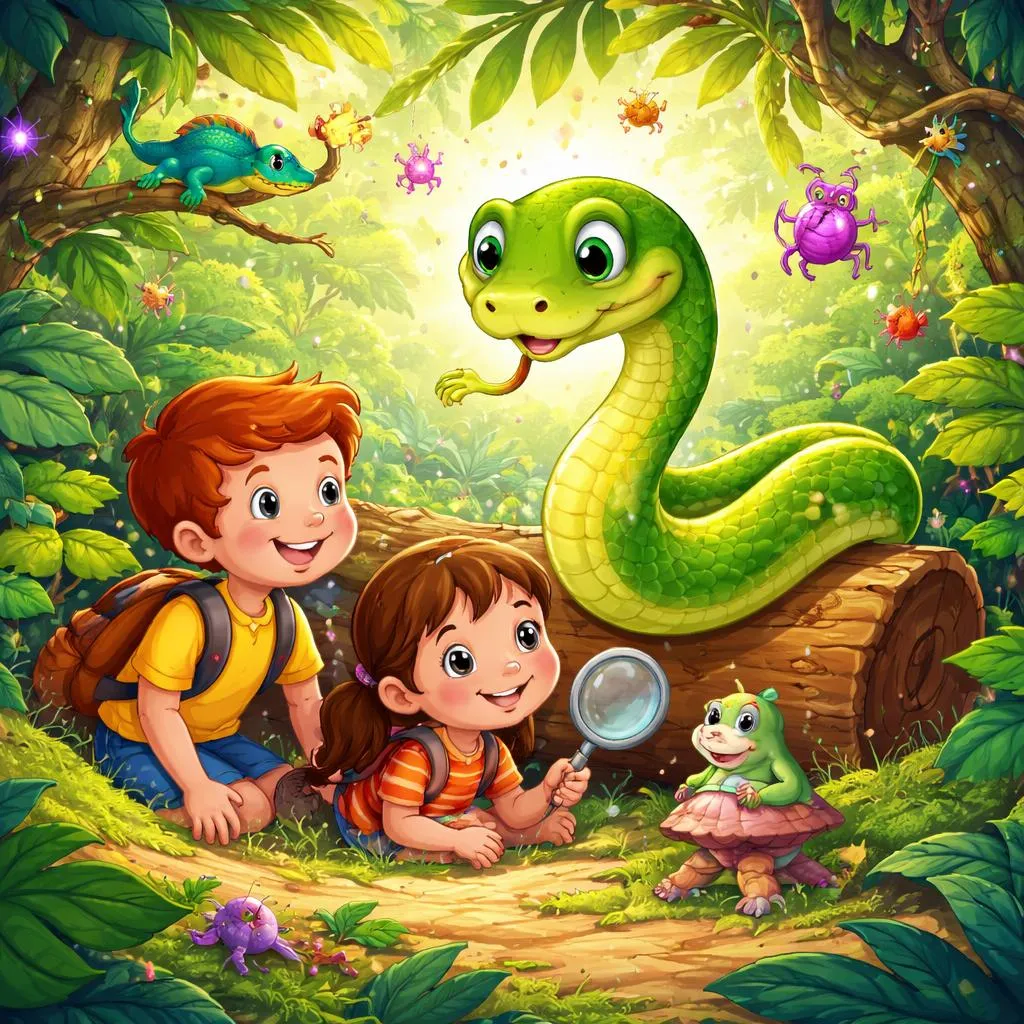

Snakes fascinate and sometimes frighten children. Their long bodies without legs. Their flickering tongues. Their way of moving. A snake children's story takes this natural curiosity and turns it into learning. It introduces snakes as creatures with their own lives and perspectives. It shows that animals different from us deserve understanding. It can transform fear into fascination. This article explores how teachers can use snake stories to build language skills while helping children appreciate these remarkable reptiles.
What Is a Snake Children's Story? A snake children's story is a narrative where a snake plays a central role. The snake might be the main character with a personality and feelings. A shy snake who wants friends. A helpful snake who solves problems. A misunderstood snake who is actually kind. The story might also feature snakes as part of the natural world. A snake hatching from eggs. A snake hunting for food. A snake shedding its skin. These stories present snakes accurately but gently. They acknowledge that some people fear snakes while showing that snakes are not dangerous when respected. The goal is to replace fear with knowledge and appreciation.
Meaning and Explanation Behind Snake Stories Snake stories serve several important purposes for young children. First, they address common fears. Many children are afraid of snakes. The fear often comes from not understanding. Stories introduce snakes in safe contexts. The snake becomes a character to know rather than a creature to fear.
Second, they teach accurate information. Snakes are not slimy. Most are not dangerous. They play important roles in nature. They eat pests. They are food for other animals. Stories can weave in these facts naturally.
Third, they build empathy. Seeing the world from a snake's perspective helps children understand that all creatures have needs and feelings. The snake wants safety, food, and comfort just like any animal.
Fourth, they celebrate diversity. Snakes are very different from humans. Their differences are not bad. They are simply adaptations for their way of life. This lesson extends to appreciating human differences too.
Fifth, they connect to science. Snake stories naturally lead to learning about reptiles, habitats, and ecosystems.
Categories or Lists of Snake Stories Snake children's stories come in several types.
Friendly Snake Stories: Snakes as positive characters.
A snake who helps garden by eating pests.
A snake who becomes a classroom pet.
A snake who saves someone from danger.
Misunderstood Snake Stories: Snakes who are feared but actually kind.
People run from a snake who just wants to play.
A snake is blamed for things it did not do.
Children discover the snake is helpful.
Snake Life Cycle Stories: Following a snake from egg to adult.
Hatching from leathery eggs.
Learning to hunt.
Shedding skin as it grows.
Snake Habitat Stories: Snakes in their natural environments.
Desert snakes.
Jungle snakes.
Garden snakes.
Water snakes.
Snake and Other Animal Stories: Interactions between snakes and other creatures.
Snake and mouse (respectful distance).
Snake and bird.
Snake in the food chain.
Snake Folktales: Traditional stories featuring snakes from various cultures.
Wise snake in Asian tales.
Trickster snake in African stories.
Rainbow serpent from Australian Aboriginal tradition.
Daily Life Examples from Snake Stories A snake children's story connects to real-world experiences. A child who sees a snake in the garden remembers the helpful snake character. Someone who visits a zoo and sees snakes connects them to stories. A snake on a nature show becomes familiar rather than frightening.
Teachers can draw these connections. "Remember how the snake in our story helped the garden by eating pests? That is what real garden snakes do." "The story showed a snake shedding its skin. If we see a snake skin on a hike, we will know what it is."
The stories also prepare children for real encounters. If they meet a snake, they know to stay back and watch quietly. They know most snakes are not dangerous. They know snakes are more afraid of people than people are of them.
Vocabulary Learning from Snake Stories Snake stories introduce rich vocabulary.
Snake Body Parts: Scales, fangs, tongue, jaw, skin, rattle, hood, tail, head, body.
Snake Actions: Slither, crawl, coil, strike, hiss, rattle, shed, swallow, hunt, hide.
Snake Types: Python, boa, rattlesnake, cobra, garter snake, grass snake, king snake.
Habitat Words: Desert, jungle, forest, swamp, garden, rock, burrow, tree, water.
Life Cycle Words: Egg, hatch, hatchling, juvenile, adult, shed, grow, molt.
Teachers can introduce these words before reading. Point them out in the story. Use them during science lessons. Create a snake word wall with pictures.
Phonics Points in Snake Stories Snake words offer phonics practice.
Beginning Sounds: Snake starts with SN. Slither starts with SL. Scales starts with SC. Rattle starts with R. Practice these beginning sounds.
Vowel Sounds: Snake has long A. Hiss has short I. Rattle has short A in first syllable. These demonstrate vowel patterns.
Syllable Practice: Snake words help with syllable counting. Snake has one. Python has two. Rattlesnake has three. Boa constrictor has five. Practice clapping.
Onomatopoeia: Hiss is a sound word. Rattle sounds like its name. These demonstrate sound-letter connections.
Teachers can pause during reading to notice these patterns. The snake theme makes phonics practice engaging.
Grammar Patterns in Snake Stories Snake stories provide natural grammar instruction.
Present Tense for Facts: Science information uses present tense. Snakes slither on the ground. They eat mice and rats. This models factual writing.
Past Tense for Stories: Narrative parts use past tense. The snake slithered through the grass. He found a sunny rock. This models storytelling.
Descriptive Language: Snake stories use vivid description. The long, green snake. The smooth, cool scales. The flickering tongue. These descriptions enrich language.
Comparatives: Snakes can be compared. This snake is longer than that one. Pythons are bigger than garter snakes. This builds comparative structures.
Teachers can point out these patterns during reading. The grammar learning happens naturally within the story.
Learning Activities for Snake Stories Activities bring snake stories to life.
Activity 1: Snake Movement Children practice moving like snakes. Slithering on the floor. Coiling up. Stretching out. This kinesthetic activity builds body awareness and fun.
Activity 2: S Is for Snake Craft Create letter S crafts shaped like snakes. Decorate with patterns like real snake scales. Connect letter learning to the theme.
Activity 3: Snake Habitat Diorama Create dioramas showing snake habitats. Desert with sand and rocks. Jungle with plants. Place model snakes in their homes.
Activity 4: Snake Life Cycle Wheel Create a wheel showing snake development. Egg, hatchling, juvenile, adult. Turn to show each stage.
Activity 5: Snake Sorting Sort pictures of snakes by characteristics. By size. By where they live. By color. This builds classification skills.
Activity 6: Snake Observer If possible, observe a classroom snake or visit one at a pet store. Draw and write observations. Connect to stories.
Printable Materials for Snake Stories Printable resources support snake story learning.
Snake Coloring Pages: Various snake types and scenes for coloring.
Snake Parts Labeling: Diagram of a snake for labeling body parts.
Snake Life Cycle Chart: Visual showing egg to adult with space for drawing.
Snake Habitat Matching: Match snake pictures to their correct habitats.
My Snake Story Writing Paper: Paper with snake border for writing original snake adventures.
Snake Flashcards: Pictures of different snakes with names and facts.
Educational Games for Snake Stories Games make snake learning playful.
Game: Snake Bingo Create bingo cards with snake-related images and words. Call out definitions. Children cover matches.
Game: Snake Charades Act out snake actions. Slithering. Hissing. Coiling. Rattling. Hunting. Children guess.
Game: Snake Memory Match Create pairs of snake pictures or words. Play memory match to find pairs.
Game: Snake Habitat Sort Create cards with different snakes and habitat pictures. Children match each snake to its home.
Game: Snake Length Race Cut strings or yarn to represent different snake lengths. Children arrange from shortest to longest.
Connecting Snake Stories to Other Subjects Snake stories connect across the curriculum.
Science Connection: Learn about real snakes. Reptile characteristics. Snake diets. Snake senses. Snake conservation. This builds scientific knowledge.
Math Connection: Measure snake lengths. Compare sizes. Count snake patterns. Create graphs of snake lengths.
Art Connection: Create snake art in various media. Draw snakes with pattern details. Make clay snakes. Design snake skin patterns.
Social Studies Connection: Explore how different cultures view snakes. Some fear them. Some worship them. Some use them in stories and symbols.
Music Connection: Create snake songs and chants. Use slide whistles for snake sounds. Move like snakes to music.
From Fear to Fascination A snake children's story can transform how children view these creatures. Fear often comes from the unknown. Stories make snakes known. They give them names and personalities. They show their lives and needs. They reveal that snakes are not out to get people. They are just living their snake lives.
This transformation matters beyond snakes. It teaches a general lesson. Creatures different from us are not automatically scary. Understanding replaces fear. Knowledge leads to appreciation. The snake becomes not a monster but a marvel.
Children who learn this lesson carry it forward. They approach the unknown with curiosity rather than fear. They seek to understand before judging. They appreciate the diversity of life.
All because of a simple story about a snake, slithering through the grass, just being itself.