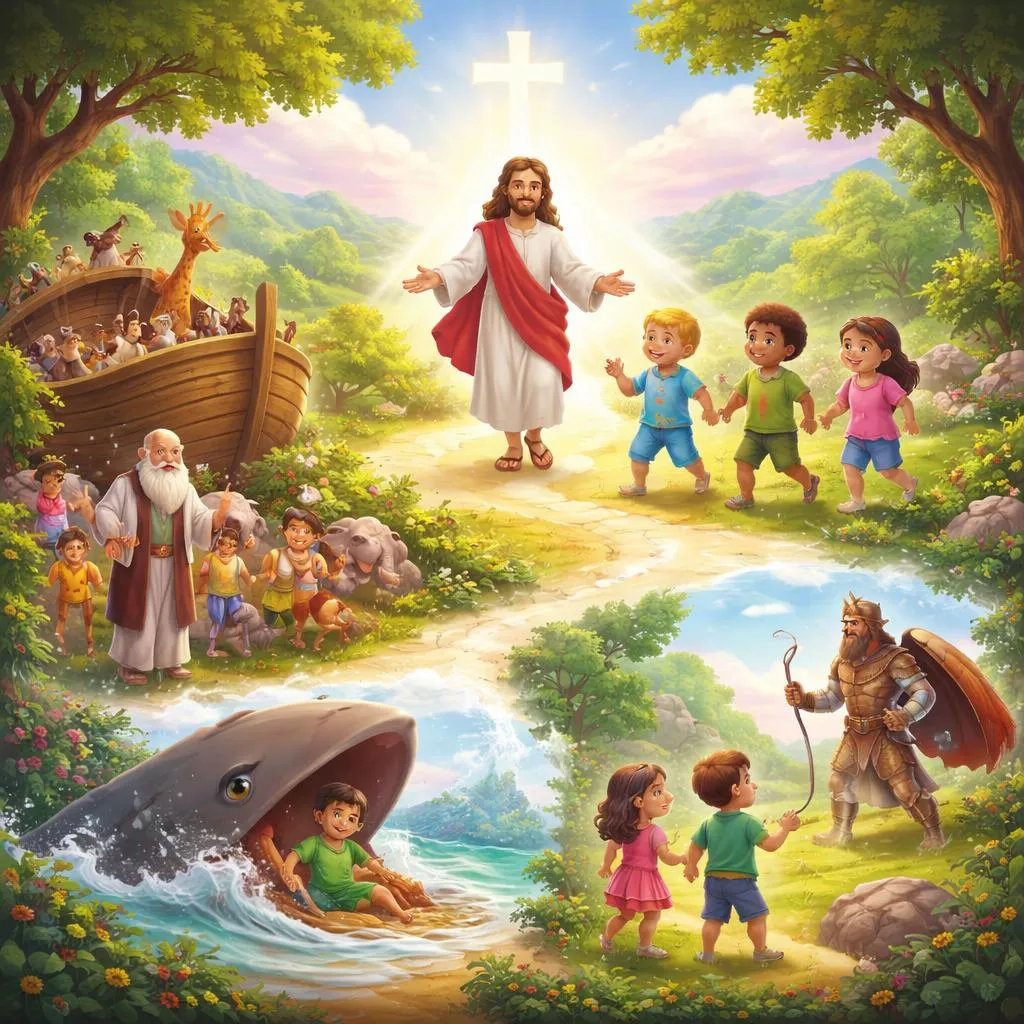

A man builds a giant boat far from any water. A boy climbs a mountain with his father carrying firewood. A general dips seven times in a muddy river. These strange choices only make sense because someone asked and someone obeyed. Children's Bible stories about obedience show us what happens when people trust and follow God's instructions.
These stories spark questions in young minds. Why would anyone do such unusual things? The answer lies in relationship. When we love someone, we listen to them. Let us explore together what obedience looks like in the Bible and what it means for our families today.
<h2>What is the story?</h2> Children's Bible stories about obedience appear throughout Scripture. One of the most powerful involves a man named Noah. God looks at the world and sees terrible wickedness. Everywhere people make wrong choices and hurt each other. God decides to start over.God speaks to Noah. He tells Noah to build an enormous boat called an ark. The ark must be exactly as God describes. Three stories high. Made of gopher wood. Covered with pitch inside and out. With rooms for Noah's family and every kind of animal.
This seems strange. Noah lives far from the ocean. Rain has never fallen on the earth before. Building a giant boat makes no sense to anyone watching. But Noah does not argue. He does not make excuses. The Bible says simply, Noah did everything just as God commanded him.
Year after year Noah builds. People must have laughed and mocked. What is that old fool doing? Building a boat in the middle of nowhere? But Noah keeps working. He trusts God's word more than people's opinions.
Finally the ark stands complete. God sends the animals, two by two. Noah, his wife, his three sons, and their wives enter the ark. Then God shuts the door. Rain begins to fall. It falls for forty days and forty nights. Water covers even the highest mountains. Every living thing outside the ark dies.
But Noah and his family float safely through the storm. When the waters finally go down, they step out onto clean earth. God makes a promise never to flood the whole earth again. A rainbow appears as a sign of that promise. Noah's obedience saved his family and all the animals with him.
<h2>The message of the story</h2> Children's Bible stories about obedience carry deep messages about trust. Noah obeyed before he saw any evidence. He trusted God's word more than what his eyes could see. This is the heart of faith.The story also shows that obedience often looks foolish to others. Building a boat on dry land made no sense. People mocked Noah for years. But he kept going. Children learn that following God may mean doing things others do not understand.
Obedience brought blessing. Noah and his family survived because he listened. The animals survived because he worked. Obedience does not just protect us. It protects others too.
God noticed Noah's obedience. The Bible calls Noah a righteous man who walked with God. His daily choices of faithfulness built a relationship that lasted through the storm.
We can ask our children, Has anyone ever asked you to do something that seemed strange? How did you decide whether to do it? What helps you trust people who love you?
<h2>Vocabulary learning</h2> Children's Bible stories about obedience introduce important words that help children understand this theme.Obedience means doing what someone in authority asks you to do. Noah showed obedience to God.
Ark means a large boat or container. Noah's ark held his family and the animals.
Righteous means living in a way that pleases God. The Bible calls Noah righteous.
Covenant means a special promise between God and people. God made a covenant with Noah never to flood the earth again.
Rainbow is the sign of God's promise. Every rainbow reminds us of God's faithfulness.
Faith means trusting in someone or something even when you cannot see. Noah had faith in God's words.
After reading, we can use these words naturally. When your child follows instructions, you might say, Thank you for your obedience. When you see a rainbow, you might say, There is God's promise, just like Noah saw.
<h2>Phonics points</h2> The words in children's Bible stories about obedience give us lovely phonics practice.Noah has two syllables but only four letters. No-ah. The O is long like in go. The H at the end is soft. No-uh. Practice saying Noah clearly.
Ark has three letters but one syllable. Ar-k. The AR makes the sound like in car. The K at the end is sharp. Ark. This short word is easy for young readers.
Rainbow has two syllables. Rain-bow. The R at the beginning requires curling the tongue. The AY in rain makes a long A sound. The OW in bow makes a long O sound. Rain-bow.
Covenant has three syllables. Cov-e-nant. The C at the beginning can sound like K. The V requires touching teeth to lip. Cov-e-nant. This longer word gives syllable practice.
We can play with these sounds by finding other words with the same patterns. Noah and no both start with No. Ark and arm both start with Ar. Rainbow and raincoat both start with Rain.
<h2>Grammar patterns</h2> Children's Bible stories about obedience use language patterns that help children understand how sentences work.We see simple, powerful statements. Noah did everything just as God commanded him. This short sentence carries huge meaning. It sums up years of faithful work.
The story uses repetition for emphasis. God said build an ark. Noah built an ark. God said take animals. Noah took animals. The pattern shows that Noah matched his actions to God's words.
We see contrast between before and after. Before the flood, people mocked. After the flood, only Noah's family remained. This contrast shows the consequences of choices.
Commands appear throughout. Build an ark. Go into the ark. Come out of the ark. God gives clear instructions. Noah follows them.
After reading, we can notice these patterns. The story said Noah did everything just as God commanded. That word everything means he did not pick and choose. He obeyed completely.
<h2>Learning activities</h2> Children's Bible stories about obedience inspire gentle activities that help children explore what obedience means.Build a small ark together using blocks or a shoebox. Gather pairs of animal toys. Load them into your ark. Talk about how Noah worked for many years. How did he keep going when people laughed?
Create an obedience chart for your family. List simple instructions that help everyone. Put toys away. Brush teeth. Speak kindly. When someone follows through, celebrate their obedience.
Practice listening games. Whisper simple instructions across the room. Can your child hear and obey? Start with one step, then add more. This builds listening skills and makes obedience playful.
Draw a rainbow together using all the colors. Hang it where you can see it. Talk about God's promises every time you notice it. What promises has God kept in your family?
<h2>Printable materials</h2> Many wonderful printable materials exist for children's Bible stories about obedience.Look for coloring pages showing Noah building the ark, animals entering two by two, and the rainbow after the flood. Children can color while you talk about Noah's faithful work.
Find printable animal cards with pairs of animals. Cut them out and match the pairs. Load them into a drawn ark. This builds matching skills while connecting to the story.
Some websites offer printable obedience coupons. Thank you for obeying quickly. This coupon is good for one special story at bedtime. These reward obedience in positive ways.
You might also find printable verse cards about obedience. Children obey your parents in the Lord, for this is right. Display these where your child can see them.
<h2>Educational games</h2> Games based on obedience stories help children internalize these lessons through play.Play Simon Says to practice listening and obeying. Talk about how obeying in the game is fun, just like obeying real instructions keeps us safe and happy.
Create an animal pairs memory game. Use pictures of different animals. Turn them over and find matching pairs, just like the animals came to Noah in pairs.
Play a game of trust fall or trust walk. One person closes their eyes while the other guides them safely. Talk about how Noah trusted God even when he could not see what would happen.
For younger children, play a simple follow the leader game. Take turns being the leader. Everyone must follow exactly. Talk about how Noah followed God as his leader.
These games show that learning about obedience can be gentle and playful. Children absorb the lessons while having fun together.
<h2>Another obedience story</h2> Children's Bible stories about obedience include another powerful example. A man named Abraham hears God's voice. God tells him to leave his country, his people, and his father's household. Go to a land I will show you, God says.Abraham goes. He does not know where. He packs up everything and starts walking. His obedience means leaving behind everything familiar. His trust means stepping into the unknown.
Years later, God tests Abraham in an even harder way. Take your son, your only son Isaac, whom you love, and go to the region of Moriah. Sacrifice him there as a burnt offering.
Abraham rises early the next morning. He saddles his donkey and takes Isaac and two servants. They travel three days. Isaac carries the wood for the fire. He asks, Father, where is the lamb for the offering?
Abraham answers, God himself will provide the lamb.
They build an altar. Abraham ties up Isaac and places him on the wood. He reaches out his hand to take the knife. Then the angel of the Lord calls out, Abraham! Abraham! Do not lay a hand on the boy. Now I know that you fear God, because you have not withheld your son.
Abraham looks up and sees a ram caught in a thicket. He sacrifices it instead. He names that place The Lord Will Provide.
This story raises hard questions. Why would God ask such a thing? The point was never about hurting Isaac. God wanted Abraham's heart completely. Abraham proved that he loved God more than anything, even his promised son. And God provided the ram, just as Abraham told Isaac he would.
<h2>The message of this story</h2> This second obedience story carries even deeper messages. Abraham waited decades for Isaac. Isaac was the son of promise, the one through whom God would bless the whole world. Giving him up cost everything.Abraham's obedience shows radical trust. He believed that even if he sacrificed Isaac, God could raise him from the dead. He trusted God's character more than he understood God's command.
The story also points forward. Centuries later, another Father would give his only Son. God the Father did not provide a ram. He provided Jesus. The sacrifice happened on another mountain, not far from where Abraham trusted.
Children learn that obedience sometimes costs. It asks us to trust when we cannot see. But God always provides. The ram in the thicket. The lamb of God. Provision comes.
We can ask our children, What is the hardest thing someone has ever asked you to do? How did you feel? Did anything good come from it?
<h2>Learning from both stories</h2> Children's Bible stories about obedience show us different kinds of faithful responses. Noah obeyed by building. Abraham obeyed by going and by trusting. Both listened. Both acted. Both received God's blessing.Obedience does not mean we understand everything. Noah did not understand rain. Abraham did not understand sacrifice. They understood the one who spoke. That was enough.
Obedience also does not mean we earn God's love. God loved Noah before the ark. God loved Abraham before the journey. Obedience flows from relationship. We obey because we trust the one who loves us.
For children, these stories offer examples without shame. Noah and Abraham were not perfect. They made mistakes too. But when God spoke, they listened. That is what matters.
When we share these stories with our children, we give them models for their own lives. They learn that following God may look strange to others. They learn that trust leads to blessing. They learn that the God who spoke to Noah and Abraham still speaks today, still guides, still provides.
So find a children's Bible with these stories. Settle in together. Build arks in your imagination. Climb mountains with Abraham and Isaac. Talk about obedience not as blind rule-following but as loving trust. The stories will stay in your children's hearts, guiding them when they face their own choices about whom to follow.