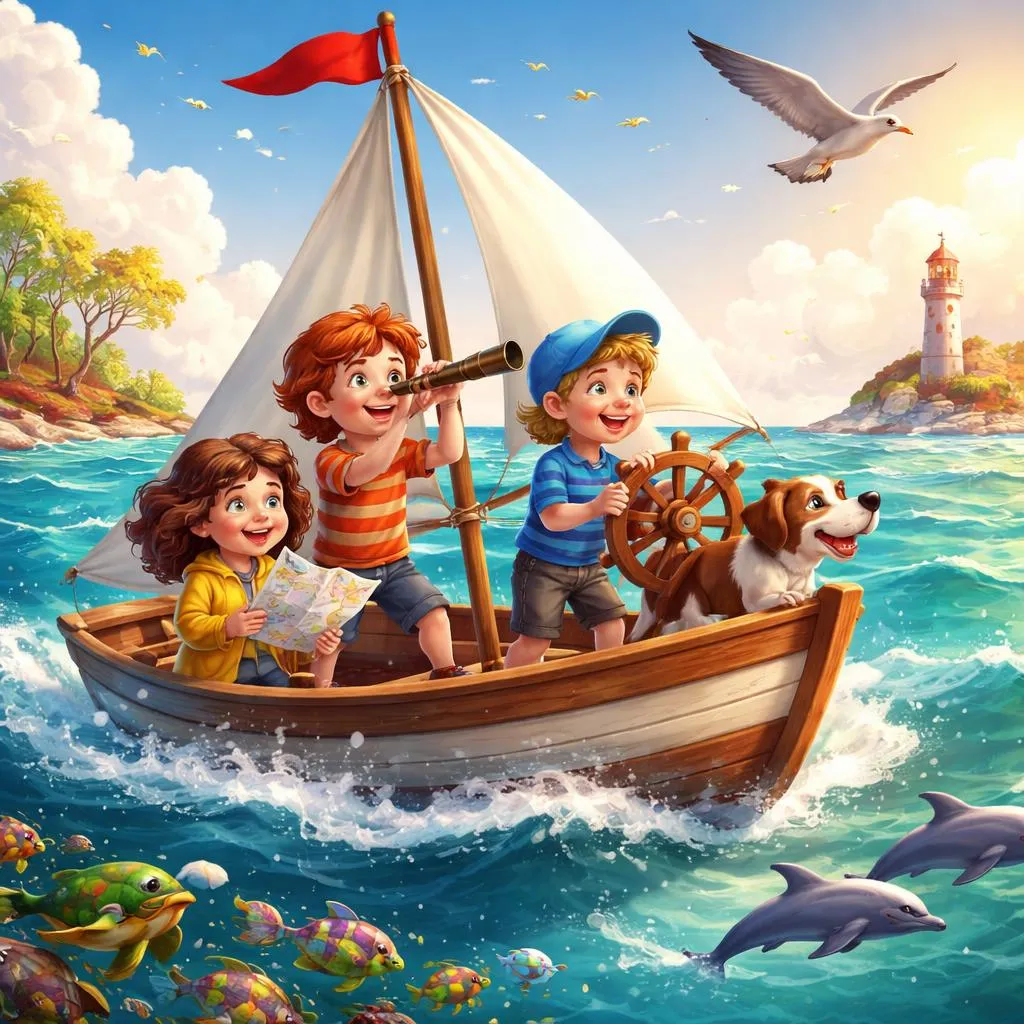

Boats hold a special fascination for children. They represent travel, adventure, and the unknown. They float on water, which itself feels magical. Children's stories about boats use this natural fascination to explore deeper themes. Journeys and destinations. Facing storms and calm seas. Working together to keep moving forward. Coming home again. These narratives carry lessons about courage, persistence, and friendship. This article explores how teachers can use boat stories to build literacy skills while launching young imaginations onto endless seas of possibility.
What Are Children's Stories About Boats? Children's stories about boats are narratives where watercraft play a central role. The boat might be the setting for the entire story. It could be the means of transportation to somewhere new. It might represent safety in a storm or freedom to explore. These stories feature many kinds of boats. Tiny paper boats sailed in puddles. Rowboats on peaceful lakes. Sailboats catching the wind. Ferries carrying passengers. Huge ships crossing oceans. Submarines exploring deep waters. The characters might be people, animals, or even the boats themselves with personalities. Each story uses the boat to carry young readers into adventures both outer and inner.
Meaning and Explanation Behind Boat Stories Boat stories carry rich symbolic meaning that children intuitively understand. A boat on a journey represents life's path. There are calm days and stormy ones. Sometimes the wind fills the sails and progress comes easily. Other times, everyone must row together against the current. The destination might be clear or unknown. These elements mirror childhood experiences.
The boat itself often represents safety and home. A small vessel on a vast sea feels vulnerable. Yet it protects those inside. Children recognize this feeling. They know what it means to be small in a big world. They know the comfort of a safe place.
Storms in boat stories represent challenges. The characters must work together, stay brave, and trust their vessel. When the storm passes, they have grown stronger. Children learn that difficulties can be survived and that challenges often lead to growth.
Returning to shore represents coming home. After all adventures, there is comfort in return. Children understand this too. The joy of exploring balanced with the joy of coming back to what is familiar and loved.
Categories or Lists of Boat Stories Children's stories about boats come in many forms. Each offers different experiences.
Adventure on the High Seas: These stories feature ocean voyages and exciting discoveries.
Pirates searching for treasure.
Explorers finding new lands.
Storms that test courage and skill.
Whales and other sea creatures encountered.
Quiet Pond and River Stories: Gentle tales set on calm waters.
A duck family learning to swim.
A child sailing a toy boat.
Fishing trips with grandparents.
Rowboat rides on peaceful summer days.
Personified Boat Stories: Boats that have feelings and personalities.
A little tugboat who wants to be brave.
A sailboat afraid of storms.
A ferry who loves carrying passengers.
An old boat remembering past adventures.
Historical Boat Stories: Tales set in other times.
Voyages of exploration.
Immigrant ships bringing families to new homes.
Battle ships in wartime (handled gently).
Fishing boats in earlier centuries.
Fantasy Boat Stories: Magical elements mixed with boating.
Boats that fly.
Underwater adventures in submarines.
Boats that talk and give advice.
Journeys to imaginary islands.
Boats in Trouble Stories: Narratives about problems and solutions.
A leak that needs fixing.
Getting lost and finding the way.
Rescuing someone in danger.
Working together when the engine fails.
Daily Life Examples from Boat Stories Children's stories about boats connect to everyday experiences. A child who has been on a ferry remembers that feeling. Someone who sailed a toy boat in a puddle understands small-boat adventures. A family fishing trip becomes part of the story world.
Teachers can draw these connections. "Remember when the boat in our story faced big waves? Has anyone been on a boat when the water was rough?" "The little boat in the story was nervous about its first trip. Has anyone felt nervous trying something new?"
Water play in the classroom connects naturally. A water table with small boats lets children act out stories. Puddle jumping after rain becomes an extension of boat adventures. Bath time at home connects to floating and sinking concepts from stories.
Vocabulary Learning from Boat Stories Boat stories introduce rich, specific vocabulary.
Boat Parts: Hull, mast, sail, rudder, anchor, deck, bow, stern, cabin, keel, oar, paddle.
Boat Types: Rowboat, sailboat, motorboat, tugboat, ferry, ship, submarine, canoe, kayak, raft.
Water Words: Ocean, sea, lake, river, pond, stream, wave, tide, current, shore, beach, harbor.
Weather Words: Storm, wind, calm, fog, rainbow, sunshine, hurricane, breeze, gale.
Journey Words: Voyage, trip, cruise, crossing, exploration, adventure, destination, homecoming.
Teachers can introduce these words before reading. Point them out in the story. Use them in discussion. Create a boat word wall with pictures. The vocabulary becomes meaningful through context.
Phonics Points in Boat Stories Boat words offer excellent phonics practice.
Beginning Sounds: Boat starts with B. Sail starts with S. Ship starts with SH. Anchor starts with A. Practice these beginning sounds.
Vowel Sounds: Boat has the long O sound. Sea has the long E sound. Lake has the long A sound. These words demonstrate different vowel patterns.
Consonant Blends: Storm has ST blend. Float has FL blend. Prow has PR blend. Cruise has CR blend. Practice these blends together.
Syllable Practice: Boat words help with syllable counting. Boat has one. Sail-boat has two. Sub-ma-rine has three. A-nchor has two. Practice clapping syllables.
Teachers can pause during reading to notice these patterns. The boat theme makes phonics practice engaging.
Grammar Patterns in Boat Stories Boat stories provide natural grammar instruction contexts.
Prepositions of Place: Boats require many location words. On the boat. In the water. Under the dock. Across the lake. Through the storm. These prepositions become concrete.
Past Tense for Voyages: Boat stories use past tense for journeys. The ship sailed for many days. The crew spotted land at dawn. They anchored in the harbor. This models narrative past tense.
Sequencing Words: Journey stories use sequencing language. First, they left the harbor. Next, they encountered a storm. Finally, they reached the island. These words build understanding of sequence.
Descriptive Language: Boat stories paint pictures with words. The vast ocean. The tiny boat. The howling wind. The calm water. These descriptions enrich language.
Teachers can point out these patterns gently during reading. The grammar learning happens naturally within the adventure.
Learning Activities for Boat Stories Activities bring boat stories to life in the classroom.
Activity 1: Build a Boat Provide various materials. Aluminum foil. Clay. Craft sticks. Paper. Children design and build boats. Test them in water. Do they float? Can they hold weight? This combines story connection with science.
Activity 2: Boat Painting Provide blue paper and art supplies. Children paint scenes from boat stories or create their own. Add real boat models for inspiration.
Activity 3: Water Table Play Set up a water table with small boats, animals, and people. Children act out boat stories. This sensory play builds comprehension through physical experience.
Activity 4: Boat Journey Map Create a large map on paper or the floor. Mark a journey from one place to another. Children move a boat along the map, describing what happens at each point.
Activity 5: Storm Sound Story Read a boat story with a storm. Children create storm sounds. Hands rubbing for wind. Fingers tapping for rain. Hands slapping for waves. Thunder by stomping. This builds listening and participation.
Printable Materials for Boat Stories Printable resources extend learning from boat stories.
Boat Coloring Pages: Various boat types for coloring while listening to stories.
Build-a-Boat Template: Printable boat shapes to cut out and assemble. Children color and construct their own fleet.
Boat Story Map: A simple graphic organizer for boat journeys. Starting place. What happened along the way. Ending place.
Boat Word Search: Create word searches using boat vocabulary. Sail, mast, anchor, wave, storm, ocean.
My Boat Story Writing Paper: Paper with boat border and lines for writing original boat adventures.
Boat Flashcards: Pictures of different boat types with names for matching and identification.
Educational Games for Boat Stories Games make boat story learning playful.
Game: Boat Bingo Create bingo cards with boat-related images and words. Call out definitions. Children cover matching squares.
Game: Float or Sink Sort Collect various small objects. Children predict and test whether each floats or sinks. Sort into two groups. Connect to boat stories and why boats float.
Game: Boat Charades Act out boat-related actions. Rowing. Sailing. Fishing. Diving. Dropping anchor. Children guess the action.
Game: Journey Obstacle Course Create an obstacle course representing a boat journey. Crawl under "waves." Step over "rocks." Balance on a "dock." Navigate through "storms."
Game: Pass the Message in a Bottle Sit in a circle with a pretend message in a bottle. Pass it around. When music stops, the child holding it shares something about boats or the story.
Connecting Boat Stories to Other Subjects Boat stories connect naturally across the curriculum.
Science Connection: Explore floating and sinking. What makes boats float? How do submarines dive and surface? Study real boats and how they work. Learn about water and weather.
Social Studies Connection: Learn about boats in different cultures. Venetian gondolas. Egyptian reed boats. Polynesian outriggers. Pacific Northwest canoes. Explore how geography influences boat design.
History Connection: Study famous boat journeys. Columbus. The Mayflower. Viking longships. Explorers throughout history. Immigration by ship.
Math Connection: Measure boat lengths. Calculate how many people different boats can hold. Graph favorite boat types. Create boat shapes with pattern blocks.
Art Connection: Explore boat art throughout history. Paint boat scenes. Create collage boats. Study famous boat paintings.
Music Connection: Learn boat songs. "Row, Row, Row Your Boat." "Sailing, Sailing." "My Bonnie Lies Over the Ocean." Create boat rhythms.
The Journey Metaphor Children's stories about boats ultimately teach about life itself. Every child is on a journey. There are calm days and stormy ones. There are times to sail with the wind and times to row against the current. There are helpers along the way. Other boats to travel beside. Lighthouses to guide the way. Harbors for rest and safety.
The boat represents the self. Each child must learn to navigate their own vessel. They must discover their own steering. They must learn to adjust sails for different winds. They must know when to move forward and when to drop anchor and wait.
These are not small lessons. They are the work of a lifetime. But stories plant the seeds early. A child who reads about a brave little tugboat learns something about courage. A child who follows a sailboat through a storm learns about persistence. A child who watches a boat find its way home learns that adventures have happy endings.
The best boat stories stay with children forever. Years later, when facing their own storms, they might remember. A little boat in a big ocean. Waves all around. But the boat kept going. And so can they.