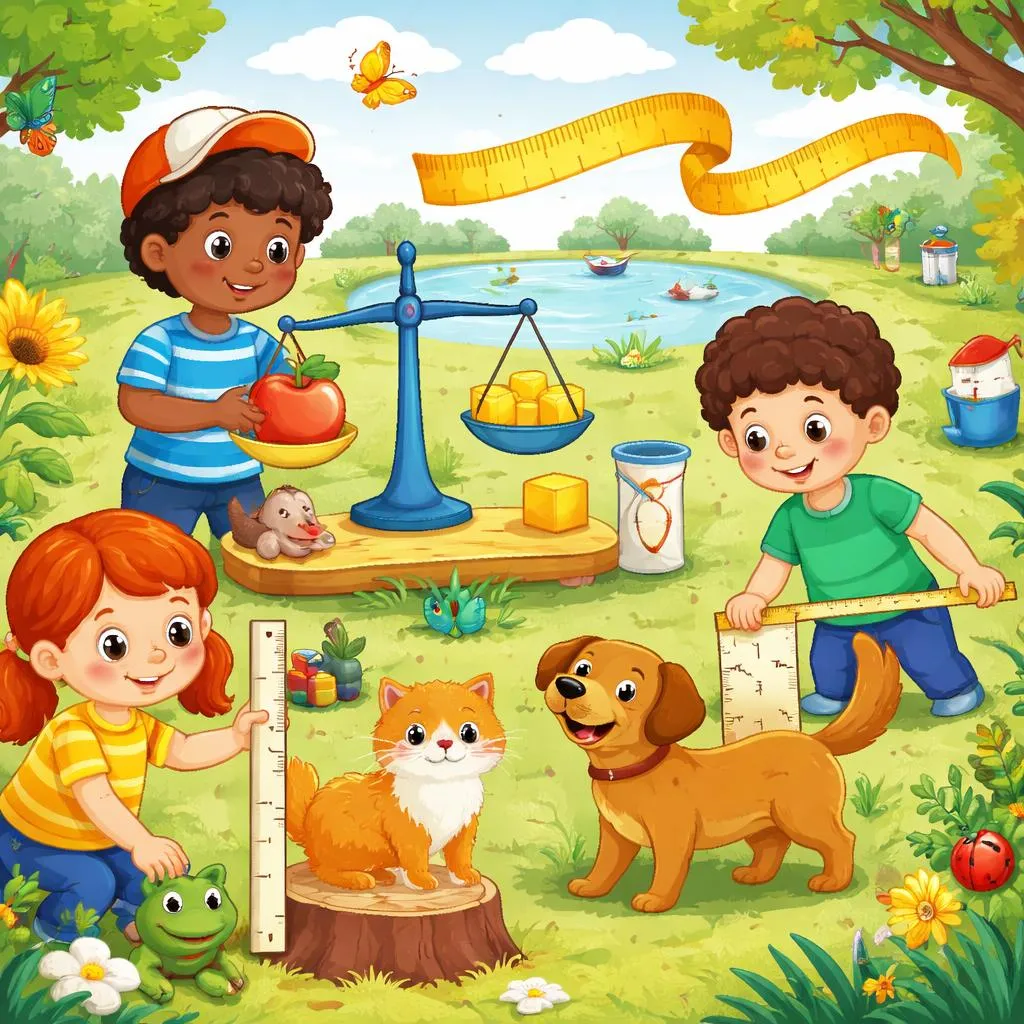

What Are Children's Stories About Measurement? Let us explore this educational genre of children's literature together. Children's stories about measurement introduce concepts of size, length, weight, and volume. Characters compare objects to see which is bigger or smaller. They measure things using non-standard units like paper clips or hands. Some stories explore how tall, how heavy, or how much something holds. The stories make abstract measurement concepts concrete and understandable. Characters might need to measure ingredients for cooking. They might compare their height to a friend or family member. They might figure out if something will fit in a certain space. The stories show measurement as a useful tool in everyday life. Children learn that measuring helps solve real problems.
Meaning and Purpose of Measurement Stories These stories serve several important purposes in early math education. They introduce measurement vocabulary in meaningful contexts. Words like longer, shorter, heavier, and lighter become clear. The stories also show why measurement matters in real life. Characters need to measure for practical reasons children understand. This connects abstract math to concrete experiences. The stories also build comparison and estimation skills. Children learn to judge which is bigger before measuring exactly. The narratives also introduce non-standard units before standard ones. Using hands or paper clips is developmentally appropriate. Children internalize the concept of a unit of measurement. This foundation supports later work with rulers and scales.
Common Elements in Measurement Stories We can identify several elements common to measurement narratives. A problem arises that requires measuring to solve. Something doesn't fit, or someone needs to compare sizes. Characters try different ways to measure and compare. They might use hands, feet, or objects as measuring tools. Comparison language appears throughout the story. Longer, shorter, taller, heavier, lighter are used. Estimation happens before exact measurement. Characters guess which will be bigger or smaller. Standard measurement tools may be introduced. Rulers, scales, and measuring cups might appear. The solution comes from measuring accurately. The problem gets solved through measurement. The story ends with the successful application of measurement.
Categories of Measurement Stories We can organize measurement stories into several helpful categories. Length stories focus on how long or tall things are. Comparing heights of characters or objects appears. Weight stories explore how heavy things are. Using scales and comparing weights are featured. Volume stories deal with how much containers hold. Cooking and filling containers appear in these tales. Size comparison stories focus on bigger and smaller. Animals, toys, and everyday objects are compared. Non-standard unit stories use hands, feet, or paper clips. Standard unit stories introduce inches, feet, and centimeters. Time measurement stories explore clocks and calendars. How long until an event happens appears in these.
Daily Life Connections Through Measurement Stories Measurement stories connect directly to children's daily experiences. Cooking at home involves measuring ingredients. Children see parents using cups and spoons. Comparing heights happens naturally with siblings and friends. Who is taller becomes a frequent question. Fitting things into spaces happens all the time. Will this toy fit in that box? Weighing themselves happens at doctor visits. Children see the scale and learn their weight. Buying clothes involves knowing sizes. Pants that are too long or too short appear. Building with blocks involves measurement concepts. Towers need to be stable and balanced. We can point out these connections during reading. "Remember when we measured ingredients to bake cookies?" "You compared your height to your friend yesterday."
Vocabulary Learning from Measurement Stories Measurement stories introduce important math vocabulary for children. Measure means to find the size, amount, or degree of something. Length means how long something is from end to end. Height means how tall something is from bottom to top. Weight means how heavy something is. Volume means how much space something takes up or holds. Compare means to look at things to see how they are similar or different. Longer means having greater length than something else. Shorter means having less length than something else. Heavier means having more weight than something else. Lighter means having less weight than something else. We can teach these words with examples from stories. Use them in sentences about real measurement situations.
Phonics Points in Measurement Stories Measurement stories provide useful phonics practice with math vocabulary. Measure has the long E and long A and silent E. Length has the L sound and ENG and TH. Height has the H sound and long I and silent GH. Weight has the W sound and long A and silent GH. Volume has the short O and long U and silent E. Compare has the short O and short A and silent E. Longer has the L sound and long O and NG and ER. Shorter has the SH digraph and OR combination and ER. Heavier has the H sound and EA digraph and long E and ER. Lighter has the L sound and long I and silent GH and ER. We can focus on one sound pattern from each story. Find all words with that sound in the measurement tale. Write them on ruler or scale shapes for practice.
Grammar Patterns in Measurement Narratives Measurement stories model useful grammar for young readers naturally. Present tense describes what is being measured now. "This block is longer than that one." Past tense tells what characters measured earlier. "Yesterday we measured how tall the sunflower had grown." Future tense shows what will be measured next. "Tomorrow we will weigh the pumpkin to see if it's heavier." Questions explore comparison and estimation. "Which is longer, the blue ribbon or the red one?" "How many paper clips long is the pencil?" Commands appear in measurement instructions. "Measure the flour carefully." "Compare the two heights." Descriptive language paints comparison pictures. "The enormous pumpkin was much heavier than the little one." Prepositional phrases describe what is being compared. "On the scale, beside the ruler, in the measuring cup." We can point out these patterns during reading.
Learning Activities for Measurement Stories Many activities deepen understanding of measurement concepts. Measure classroom objects using non-standard units. Use paper clips, cubes, or hands to measure length. Compare heights of children in the class. Record who is tallest, shortest, and in between. Cook a simple recipe together measuring ingredients. Use cups and spoons to practice volume measurement. Weigh objects using a simple balance scale. Compare which is heavier and which is lighter. Measure how many cups of water fill different containers. Explore volume through hands-on experimentation. Create a measurement scavenger hunt finding objects of specific lengths. Find something longer than a pencil, shorter than a book. These activities make measurement concepts concrete and engaging.
Printable Materials for Measurement Learning Printable resources support deep engagement with measurement themes. Create measurement vocabulary cards with words and pictures. Measure, length, height, weight, volume, compare included. Design non-standard measurement recording sheets. Measure objects using paper clips and record how many. Make comparison charts for recording measurements. Longer/shorter, heavier/lighter, taller/shorter columns. Create a measurement hunt checklist with specific items. Find something longer than your hand, shorter than your foot. Design a cooking measurement activity with pictures. Match measuring cups with amounts they hold. Make a height chart for recording and comparing growth. Children mark and measure their height periodically. These printables structure measurement exploration activities effectively.
Educational Games About Measurement Games make measurement learning playful and interactive. Play "Measurement Charades" acting out measurement actions. Measuring height, weighing something, pouring volume appear. Create "Longer or Shorter?" with classroom objects. Hold up two items, children say which is longer. Play "Heavier or Lighter?" feeling mystery bags. Guess which bag is heavier without looking inside. Design "Measurement Scavenger Hunt" finding specific lengths. Find something exactly as long as a pencil, book, or hand. Play "Estimation Station" guessing measurements before checking. Estimate how many cubes tall the water bottle is. Create "Measurement Bingo" with measurement terms on cards. Longer, shorter, heavier, lighter, taller, shorter included. These games build measurement skills through active participation.
Teaching Non-Standard Units First Children understand non-standard units before standard ones. Using hands, feet, or objects to measure makes sense. A book is 8 paper clips long is concrete and understandable. The concept of a unit is established without abstraction. Children learn that the same unit must be used consistently. Paper clips must be the same size for accurate measurement. This foundation prepares for standard units later. Inches and centimeters become just different-sized units. The concept transfers easily to standard measurement. Non-standard measurement also develops estimation skills. Children get better at judging sizes through practice. This hands-on approach builds deep understanding of measurement.
Comparing and Ordering Through Stories Measurement stories naturally involve comparing and ordering. Which character is tallest becomes a story question. Children compare and order characters by height. Which object is heaviest drives the plot forward. Children order objects from lightest to heaviest. These comparison skills are foundational for math. They also develop logical thinking and reasoning. Children learn to analyze and make judgments. The stories provide context for these important skills. Characters have reasons for needing comparisons. Children engage with the purpose behind the math. This makes the learning meaningful and memorable.
Estimation Skills Through Stories Estimation is an important math skill measurement stories teach. Characters guess before they measure in many tales. Will the ribbon be long enough for the package? Children estimate before seeing the answer. The story shows whether their guess was close. This builds estimation skills naturally over time. Estimation is useful in daily life constantly. Judging whether something will fit saves time. Approximating amounts helps in cooking and shopping. Stories that include estimation make this skill concrete. Children learn that estimating is valuable and fun. They become more willing to guess and check.
Why Measurement Stories Work Measurement stories succeed because they embed math in narrative. Children learn while being entertained by characters. The math serves the story, not the other way around. This makes measurement feel useful and relevant. Children see characters using math to solve problems. They internalize that math helps in real life. The stories also provide repeated exposure to measurement language. Hearing the words in context builds vocabulary. Children can practice skills alongside the characters. The stories become shared experiences for learning. Teachers and parents can reference them during real measurement. "Remember how the story measured with paper clips?" This connection reinforces learning long after the story ends.