
A Friendly Hello and First Impressions
Ciao! (CHOW). This is a friendly "Hello" or "Goodbye" in Italian. Grazie! (GRAHT-see-eh). This is a warm "Thank you". People say it with a smile. Learning reading about Italy starts with these musical, everyday words.
Italy is a country in Southern Europe. Its shape looks like a tall, high-heeled boot. The boot kicks a triangular ball into the Mediterranean Sea. The country is in Europe. France, Switzerland, and Austria are its neighbors. The Mediterranean Sea surrounds it on three sides. The land is a mix of snowy Alps, rolling hills, and long coasts. It is a country of breathtaking beauty.
People call it the "Bel Paese". This means "Beautiful Country". Another nickname is the "Boot-shaped Country". This is for its obvious shape on the map. Are you ready to explore a land where every city is an open-air museum?
Deep Dive into Culture and Stories
Echoes of History
A mighty empire began here. It was the Roman Empire. It started as a small city called Rome. Legend says twins, Romulus and Remus, founded it. Romulus became the first king. The empire grew very large. It covered Europe, North Africa, and the Middle East. The Romans built roads, aqueducts, and laws. Their story is a key part of learning reading about Italy. It is a story of power and engineering.
Another important period was the Renaissance. It means "rebirth". It started in Florence in the 1300s. It was a time of great art and science. Leonardo da Vinci and Michelangelo lived then. This era changed the world of art forever.
A Gift of Art and Science
Italy gave the world an explosion of beauty and ideas. The Renaissance was a gift of art. Masterpieces like the Mona Lisa were painted. Italy also gave the world modern science. Galileo Galilei studied the stars and planets. This love for creativity and discovery is a key part of learning reading about Italy. It shows the power of the human mind.
A Land of Mountains and Sea
Italy's geography is very diverse. The Alps are in the north. They are tall and snowy. The Apennine Mountains run down the center like a spine. The Po Valley in the north is flat and fertile. The coast has beautiful beaches and cliffs. The landscape changes from icy peaks to sunny vineyards.
The climate varies a lot. The north has cold winters. The south has hot, dry summers. The environment shapes life. People grow grapes for wine, olives for oil, and wheat for pasta. In the north, they also grow rice. Traditional houses in the countryside are made of stone. They have red-tiled roofs. The main exports are machinery, clothing, and wine.
A special animal is the Italian wolf. It lives in the Apennine Mountains. The national animal is the Italian wolf. The national bird is the Italian sparrow. The national flower is the lily. The olive and oak trees are national symbols. The grapevine is everywhere.
Landmarks of Stone and Grandeur
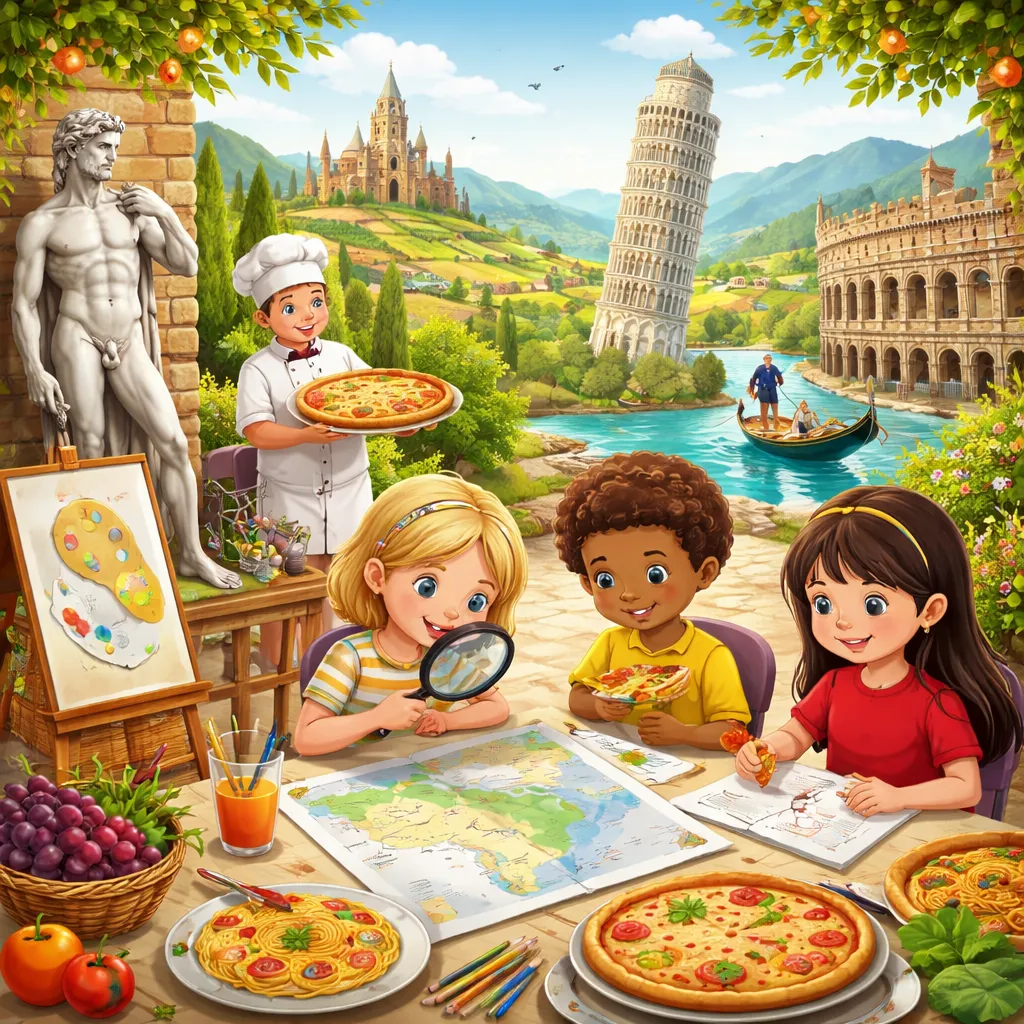
Visit the Colosseum. It is in Rome. It is a giant stone amphitheater. The Romans built it 2,000 years ago. Gladiators fought there. They had battles with animals. A fun legend says the Colosseum was once full of water. They had fake naval battles inside! The building is a symbol of ancient engineering.
See the Leaning Tower of Pisa. It is in the city of Pisa. It is a bell tower. It started leaning during its construction. The ground was too soft on one side. A fun story says Galileo dropped balls from the tower. He tested gravity. The tower is a famous mistake that became beautiful.
Another wonder is Venice. It is a city built on water. There are no cars, only boats. You can ride in a gondola through canals. A local legend says Venice was founded by people escaping invaders. The city is magical and unique.
Festivals of Masks and Celebration
The most colorful festival is Carnevale. It happens before Lent. The most famous is in Venice. People wear elaborate masks and costumes. The masks are beautiful and mysterious. There are parades and parties in the streets.
The festival is about fun, disguise, and celebration before a quiet time. Children throw confetti. The air is full of music and laughter. The festival feels like a fairy tale.
Another important day is Festa della Repubblica. It is on June 2nd. It celebrates Italy becoming a republic in 1946. There is a big military parade in Rome. Jets fly over, leaving trails of green, white, and red smoke. The national flag is everywhere. The day is about national pride and freedom.
Food and Flavors
The national dish is Pizza. It was born in Naples. A classic pizza is "Margherita". It has tomato, mozzarella, and basil. The colors are red, white, and green. These are the Italian flag colors. Families eat it any time. A good pizza is thin, chewy, and delicious. It is the taste of Italy.
You must try Pasta. It comes in hundreds of shapes. Spaghetti, penne, and ravioli are popular. It is served with many sauces. A simple "pasta al pomodoro" is tomato and basil. Families eat it for lunch or dinner. Pasta is comforting, versatile, and beloved.
A Culture of Music and Style
Music is in the Italian soul. Opera was invented in Italy. Composers like Verdi and Puccini are famous. People also love to sing folk songs. This love for melody is a joyful part of learning reading about Italy.
Italy is a world leader in fashion and design. Cities like Milan are fashion capitals. Italian cars and furniture are famous for their style. This shows a national talent for making beautiful, functional things.
Tips for Young Explorers
Cultural Manners Matter
Italians are warm and expressive. Greetings are important. A handshake is common. Close friends and family kiss on both cheeks. Say "Buongiorno" (Good day) in the morning. Use titles like "Signore" (Mr.) or "Signora" (Mrs.) for adults. This is polite.
Punctuality is flexible. Being 10-15 minutes late is often acceptable. This is called "Italian time". But try to be on time for tours and appointments. For social events, it is fine to be late.
When visiting a home, bring a small gift. Wine, pastries, or flowers are nice. Do not give chrysanthemums. They are for funerals. Compliment the home and the food. Do not start eating until the host invites you.
A Note on Staying Safe
Italy is a very safe country. But be careful in big cities and tourist spots. Watch for pickpockets in crowds. Keep your bag closed. Do not put your phone on a caf谷 table. Use common sense.
The sun in the south is very strong. Use sunscreen. Wear a hat. The Mediterranean sun can burn you quickly. Drink lots of water. Stay hydrated.
Be careful when crossing streets. Traffic in cities can be busy. Use crosswalks. Look both ways. Drivers do not always stop for pedestrians.
A Tasty Stop
Look for a "gelateria". This is an ice cream shop. Gelato is Italian ice cream. It is creamier and denser. Try flavors like pistachio, stracciatella, or lemon. Eat it in a cone or cup. The gelato is smooth, flavorful, and delicious. It is the perfect treat.
Healthy and Happy Travels
Tap water is safe to drink in most cities. In fountains, look for signs. If it says "Acqua Potabile", you can drink it. Carry a refillable bottle. This saves plastic and money.
Walk a lot. Italian cities are made for walking. Wear comfortable shoes. The streets are often cobblestone. Your feet will thank you.
Dress modestly in churches. Cover your shoulders and knees. This shows respect. Be quiet and do not use flash photography.
Your Invitation to Explore
Start your journey with art. Look at a painting by Michelangelo or Leonardo da Vinci. See the detail and emotion. Or, listen to a piece of Italian opera. Hear the powerful voices. This is a wonderful way of learning reading about Italy.
Visit a local market or grocery. Look for real Parmesan cheese or olive oil. Taste the rich flavors. Imagine the sunny fields. You can also try making a simple pizza or pasta at home. Taste the joy of creating Italian food. Share it with your family.
The world is a big, open book. Each country is a different chapter. Italy's chapter is about empire, art, and "la dolce vita" (the sweet life). Open it with curiosity. Read about its ruins, Renaissance, and rich traditions. Your curiosity is your guide.
Italian families gather for a long Sunday lunch. Friends discuss football with passion. Children learn about ancient Rome in school. We all know these scenes. We love sharing big meals. We enjoy lively talks about sports. We are fascinated by history. Learning about Italy shows us this. Our global family shares the same joys of food, family, and celebration. Keep exploring, one page, one country, at a time. Your adventure has just begun.