
Opening Introduction
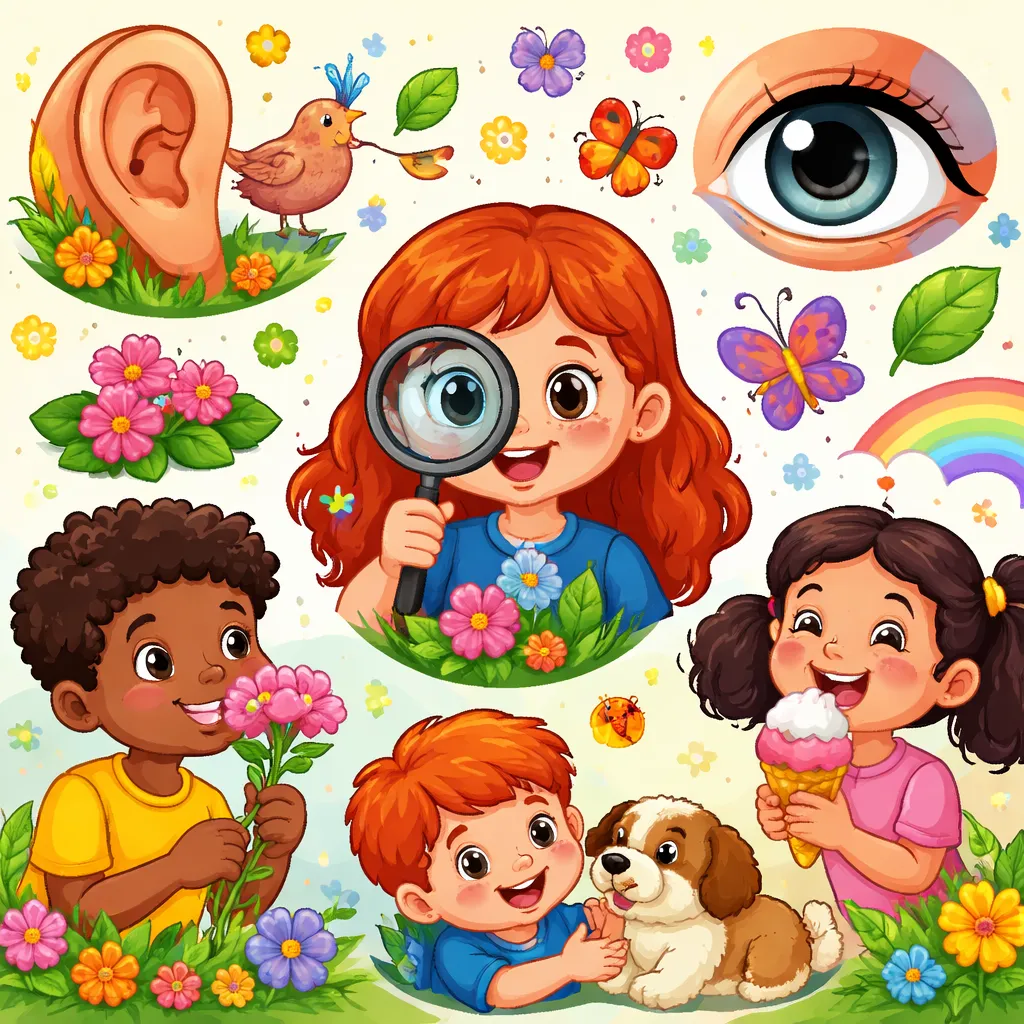
Leo and Mia were walking in the garden with their eyes closed. "What can you hear?" asked their dad. "I hear a bird singing!" said Mia. "I feel the warm sun on my arms," said Leo. "Good!" said Dad. "Now, what can you smell?" They sniffed the air. "Flowers!" they both said. "You are using your senses. Your senses are your body's tools to explore the world. You have five main senses. Let's open our eyes and learn all about them with some fun five senses activities and vocabulary. When you know the words, you can describe your whole world better!" Leo and Mia opened their eyes, ready to explore. Let's use all our senses and learn together.
Core Knowledge Explanation
What are senses? Senses are ways your body gathers information from the world around you. You have five main senses: sight, hearing, smell, taste, and touch. Each sense has a special body part. Learning the five senses activities and vocabulary helps you talk about your experiences. Let's meet each sense.
The first sense is sight. You see with your eyes. Eyes collect light and send pictures to your brain. The vocabulary for sight is about how things look. Words are: see, look, watch, bright, dark, colorful, shiny, blurry, clear. You can say, "I see a bright, yellow sun." The second sense is hearing. You hear with your ears. Ears catch sound waves. The vocabulary for hearing is about sounds. Words are: hear, listen, loud, quiet, silent, noisy, high-pitched, low, musical. You can say, "I hear a loud, barking dog."
The third sense is smell. You smell with your nose. Your nose has special cells that detect scents in the air. The vocabulary for smell is about scents. Words are: smell, sniff, stinky, fragrant, sweet, sour, fresh, smoky, musty. You can say, "I smell the fragrant flowers." The fourth sense is taste. You taste with your tongue. Your tongue has tiny buds that tell you if something is sweet, sour, salty, or bitter. The vocabulary for taste is about flavor. Words are: taste, sweet, sour, salty, bitter, spicy, yummy, yucky, bland. You can say, "The lemon tastes sour."
The fifth sense is touch. You feel with your skin. Skin all over your body feels things. The vocabulary for touch is about texture and temperature. Words are: touch, feel, soft, hard, rough, smooth, bumpy, hot, cold, wet, dry. You can say, "The kitten feels soft and warm." These are the basic five senses activities and vocabulary. Your brain puts all this information together to help you understand everything around you.
Fun Interactive Learning
Let's play the "Sense Scavenger Hunt"! This is the best way to practice. You need a notebook. Go to a room or your yard. For sight, find something red. Draw it. For hearing, listen for one minute. What is the quietest sound you hear? Write it down. "I hear the clock ticking." For smell, find something that smells good. It could be soap or a herb. For touch, find something rough. For taste, this one needs a grown-up! Find a safe food, like a cracker. Taste it. Is it salty or bland? This hunt makes you use all your senses. It is a full of five senses activities and vocabulary practice.
Another fun game is "Mystery Box." Get a small box. Cut a hole just big enough for a hand. Ask a grown-up to put different objects inside, one at a time. You cannot look! Put your hand in. Use only your sense of touch. What do you feel? Is it fuzzy like a pom-pom? Is it hard and smooth like a spoon? Guess what it is. Say, "I feel something hard and bumpy. I think it is a pinecone." This game focuses on touch vocabulary. You can also play "Sound Bingo." Record or make different sounds: a bell, crumpling paper, pouring water. Play the sounds. On a bingo card, have pictures of the items. Mark the picture when you hear the sound. This sharpens your hearing.
Expanded Learning
All animals have senses, but some are much stronger than ours. A dog has a super sense of smell. A bat uses sound waves to "see" in the dark. This is called echolocation. An eagle has amazing sight. Learning about the five senses activities and vocabulary connects us to the animal kingdom. In some people, one sense does not work well. A person who cannot see might use their sense of touch to read braille. A person who cannot hear might use their sight to understand sign language. Our senses help us adapt.
Long ago, humans needed sharp senses to survive. They needed to hear predators, see danger, and smell good food. Today, we use our senses to enjoy life, learn, and stay safe. When you learn the five senses activities and vocabulary, you are learning to be more aware and appreciative of the world. Let's make a five senses song. Sing to the tune of "Head, Shoulders, Knees, and Toes."
Eyes and ears and nose and tongue, and skin! (and skin!) Eyes and ears and nose and tongue, and skin! (and skin!) We use them all to sense the world, every day! Eyes and ears and nose and tongue, and skin! (and skin!) Sight and hearing, smell and taste, and touch! (and touch!) These five senses tell us much, yes so much!
What You Will Learn
You are learning about biology, observation, and descriptive language. You are learning the five senses activities and vocabulary: sight (see, look, bright, dark), hearing (hear, listen, loud, quiet), smell (smell, fragrant, stinky), taste (taste, sweet, sour, salty, bitter), touch (touch, feel, soft, rough, smooth). You are also learning the body parts: eyes, ears, nose, tongue, skin.
You are learning descriptive and experiential sentences. You can say, "I see a shiny, red apple." You can explain, "The blanket feels soft and warm." You can compare, "The drum is loud, but the whisper is quiet." You are using English to give rich, detailed descriptions of your experiences. This builds strong communication skills.
You are building crucial observation skills. You are building attention. You focus on specific senses. You are building vocabulary. You learn precise words for sensations. You are building mindfulness. You notice the details of the world. You are building scientific method. You gather information through observation. You are building empathy. You understand how others might experience the world differently.
You are forming a mindful and curious habit. The habit of paying full attention to the present moment through your senses. You learn to experience the world more deeply. Learning the five senses activities and vocabulary turns everyday moments into adventures of discovery and gives you the words to share those adventures.
Using What You Learned in Life
Use your senses actively every day. In the kitchen, help cook. Say, "I smell the spices. They smell spicy and warm." In the park, close your eyes and listen. "I hear three different bird songs." When you get dressed, think about touch. "This shirt feels smooth. These jeans feel rough." When you read a book, imagine the senses. "The character must taste the salty sea air."
At school, use this in writing. Instead of "The cake was good," write, "The cake looked fluffy, smelled sweet, and tasted delicious." In art class, describe the colors you see. In music class, describe the sounds you hear. Teach a friend the "Mystery Box" game. The more you practice using the five senses activities and vocabulary, the more vivid your world will become, and the better you will be at telling others about it.
Closing Encouragement
You are a sense explorer. You are a world noticer. You are a mindful and descriptive learner. I am so proud of you. Learning all about the five senses and their vocabulary shows you have a curious heart and attentive mind.
Keep exploring, keep sensing, keep describing. The world is full of wonders waiting for your eyes, ears, nose, tongue, and skin to discover. You have the keys to experience it all.
You are observant, you are expressive, and you are learning the language of experiencing life. Great work, my wonderful sense detective.