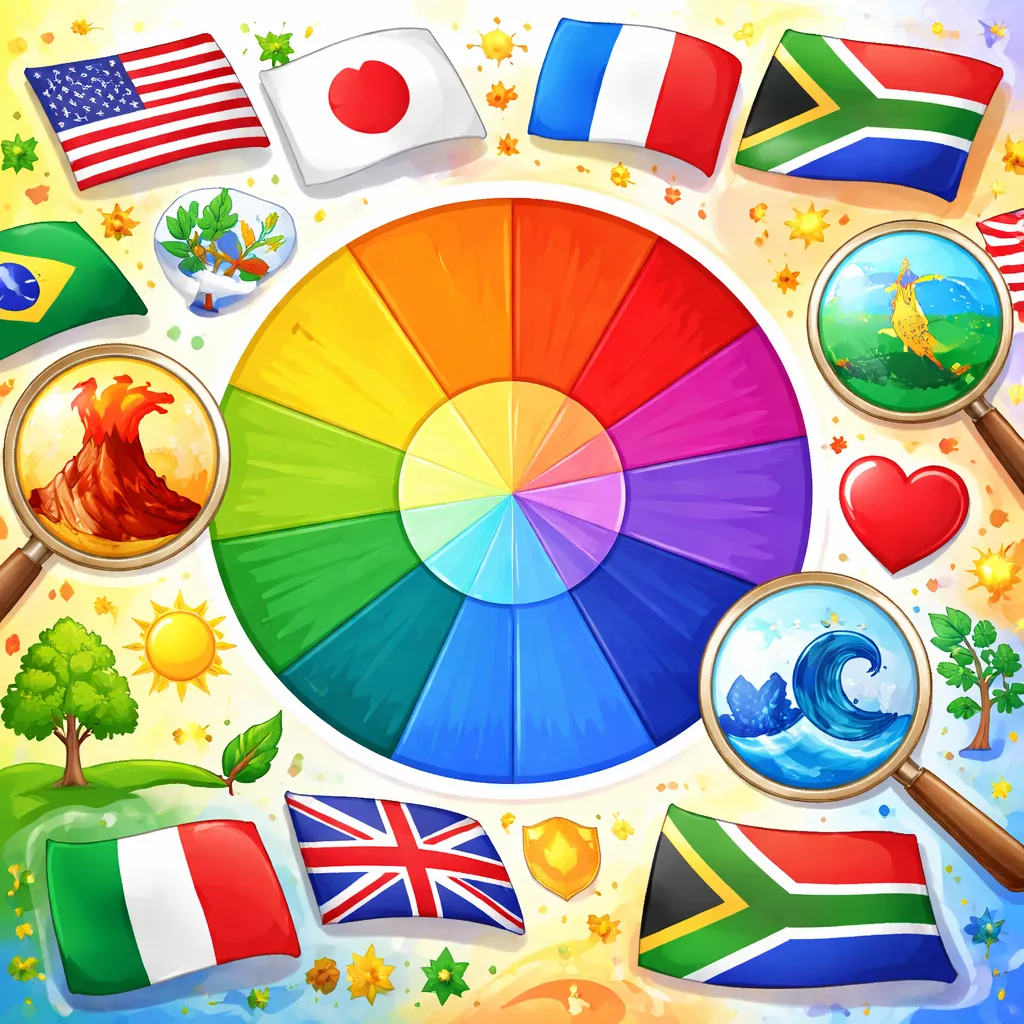

Flag Colors, Symbolism, World Cultures, Geography for Kids, History Learning, Visual Symbols
Opening Introduction
Leo was drawing a picture. He colored a rectangle with red, white, and blue stripes. "It's the flag of France!" he said proudly. His friend Sam looked at his own drawing. "Mine is red, white, and green. It's Italy's flag. But why do they choose these colors?" Their teacher, Ms. Chen, overheard. "Great question! Flags are not just pretty patterns. Their colors are like a secret code. Each color can tell a story about the country's land, history, or hopes. Let's learn about national flags and colors meaning. It's like being a detective for history and culture!" Leo and Sam were excited. A secret code in colors? They wanted to crack it. Let's start our colorful investigation.
Core Knowledge Explanation
A national flag is a special symbol for a country. It is a piece of cloth with colors and shapes. People fly it to show pride and unity. But the colors are not chosen by accident. For centuries, people have given meanings to colors. Understanding the national flags and colors meaning helps us understand the country's heart. Let's look at the most common colors and what they often represent.
First, the color red. Red is a strong, bright color. In flags, red can mean bravery, strength, and valor. It can also stand for the blood shed by people who fought for the country's freedom. Look at the flag of the United States. The red stripes stand for hardiness and valor. In the flag of China, red is the color of revolution and happiness. The Canadian flag has a red maple leaf. The red represents sacrifice and endurance.
Second, the color white. White is pure and clean. In flags, white often means peace, honesty, and purity. It can also stand for snow or peace. The white in Japan's flag stands for honesty, purity, and integrity. The white stripes in the flag of the Netherlands stand for peace. In the French flag, white is the color of the king and also represents peace.
Third, the color blue. Blue is the color of the sky and the sea. In flags, blue can mean freedom, vigilance, truth, loyalty, perseverance, and justice. Look at the flag of the United Nations. The light blue stands for peace. The blue in the flag of Greece represents the sea and the sky. The blue stripe in the flag of Argentina stands for the sky.
Fourth, the color green. Green is the color of nature. In flags, green often represents the land, agriculture, forests, hope, and fertility. The flag of Italy has a green stripe. It stands for the hills and plains of Italy. The flag of Pakistan is mostly green, representing the Muslim majority and prosperity. The flag of Brazil has a green field, representing the lush forests.
Fifth, the color yellow or gold. Yellow is the color of the sun. In flags, it can mean wealth, energy, happiness, generosity, and the sun itself. The yellow in the flag of Spain represents generosity. The yellow sun on the flag of Argentina is the Sun of May, a national symbol. The yellow in the flag of Colombia stands for sovereignty and justice.
Sixth, the color black. Black is a strong color. In flags, black can stand for determination, ethnic heritage, or the dark past a country has overcome. The black in the flag of Germany represents determination. The flag of Jamaica has black triangles, standing for the strength and creativity of the people. These are general meanings. Each country's national flags and colors meaning can have a special story. Learning them is like reading a short, colorful history book.
Fun Interactive Learning
Let's play a game called "Color Detective." Get pictures of different flags: France, Italy, Japan, Brazil, Canada, South Africa. Look at each flag. What colors do you see? Now, guess what the colors might mean for that country. For Italy: Green for the land, white for the snow in the Alps, red for the blood in the wars for independence. Then, ask a grown-up to help you look up the real meaning online or in a book. See if you were close! This game makes you think about the national flags and colors meaning and connects geography with history.
Another fun activity is "Design Your Own Flag." Think about what is important to you, your family, or your street. What colors would you choose? Draw your flag. Then, write a short explanation. "My flag is blue and green. Blue is for the clear sky above our house. Green is for the big tree in our garden. The white star is for hope." This activity lets you use the idea of national flags and colors meaning in a personal, creative way. You are the designer and the storyteller.
You can also play "Flag Memory." Make pairs of cards. On one card, draw a flag. On the matching card, write the main color and its common meaning. For example, a card with a red stripe and the word "Bravery." Mix the cards and try to match the flag color to the meaning. This helps you remember the symbolism. These games turn learning about national flags and colors meaning into an active, thoughtful adventure.
Expanded Learning
The use of colors in flags is very old. Hundreds of years ago, kings and armies used flags with colors to show who they were. The national flags and colors meaning we know today became more fixed in the last 200 years. In different cultures, colors can mean different things. In Western cultures, white means peace. In some Eastern cultures, white is the color of mourning. But in flags, countries usually choose meanings that are shared and positive.
Some flags tell a specific story. The flag of the United States has 13 stripes for the 13 original colonies and 50 stars for the 50 states. The colors red, white, and blue have the meanings we learned. The flag of South Africa is full of meaning. The red, white, and blue come from old flags, and the green, black, and gold are from African nationalist flags. Together, they show unity. Learning about national flags and colors meaning connects us to art, politics, and the shared dreams of people. Let's make a flag color song. Sing to the tune of "Twinkle, Twinkle, Little Star."
Red for courage, brave and true, white for peace and honesty too. Blue for justice, sky, and sea, green for land and liberty. Yellow for the shining sun, for the victories that are won. Black for strength of people free, in the flag for all to see! Every color tells a tale, on the breeze it sets to sail!
What You Will Learn
You are learning about symbolism, history, and global awareness. You are learning the common national flags and colors meaning: red for bravery, white for peace, blue for freedom, green for nature, yellow for the sun, black for determination. You are also learning to observe and interpret symbols, and you are building a foundation in world cultures.
You are learning descriptive and analytical sentences. You can say, "The green in the Italian flag represents the countryside." You can explain, "Many flags use blue to symbolize the sky or the ocean." You can compare, "Both the French and US flags use red, white, and blue, but the meanings are a little different." You are using English to discuss abstract concepts like freedom and justice, which builds higher-level thinking.
You are building valuable skills. You are building observation. You look closely at flags and their parts. You are building cultural literacy. You understand common symbols across nations. You are building historical thinking. You connect colors to past events. You are building empathy. You appreciate what different countries value. You are building communication. You can describe and explain symbols.
You are forming an inquisitive habit. The habit of looking beyond the surface. You learn that even a simple flag is a window into a nation's soul. Understanding national flags and colors meaning makes you a more informed, thoughtful, and connected global citizen.
Using What You Learned in Life
Use your new knowledge when you see flags. During the Olympic Games, look at the flags of different countries. Try to guess what their colors might mean. When you visit a new place, notice the flags. Ask, "What does the green in this flag stand for?" You can also use this when you draw or do art projects. Choose colors for a project based on what you want to say. "I'll use blue for calm and yellow for happiness."
At school, this knowledge is great for geography, history, and art classes. You can do a presentation on your favorite flag and explain its colors. When you read a book or watch a movie set in another country, look for the flag. See if the story matches the values on the flag. The more you practice seeing the national flags and colors meaning, the more you will see stories woven into the world around you.
Closing Encouragement
You are a color detective. You are a symbol decoder. You are a curious and thoughtful world explorer. I am so proud of you. Learning about the meaning behind flag colors shows you have a sharp eye for detail and a deep mind for understanding.
Keep looking for the stories in the symbols around you. Every flag is a conversation starter about a land and its people. You are learning to speak the language of symbols, and that is a beautiful skill.
You are observant, you are knowledgeable, and you are learning to connect with cultures through their colors. Great work, my wonderful flag expert.