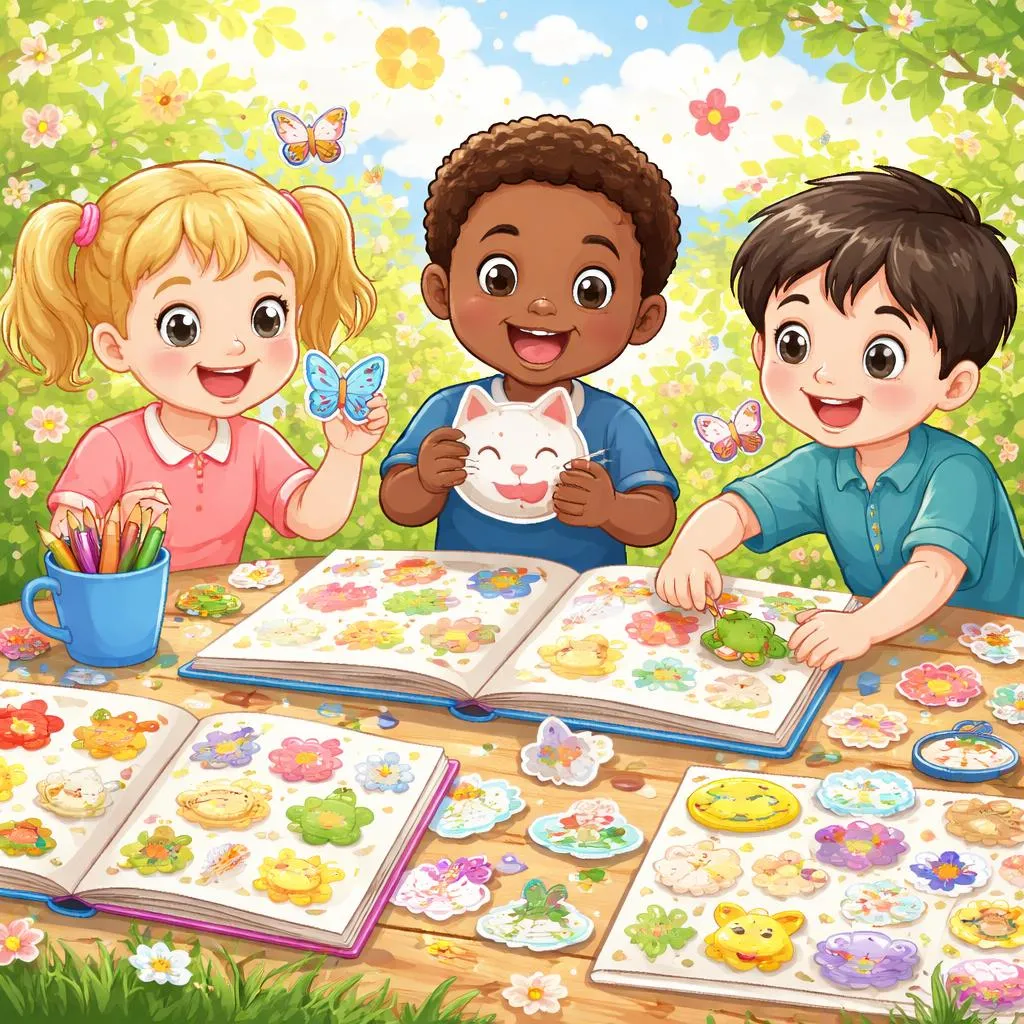

Hello, young learners and teachers! Welcome to our colorful spring lesson. Today we explore the wonderful world of springtime stickers. These little sticky pictures make learning English fun and hands-on.
Spring is a season of new beginnings. Flowers bloom, animals wake up, and the weather gets warmer. Stickers with spring themes help children learn vocabulary about this beautiful season.
Let us open our sticker books. Let us discover all the ways stickers can help with learning. Spring is waiting to stick with us.
What are Springtime Stickers? Springtime stickers are small sticky pictures with spring themes. They show things we see in spring. Flowers, butterflies, baby animals, rainbows, and sunny days.
Stickers come in many shapes and sizes. Some are big. Some are tiny. Some are sparkly. Some have fun shapes. Children love to peel and stick them everywhere.
Teachers and parents use stickers for many reasons. They reward good work. They decorate projects. They make learning more exciting. Stickers turn ordinary lessons into special experiences.
Spring stickers are extra special because they celebrate the season. They bring the beauty of spring into the classroom or home.
Meaning and Explanation When we talk about springtime stickers, we mean stickers that represent spring themes. They help children learn vocabulary related to the season.
Spring vocabulary includes words like flowers, rain, sunshine, butterflies, bees, birds, nests, eggs, bunnies, and baby animals. Stickers with these images make the words real.
Children can see the picture and learn the word. They can touch the sticker and feel its texture. They can place it somewhere special. This multi-sensory experience helps memory.
Stickers also motivate children. Earning a sticker for good work makes them proud. Choosing a sticker for a project gives them ownership. Stickers make learning personal and fun.
Categories or Lists Let us look at different types of springtime stickers organized by theme. This helps in choosing stickers for learning.
Flower Stickers Roses - pretty flowers with many petals Daisies - white petals with yellow centers Tulips - cup-shaped flowers on long stems Sunflowers - tall flowers with big yellow heads Daffodils - yellow trumpet-shaped flowers Cherry blossoms - pink flowers on trees Lilies - large, showy flowers Lavender - purple flowers that smell nice
Animal Stickers Butterflies - colorful insects with wings Bees - yellow and black insects that make honey Ladybugs - small red beetles with black spots Birds - feathered animals that sing Robins - birds with red chests Nests - homes that birds build Eggs - baby birds inside shells Bunnies - small furry animals with long ears Lambs - baby sheep Chicks - baby chickens Ducks - water birds with webbed feet Frogs - green animals that jump and croak
Weather Stickers Sun - bright yellow circle that gives light Rain - drops of water falling from clouds Rainbow - colorful arc in the sky after rain Clouds - fluffy white shapes in the sky Wind - moving air that blows things Umbrella - used to stay dry in rain Rain boots - boots for splashing in puddles
Nature Stickers Trees - tall plants with leaves Grass - green plants that cover the ground Leaves - green parts of trees and plants Puddles - small pools of water after rain Mud - wet, soft dirt Ponds - small bodies of water Streams - small flowing water
Spring Activities Stickers Planting - putting seeds in the ground Gardening - working in a garden Picnic - eating outside on a blanket Kite flying - flying a kite in the wind Splashing - playing in puddles Hunting for eggs - looking for Easter eggs Riding bikes - cycling on spring days
Baby Animal Stickers Baby chicks - fluffy yellow baby chickens Baby ducks - small, yellow ducklings Baby bunnies - tiny rabbits with soft fur Baby lambs - small sheep with curly wool Baby birds - little birds in nests Fawns - baby deer with spots Kittens - baby cats Puppies - baby dogs
Daily Life Examples Let us see how springtime stickers appear in daily learning. These examples show real moments.
In the classroom, a teacher gives each child a sticker chart. When children learn a new spring word, they get a spring sticker to put on their chart. They collect flowers, butterflies, and bunnies. By the end of spring, their charts are full.
At home, a parent helps a child make a spring scene. They take a large piece of paper. They draw grass and a sky. Then they use spring stickers to add flowers, butterflies, and a rainbow. The child names each sticker as they place it.
During a nature walk, children carry small notebooks. They look for real spring things. When they see a flower, they put a flower sticker in their notebook. When they see a bird, they add a bird sticker. They create a record of their spring discoveries.
On a rainy day, children do a spring sticker sorting activity. They have many spring stickers. They sort them into groups. Flowers in one pile. Animals in another. Weather in another. They practice vocabulary while sorting.
Printable Flashcards We can make printable materials using springtime stickers. Here are ideas for using stickers with flashcards.
Make blank flashcards. Add a spring sticker to each card. On the back, write the word for that sticker. Flower, butterfly, rainbow, bunny. Use these for vocabulary practice.
Make matching cards. Have one set of cards with stickers. Another set with words. Children match the sticker to the correct word.
Make sequence cards. Use stickers to show the life cycle of a butterfly. Egg, caterpillar, chrysalis, butterfly. Children put them in order.
Make story cards. Put different spring stickers on cards. Children arrange them and tell a story using the stickers.
Make bingo cards. Place spring stickers in the squares. Call out the words. Children cover the matching sticker.
Learning Activities or Games Let us play some games with springtime stickers. These activities make learning fun and hands-on.
Activity 1: Sticker Scavenger Hunt Hide spring stickers around the room. Give children a list of words. They search for the sticker that matches each word. When they find one, they name it and put it on their paper.
Activity 2: Sticker Sorting Provide a variety of spring stickers. Make sorting mats with categories. Flowers, Animals, Weather, Activities. Children sort the stickers into the correct groups. They name each sticker as they sort.
Activity 3: Sticker Story Time Give each child a blank book made from folded paper. They use spring stickers to create a story. They place stickers on each page and dictate or write sentences. "The butterfly flew over the flowers." "The bunny hopped in the grass."
Activity 4: Sticker Patterns Create patterns with spring stickers. Flower, butterfly, flower, butterfly. What comes next? Children continue the pattern using stickers. This builds math and logic skills.
Activity 5: Sticker Bingo Make bingo cards with spring stickers in the squares. Call out the words. Children cover the matching sticker with a small token. First to cover a row wins.
Activity 6: Sticker Graphing Give each child a collection of spring stickers. They sort them by type. Then they create a graph showing how many of each they have. Flower graph, butterfly graph, etc. This combines math and vocabulary.
Activity 7: Sticker Writing Children choose a spring sticker and place it at the top of a page. They write a sentence or story about that sticker. "The rainbow is colorful." "The bunny likes to hop."
Activity 8: Sticker Counting Give children a number card and spring stickers. They put that many stickers on their paper. For number 5, they add five flower stickers. For number 3, they add three butterfly stickers.
Activity 9: Sticker Memory Game Make pairs of cards with matching spring stickers. Place them face down. Players take turns flipping two cards. If they match, they keep the pair and name the sticker.
Activity 10: Sticker Sorting by Color Provide spring stickers in different colors. Children sort them by color. Yellow flowers, yellow butterflies. Red flowers, red ladybugs. This teaches color vocabulary.
Activity 11: Sticker Letter Match Write letters on paper. Children find spring stickers that start with each letter. B for butterfly, F for flower, R for rainbow, S for sun. They place the sticker next to the letter.
Activity 12: Sticker Feelings Use spring stickers to talk about feelings. Place a flower sticker. "How does this flower make you feel?" Happy? Calm? Children share their feelings. This builds emotional vocabulary.
Activity 13: Sticker Observation Give each child a magnifying glass and a spring sticker. They look closely at the sticker. They describe what they see. "The butterfly has blue wings." "The flower has five petals."
Activity 14: Sticker Rewards Use spring stickers as rewards for good work. When children complete a task, they choose a spring sticker for their chart. This motivates and builds vocabulary.
Activity 15: Sticker Calendar Create a spring calendar. Each day, children add a spring sticker. They talk about the weather and choose a matching sticker. Sunny day gets a sun sticker. Rainy day gets a raindrop sticker.
Activity 16: Sticker Puppets Attach spring stickers to craft sticks to make puppets. Children use them to act out spring stories. They can make the butterfly fly and the bunny hop.
Activity 17: Sticker Collage Give children a large piece of paper. They create a spring scene using many stickers. They add grass, flowers, butterflies, and a sun. Then they describe their scene.
Activity 18: Sticker Guessing Game Place a spring sticker in a bag without showing it. Give clues. "This is an insect. It has colorful wings. It flies from flower to flower." Children guess butterfly. Pull out the sticker to check.
Activity 19: Sticker Alphabet Book Make an alphabet book. For each letter, children find a spring sticker that starts with that letter. A is for ant, B is for butterfly, C is for caterpillar. They stick it on the page.
Activity 20: Sticker Dance Play spring music. Children dance with spring stickers in their hands. When the music stops, they hold up their sticker and name it. "I have a flower!" "I have a bee!"
Activity 21: Sticker Hide and Seek One child hides a spring sticker somewhere in the room. Others look for it. When someone finds it, they name the sticker and hide it next time.
Activity 22: Sticker Patterns on Clothes Give children a paper person outline. They use spring stickers to decorate the clothes. They describe their creation. "My person has a flower shirt and butterfly pants."
Activity 23: Sticker Symmetry Fold a paper in half. Put spring stickers on one side. Children try to place matching stickers on the other side to create symmetry. This teaches math concepts.
Activity 24: Sticker Sentences Place several spring stickers on a page. Children write a sentence using as many sticker words as possible. "The butterfly and the bee flew over the flower."
Activity 25: Sticker Celebration At the end of spring, have a sticker celebration. Children bring their sticker collections, charts, and crafts. They share what they learned. Everyone gets a special spring sticker to take home.
Springtime stickers bring the beauty of the season into learning. Children touch, see, and name spring things. They create art, tell stories, and practice vocabulary.
Stickers make learning hands-on and fun. A simple sticker can spark a conversation. It can be a reward. It can be a teaching tool. The possibilities are endless.
Every spring sticker tells a story. The flower that bloomed. The butterfly that emerged. The rain that made a rainbow. Children learn about the world while learning English.
Keep sticking and learning. Keep exploring spring through stickers. The season is full of beauty and new words.
Happy spring sticking, everyone