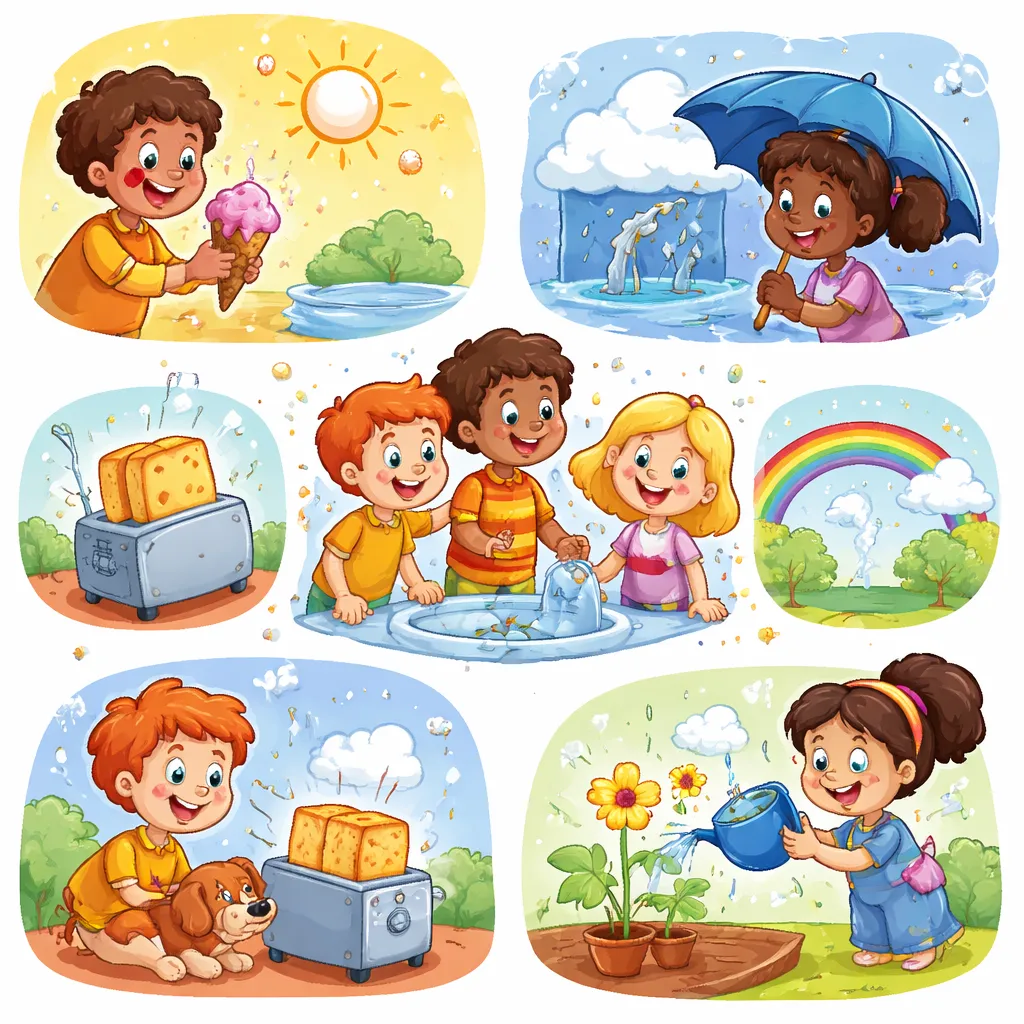

What happens if you drop a ball? It falls. What happens if you heat ice? It melts. These are facts. They are always true. In English, we have a special way to talk about these always-true facts. It is called the zero conditional. Think of it as your "Science Detective" tool. It helps you talk about things that are always true. Let's learn how to use this cool grammar tool.
What Is the 'Science Detective' Tool?
The zero conditional is a sentence pattern. It talks about a general truth or a scientific fact. It shows a cause and an effect that is always real. It uses two parts: the "if" part (the condition) and the "result" part. Both parts use the present simple tense. At home, you know: "If you don't water a plant, it dies." This is a fact. At the playground: "When you push a swing, it moves." This is always true. In school: "If you mix blue and yellow, you get green." This is a science fact. In nature: "If bears are hungry, they look for food." This is a general truth about animal behavior. The zero conditional is about what always happens.
Why Is This Tool So Valuable?
Knowing the zero conditional makes you a clear thinker and communicator. It helps your ears, your voice, your reading eyes, and your writing hand.
First, it helps your listening. You watch a science show. The host says, "If you heat water to 100~C, it boils." You hear the pattern. You know it's stating a fact. You catch the key scientific information. Your teacher might say, "If you finish your work, you can read." You know this is a class rule. It helps you understand cause and effect.
Next, it makes your speaking logical and strong. You can explain rules clearly. You can say, "If you are late, you miss the bus." This states a clear result. You can share fun facts. "If you touch a cactus, it hurts!" Your words become powerful and factual. People see you as knowledgeable.
Then, it gives you a reading superpower. You read a science book. It says, "When clouds get heavy, it rains." You see the zero conditional structure. You know it's explaining a natural process. This helps you understand how the world works. You can read instructions and facts with confidence.
Finally, it makes your writing factual and clear. Your science reports are accurate. Instead of writing "Water boils sometimes," you can write "Water boils if you heat it to 100~C." This is precise. You can write clear rules for a game. Your instructions become easy to follow. Your writing sounds expert.
The Simple Rule of the Zero Conditional
The zero conditional is very simple. It follows one easy rule. The rule is: If/When + Present Simple, Present Simple. The word 'if' or 'when' can start the sentence. The result is in the present simple. It is a fact. You can also swap the two parts. Look at these examples.
At home: "If I am late, my mom gets worried." Or, "My mom gets worried if I am late." Both are correct. The cause and effect are clear.
At the playground: "When the bell rings, we go inside." Or, "We go inside when the bell rings." This is a regular rule.
In school: "If the teacher asks a question, we raise our hands." This is a classroom habit.
In nature: "When winter comes, some birds fly south." This is a general truth about nature.
The most important thing is that both verbs are in the present simple tense. This shows it is always true.
Your Detective Tool: How to Spot It
Finding the zero conditional is a fun game. Here is the secret. Look for the word 'if' or 'when'. Then, check the verbs in both parts of the sentence. Are both verbs in the present simple tense? If yes, you have found a zero conditional! Ask yourself: "Is this sentence talking about something that is always true or a general rule?" If yes, it is your Science Detective tool. The pattern is: If/When + [present simple], [present simple].
How to Use Your Science Detective Tool
Using the zero conditional is easy. Follow this simple map. You have two boxes. Box A is the condition. Box B is the result. You can say: "If Box A, then Box B." Or "Box B if Box A." Remember to use the present simple in both boxes. For example: "If (you touch fire), (you get burned)." You can also use 'when' instead of 'if'. 'When' is used for things that are certain to happen. "When (the sun sets), (it gets dark)." The comma is important when the 'if' or 'when' part comes first.
Oops! Let's Fix Common Mistakes
Everyone makes mistakes. Let's fix common errors. One big mistake is using 'will' in the result. A child might say, "If you heat ice, it will melt." This is not wrong, but for a general fact, the zero conditional is stronger: "If you heat ice, it melts." Using the present simple for both shows it is always true.
Another mistake is mixing up tenses. Do not say, "If you mix colors, you got a new color." Use the present simple in both parts: "If you mix colors, you get a new color."
A third mistake is forgetting that both parts are facts. The zero conditional is not for possible futures. It is for general truths. Do not use it for personal plans. "If I have time, I will call you" is a first conditional for a possible future. "If I have time, I call you" is a zero conditional for a habit. Be careful.
Are You Ready for a Science Detective Challenge?
Let's test your skills. Think of three science facts. Write them as zero conditional sentences. Example: "If you freeze water, it becomes ice." Now, think of two rules at home or school. Write them as zero conditional sentences. Example: "If you finish your homework, you can play." Imagine you are explaining how a plant grows. Write two zero conditional sentences. Example: "If a plant gets sunlight, it grows." Finally, make up a funny rule for an imaginary planet. Use the zero conditional. Be creative!
You Are Now a Science Detective
You have learned all about the zero conditional. You know it is for facts and general truths. You understand the simple rule: present simple in both parts. You can spot it by looking for 'if' or 'when'. You have the formula to use it. You can even fix common mistakes. You can now talk about the world's always-true rules.
You can learn many things from this article. You now know that the zero conditional is used to talk about general truths and scientific facts. You understand that it uses the present simple tense in both the 'if/when' part and the result part. You learned the two structures: 'If/When + present simple, present simple' and 'Present simple if/when present simple'. You saw that it is different from other conditionals because it deals with things that are always true. You also know how to use it to explain rules, habits, and natural laws.
Now, try using your new knowledge in real life. Here are two fun ideas. First, be a 'Fact Finder' for a day. Look around you and notice three things that always happen. Write them as zero conditional sentences in a notebook. For example, "If I drop my pencil, it falls." Second, play the 'If... Then...' game with a friend. Take turns saying true facts using the zero conditional. For example, "If you eat too much candy, you get a stomachache." See how many you can think of. Have fun discovering the rules of your world!