
Opening Introduction
Mia is telling a story. "The dog ate the bone," she says. "Then, the dog found a bone. Then, the dog dug a hole." Her friend, Ben, looks confused. "Wait," Ben says. "How can the dog eat the bone before he finds it? That does not make sense." Mia thinks. She mixed up the order. Stories need to be in the right order. First, the dog finds the bone. Then, he digs a hole. Last, he eats the bone.
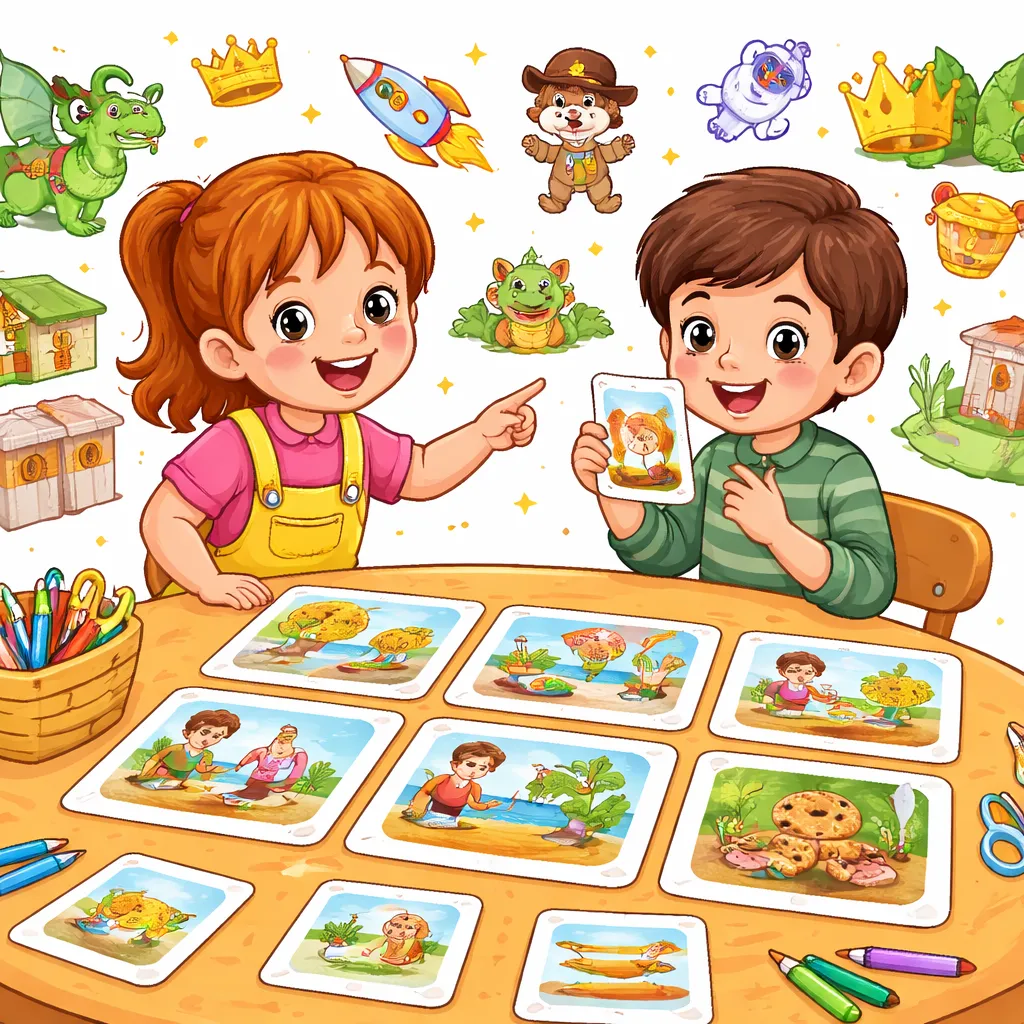
Their teacher, Mr. Reed, hears them. He has a fun tool. He shows them cards with pictures. The first card shows a dog finding a bone. The second shows the dog digging. The third shows the dog eating. "These are printable sequencing cards for stories," he explains. "They help you put the story events in the correct order. Let's use them to make stories that make perfect sense." Mia and Ben are ready. Let's become story detectives and find the right sequence.
Core Knowledge Explanation
What is sequencing? Sequencing is putting things in order. It is putting things in the correct step-by-step order. We sequence things every day. We wake up first. Then we get dressed. Then we eat breakfast. That is a sequence. Stories have a sequence too. A story has a beginning, a middle, and an end. The beginning introduces the characters and the problem. The middle shows what happens. The end shows how it is solved.
Printable sequencing cards for stories are special picture cards. Each card shows one important event from a story. The cards are mixed up. Your job is to put them in the right order. You must think. What happened first? What happened next? What happened last? This is called chronological order. Chronological means in time order. It is the order in which things happen in time.
These cards are printable. You can find them online and print them. They often come in sets. One set might tell the story of a seed growing into a flower. Another set might tell the story of making a sandwich. Another set might tell a classic fairy tale like "The Three Little Pigs". Each set has three, four, or five cards. You start with three-card sequences. Then you try four-card sequences. It gets more challenging and fun.
Why is this so important for learning? Sequencing teaches you logic. Logic is clear thinking. It helps you understand cause and effect. Cause is why something happens. Effect is what happens. If you mix the cards, the story is silly. The effect happens before the cause. The dog eats the bone before he finds it. That is illogical. Putting the cards in order trains your brain to think logically. It is a super skill for school and for life.
Sequencing also helps you with reading comprehension. Comprehension means understanding. When you read a story, you must remember the order of events. If you practice with picture cards, it becomes easier. You learn to look for clue words. Clue words like "first", "next", "then", "after that", and "finally". These words guide you through the sequence. Your printable sequencing cards for stories might have these words on them. They are your helpers.
These cards are also wonderful for English learners. You look at the pictures. You must describe what is happening in each picture. You use complete sentences. "First, the little pig builds a house of straw." "Next, the big bad wolf comes." You are building your speaking skills. You are learning new vocabulary from the pictures. Words like "build", "huff", "puff", "blow down", "escape". You are learning past tense verbs. "Built", "came", "blew", "ran". This is powerful grammar practice in a fun way.
You can use the cards in many ways. You can lay them on the floor. You can hold them in your hand. You can work alone. You can work with a friend. You can even make up your own story for the pictures. The cards are a tool for your imagination. They are a puzzle. A story puzzle. And you are the solver.
Fun Interactive Learning
Let's play with a set of cards. Print a set of printable sequencing cards for stories. Let's use a simple three-card set. The story is "Making a Sandcastle". The three pictures are: 1. A boy with an empty bucket. 2. The boy turning over a bucket full of sand. 3. A finished sandcastle with a flag.
First, mix up the cards. Lay them face up. Look at each picture carefully. Ask yourself, "What is happening in this picture?" Now, find the picture that must be first. Which picture shows the beginning? The boy has an empty bucket. He is about to start. That is card one. Put it on the left.
Now, what happens next? He uses the bucket to make the castle shape. He turns over the bucket full of sand. That is card two. Put it in the middle. What happens last? The castle is finished. It has a flag. That is card three. Put it on the right. Great. You made a sequence. Now, tell the story. "First, the boy gets his bucket. Next, he fills the bucket with sand and turns it over. Then, he adds a flag to the beautiful sandcastle."
Let's play a game called "Sequence Race". You need a friend. Each of you has the same set of cards, but they are mixed up. Say "Go!" Both of you must put your cards in the correct order as fast as you can. The first to finish says, "Sequence!" Then, you must tell the story correctly. If you are right, you get a point. Play five rounds. The one with the most points wins. It is a fast and fun thinking game.
Another game is "Create the Middle". Use a four-card sequence. But hide the third card. Give your friend the first, second, and last card. Your friend must tell you what they think happened on the missing card. They can draw it. They can describe it. Then, show them the real third card. Compare the ideas. This game makes you think creatively. It is like being a story writer.
Expanded Learning
Sequencing is not just for stories. It is a part of life. Think about a recipe. You must follow the steps in order. First, get the ingredients. Next, mix them. Then, bake. Last, eat. Think about a science experiment. You must follow the procedure. First, pour the liquid. Next, add the powder. Then, watch the reaction. Knowing sequence keeps you safe and helps you succeed.
Many cultures have traditional stories that follow a clear sequence. Fairy tales often start with "Once upon a time" and end with "happily ever after". Fables have a clear beginning, middle where a lesson is learned, and an end with a moral. Your printable sequencing cards for stories might be based on these tales. They connect you to stories people have told for hundreds of years.
Let's make a sequencing song. Songs help us remember order. Sing this to the tune of "The Itsy Bitsy Spider".
First, you start the story, with a great big smile. Then, you add the middle, that goes on for a while. Next, you solve the problem, the characters are glad. Finally, you end it, the best you ever had! These are the story parts, that make it fun to read. Put them all in order, that's the skill you need!
You can sing this when you are ordering your cards. It makes the activity musical.
What You Will Learn
You are learning important words. You are learning sequence words: first, next, then, after that, finally, last, beginning, middle, end. You are learning story words: character, setting, problem, solution, event, plot. You are learning verbs to describe actions: build, run, jump, find, eat, make, create.
You are learning powerful sentences. You can say, "The first step is to find the bucket." You can describe, "In the middle of the story, the wolf huffs and puffs." You can explain, "The sequence of events is very important." You are using English to analyze and tell stories. Your language is becoming rich and detailed.
You are building critical skills. You are building logical thinking. You see how events connect. You are building prediction skills. You guess what comes next. You are building narrative skills. You can tell a coherent story. Coherent means it makes sense and flows well. You are building attention to detail. You notice small clues in the pictures.
You are forming a brilliant habit. The habit of orderly thinking. You learn to break down a big story into small steps. You learn to organize information. This habit will help you in writing, in science, in history, and in everyday planning. Your printable sequencing cards for stories are training your brain to think in a clear, step-by-step way.
Using What You Learned in Life
Use your sequencing skills every day. After school, tell your parent about your day in order. "First, we had math. Next, we had lunch. Then, we played outside. Finally, we read a story." You are practicing sequencing and English speaking.
When you are helping in the kitchen, notice the sequence. "First, we wash the vegetables. Next, we chop them. Then, we cook them." You are a sequencing expert in the kitchen. It makes cooking safer and more fun.
At school, when you write a story, use your sequence words. Draw pictures for the beginning, middle, and end before you write. This is like making your own sequencing cards. It will make your story much better.
When you are playing with toys, create a sequence. For example, with building blocks. "First, I will build the base. Next, I will add the walls. Then, I will put on the roof." Say it out loud. You are the director of your play, and you are using clear, sequential language.
Closing Encouragement
You have done an amazing job. You are a sequence master. You are a story organizer. You are a logical thinker. I am so incredibly proud of you. Your sequencing cards are more than pictures. They are a gym for your brain. They make you strong in thinking and telling.
Keep your cards. Make new ones by drawing your own stories. Challenge your friends and family. Your ability to see order in the world will help you in everything you do.
Remember, every great story, every great invention, every great day has a sequence. You now have the power to see it, to understand it, and to create it. Keep ordering. Keep telling. Keep thinking. You are clever, creative, and capable. Fantastic work, my wonderful story sequencer.