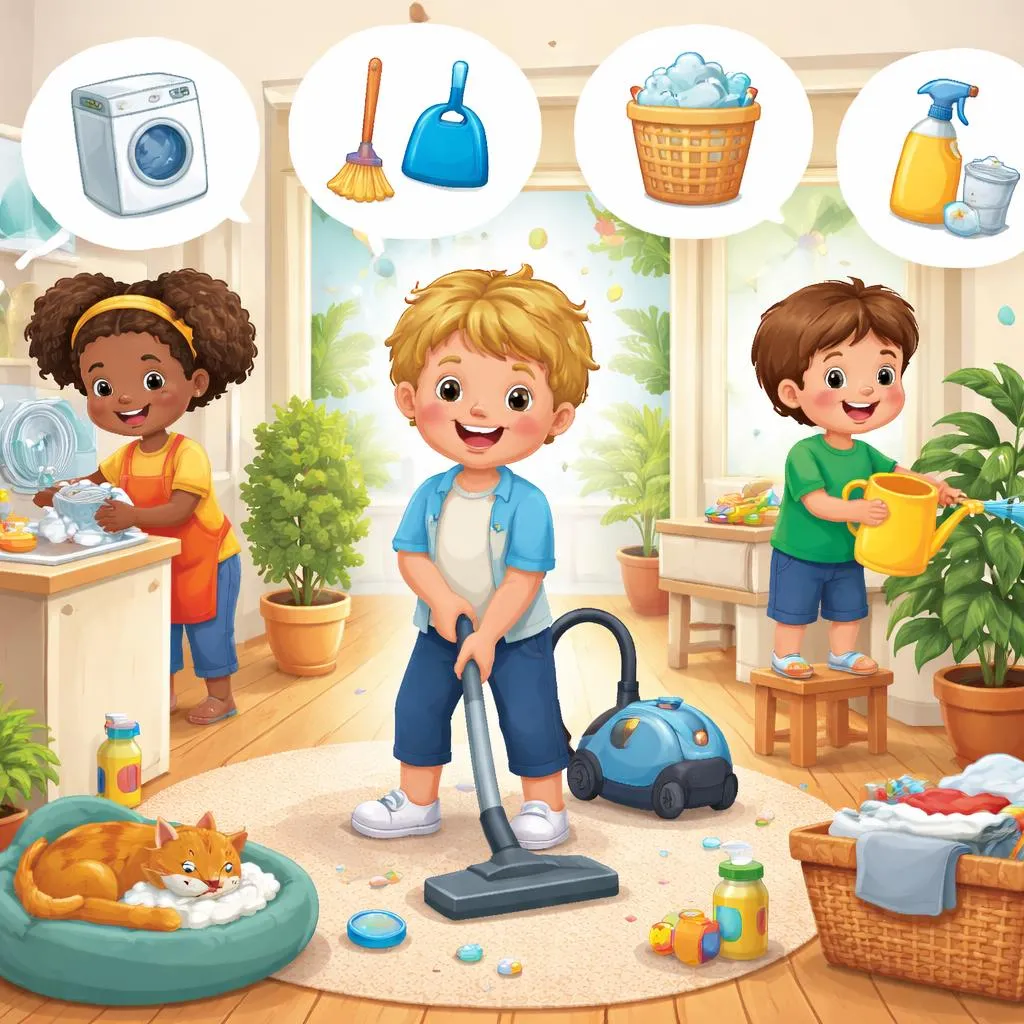

Hello, super helpers and word wizards. Welcome to a very useful lesson today. We are going to talk about something you do at home. We are going to talk about a chore. What is a chore in English. It is a small job you do to help your family. Every home has chores. Learning the words for chores in English helps you talk about your day. It helps you be a responsible family member. Let us learn all about chores and the words we use for them.
What is a chore in English?
A chore in English is a regular or boring task. It is a job you do at home. Chores are not always fun, but they are important. They help keep the home clean and tidy. They help the family work together. The word "chore" is a noun. It names the task. Examples of a chore are making your bed, setting the table, or taking out the trash. When you ask "what is a chore in English," you are asking for the name of these jobs. Knowing these words is part of growing up and learning English. It makes you a good helper and a good communicator.
Meaning and explanation
The meaning of the word chore is about responsibility. Let us explain. A chore is a duty. It is something you are expected to do. The explanation is that chores teach us skills. They teach us to be organized. They teach us to help others. The word itself can feel a bit negative. It sounds like hard work. But we can make it positive. We can call them "helping jobs" or "family tasks." The meaning of learning "chore in English" is to understand this part of daily life. It is to learn the vocabulary for contributing to your home. This is a valuable life lesson and a language lesson combined.
Categories or lists
We can sort chores into different groups. This makes them easier to learn and remember. One group is Cleaning Chores. These jobs make the home neat. Sweep the floor, dust the furniture, vacuum the carpet, mop the floor, clean the window. Another group is Kitchen Chores. These happen in the kitchen. Set the table, clear the table, load the dishwasher, wash the dishes, dry the dishes, take out the trash.
A very personal group is Bedroom Chores. These are for your own space. Make your bed, put away your toys, organize your books, tidy your desk. We also have Laundry Chores. Put clothes in the hamper, fold clothes, put clothes away. Another list is Pet and Plant Chores. Feed the pet, walk the dog, water the plants. Learning chores by category helps you know where and when to do them. It builds a complete picture of helping at home.
Daily life examples
You can talk about chores in your daily life. Here are some scenes. First, the morning routine. After you wake up, you make your bed. You can say, "I made my bed. That's my morning chore." At breakfast, you help set the table. "My chore is to put out the spoons and napkins." Using the words right when you do the chore helps you remember.
Second, after school or playtime. Your mom might say, "It's time for your chores." You might need to put your toys in the toy box. You can say, "My chore is to tidy the living room." Later, before dinner, you might feed the fish. "I have to do my pet chore and feed Goldie." Talking about it makes it a normal part of your day.
Third, a family cleanup time on the weekend. Everyone has a chore. Dad vacuums. Mom dusts. Your chore is to empty the small trash cans. You can say, "My weekend chore is to take out the bathroom trash." You can ask, "What is your chore, Dad?" This creates conversation. Daily life is full of chances to use the words for chore in English. It turns routine tasks into language practice.
Printable flashcards
Printable flashcards are a great tool for learning chores. How to make them. You can make "Chore Picture Cards." On one side, draw a simple picture. Draw a person making a bed. On the other side, write the phrase: "MAKE THE BED." Do this for many chores. You can also make "Category Cards." A header card says "KITCHEN CHORES." Then have smaller cards with pictures of setting the table, washing dishes.
Another idea is "Before and After" cards. One card shows a messy bed. The other card shows a made bed. The child matches them and says the chore. How to use the cards. Play a matching game. Match the chore picture to the word. Play "Chore Charades." Pick a card and act out the chore. Others guess. You can also sort the cards by room. Put all the kitchen chore cards in the kitchen. Put all the bedroom chore cards in the bedroom. Printable flashcards make the idea of a chore in English visual. You can create a chore chart with them.
Learning activities or games
Learning about chores should be a fun, positive activity. Let us play some games. First, "Chore Bingo." Make bingo cards with pictures of different chores. The caller holds up a word card or says a chore. "Set the table!" Players find the picture and mark it. First to get a line wins. This is great for word and picture recognition.
Second, the "Helping Hands" board game. Create a simple path game board. Each space has a picture of a chore or a room. When you land on a space, you must say the chore in a sentence. "I can sweep the floor." Or you must answer a question. "Where do you wash dishes?" (In the kitchen). First to finish the path wins. This encourages speaking.
Third, "Chore Story Chain." Sit in a circle. Start a story. "Once, a robot came to help with chores." The next person adds a sentence with a chore. "...The robot's first chore was to vacuum." Keep going. The story gets silly. This uses chore vocabulary creatively.
For a craft, make a "My Chore Wheel." Divide a paper plate into sections. In each section, draw or write a chore. Attect a cardboard arrow with a brad. Spin the arrow. Wherever it lands, that is your "chore of the day" to talk about or pretend to do. This adds an element of chance. For a movement game, play "Chore Obstacle Course." Set up a simple course. At each station, there is a pretend chore. Station 1: Crouch and pretend to put toys in a box. Station 2: Stretch high to pretend to dust a shelf. Station 3: Make big arm circles to pretend to wash a window. Race through the course. This connects the words to actions. All these activities make learning about a chore in English engaging. You are learning responsibility and new words at the same time. You are becoming a family super helper.