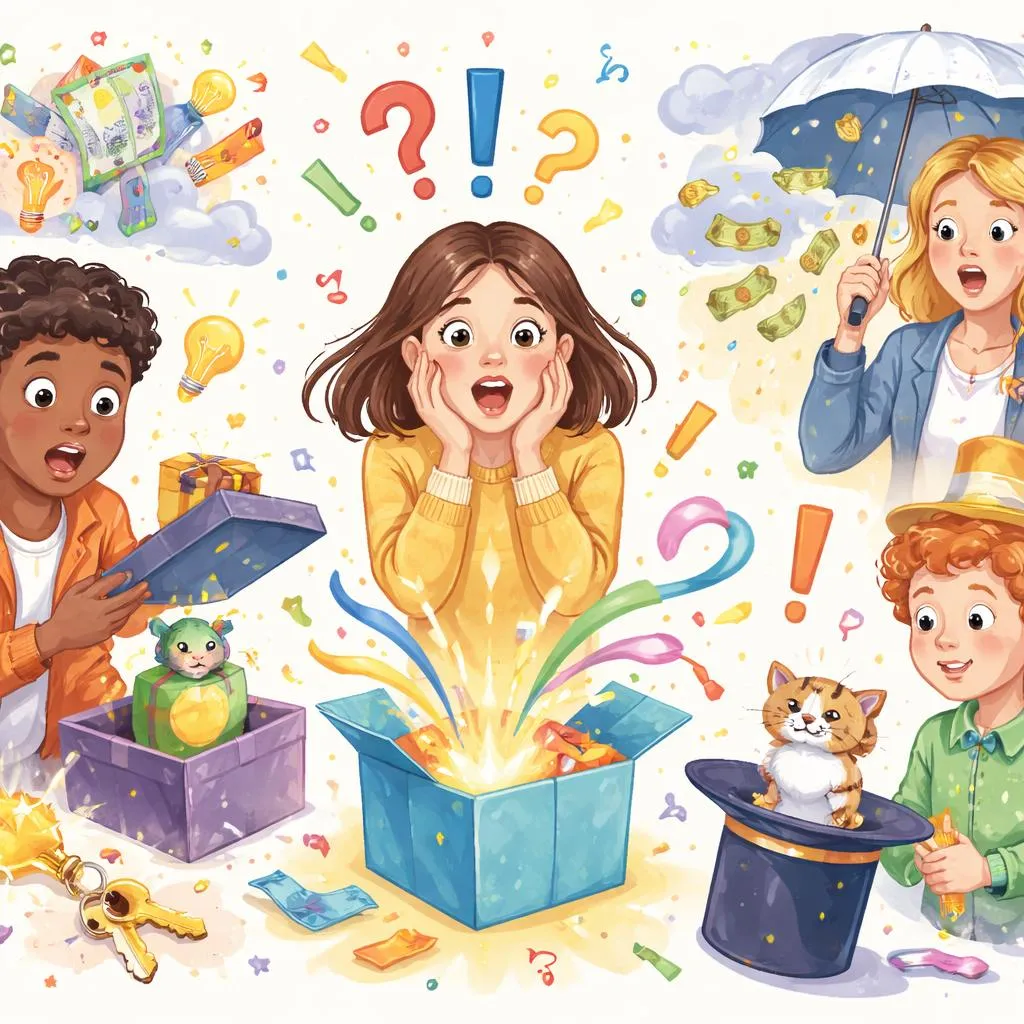

A surprise party makes you smile. A surprising ending leaves you thinking. The words “surprise, surprising, surprised, surprisingly” all come from one family. Each word talks about something unexpected. But each one has a different job in a sentence. Learning this family helps children describe unexpected events and feelings. Let us explore these four words together.
What Does “Same Word, Different Forms” Mean? One core idea can grow into many word shapes. The meaning stays the same at the heart. But the word changes its ending for a new role. For example, “surprise” is a noun or a verb. “Surprising” is an adjective. “Surprised” is an adjective or a verb form. “Surprisingly” is an adverb. Knowing these four forms helps a child talk about unexpected moments.
Personal Pronouns Change Their Form Pronouns change from “he” to “him” or “his”. Our word family changes by adding suffixes, not by changing person. Think of “surprise” as the core unexpected event or action. “Surprising” turns that idea into a description of the event. “Surprised” turns the idea into a description of a person’s feeling. “Surprisingly” turns the quality into a way of doing something. Each form answers a simple question. What event? Surprise. What kind of event? Surprising. How does a person feel? Surprised. How? Surprisingly.
From Verb to Noun to Adjective to Adverb – One Family, Many Words This family has a noun, a verb, adjectives, and an adverb. Let us start with the noun “surprise”. Noun: The surprise on his face was priceless. “Surprise” means an unexpected event or the feeling of wonder.
“Surprise” can also be a verb. Verb: Do not surprise me while I am reading. Here “surprise” means to cause unexpected wonder.
Next is the adjective “surprising”. Adjective: The surprising news made everyone stop talking. “Surprising” describes something that causes surprise.
Then the adjective “surprised”. Adjective: I was surprised to see you here. “Surprised” describes the feeling of being amazed by something unexpected.
Finally the adverb “surprisingly”. Adverb: The test was surprisingly easy. “Surprisingly” means in a way that causes surprise.
One Root, Many Roles – How Words Grow from Actions to Qualities The Old French word “surprendre” meant to overtake or capture. From this root, we built a family about unexpectedness. “Surprise” kept the main noun and verb meanings. Adding -ing made “surprising” (causing surprise). Adding -ed made “surprised” (feeling surprise). Adding -ly made “surprisingly” (in a surprising way). Children can see the same pattern in other families. For example, “amaze, amazing, amazed, amazingly”. Learning patterns helps kids describe feelings and events.
Same Meaning, Different Jobs – Is It a Verb or a Noun? Look at each word’s job carefully. “Surprise” can be a noun or a verb. Noun example: The surprise made me laugh. Verb example: Do not surprise the cat.
“Surprising” is an adjective. Example: The surprising result shocked everyone.
“Surprised” is an adjective or a verb form. Adjective example: She looked surprised. Verb example: The ending surprised me.
“Surprisingly” is an adverb. Example: Surprisingly, no one was late. Each form has a clear job. Only “surprise” has two roles.
Adjectives and Adverbs – When Do We Add -ly? We add -ly to “surprising” to make “surprisingly”. Surprising + ly = surprisingly. No letter changes. No letters lost. The rule is simple: adjective + ly = adverb. A simple reminder: “Surprising describes an event. Surprised describes a person. Surprisingly describes an action or fact.”
Watch Out for Tricky Spelling Changes (Double Letters, y to i, and More) “Surprise” has no double letters, but people often misspell it. The correct spelling is S-U-R-P-R-I-S-E. Many forget the first r. Say “Surprise has two r’s? No, it has one r? Let us check: S U R P R I S E. Yes, there is an R after the P. So surprise has two R’s? No: positions: S (1), U (2), R (3), P (4), R (5), I (6), S (7), E (8). So yes, two R’s: one at position 3 and one at position 5. And one S at position 7 and starting S. So surprise has two R’s and two S’s? No, one S at 1 and one S at 7. So two S’s as well.” Actually surprise is spelled with an R after the P. Common mistake: writing “suprise” (missing the first r). Say “Surprise has a secret r after the p. Sur-prise.” Add -ing to make “surprising”. Surprise → surprising (drop the e, add ing). Add -ed to make “surprised”. Surprise → surprised (drop the e, add ed). Add -ly to make “surprisingly” from “surprising”. Surprising + ly = surprisingly (no change). A common mistake is “surprising” spelled “surprizing” with a z. Say “Surprising has an s, not a z.”
Let’s Practice – Can You Choose the Right Form? Try these sentences with your child. Read each one aloud. Pick the correct word from the family.
The birthday ______ made me jump with joy. Answer: surprise (noun)
The magician’s trick was truly ______. Answer: surprising (adjective)
I was ______ to see snow in April. Answer: surprised (adjective)
______, the small dog won the race. Answer: surprisingly (adverb)
Please do not ______ your little brother while he sleeps. Answer: surprise (verb)
The ______ ending of the book made me cry. Answer: surprising (adjective)
She looked ______ when she opened the gift. Answer: surprised (adjective)
The weather was ______ warm for winter. Answer: surprisingly (adverb)
What a nice ______ to see you here. Answer: surprise (noun)
The news ______ everyone in the room. Answer: surprised (verb)
After the practice, ask your child one question. Is this word an event, a description of an event, a feeling, or a how word? That simple question teaches grammar through unexpected joy.
Tips for Parents – Help Your Child Learn Word Families in a Fun Way Use a hidden toy to teach “surprise”. Hide a sticker under a cup. Say “Lift the cup for a surprise.”
Use a magic trick to teach “surprising”. Pull a coin from behind an ear. Say “That was surprising.”
Use a jump scare (gentle) to teach “surprised”. Pop out from behind a door. Say “You look surprised!”
Use an easy quiz to teach “surprisingly”. Say “The test was surprisingly easy. I thought it would be hard.”
Play “fill in the blank” during car rides. Say “The ______ on your face was funny.” (surprise - noun) Say “The ______ loud noise scared the dog.” (surprising) Say “I was ______ to get a letter from Grandma.” (surprised) Say “______, the quiet child sang beautifully.” (surprisingly)
Read a story with a twist ending. Ask “What surprise happened?” Ask “How did the characters feel? Surprised?”
Turn a drawing activity into a word lesson. Draw a gift with a pop-out spring. Label “surprise”. Draw a question mark over a rainbow. Label “surprising”. Draw a person with wide eyes and an open mouth. Label “surprised”. Draw a clock with “easy” written on it. Label “surprisingly quick”.
When your child makes a mistake, stay calm. If they say “I was surprising,” say “Almost. You were surprised. Surprising describes the event. Surprised describes your feeling.” If they say “That was a surprised event,” say “Close. That was a surprising event. Surprising is for events. Surprised is for people.”
Write the four words on sticky notes. Put them near the front door. Each time a visitor arrives unexpectedly, point to “surprise”.
Remember that surprises can be happy or scary. Use these words to talk about both. “The surprise party was happy.” “The sudden noise was surprising but funny.” Soon your child will love nice surprises. They will know what a surprising fact is. They will say “I am surprised” with joy. And they will use “surprisingly” to share unexpected news. That is the wonderful power of learning one small word family together.