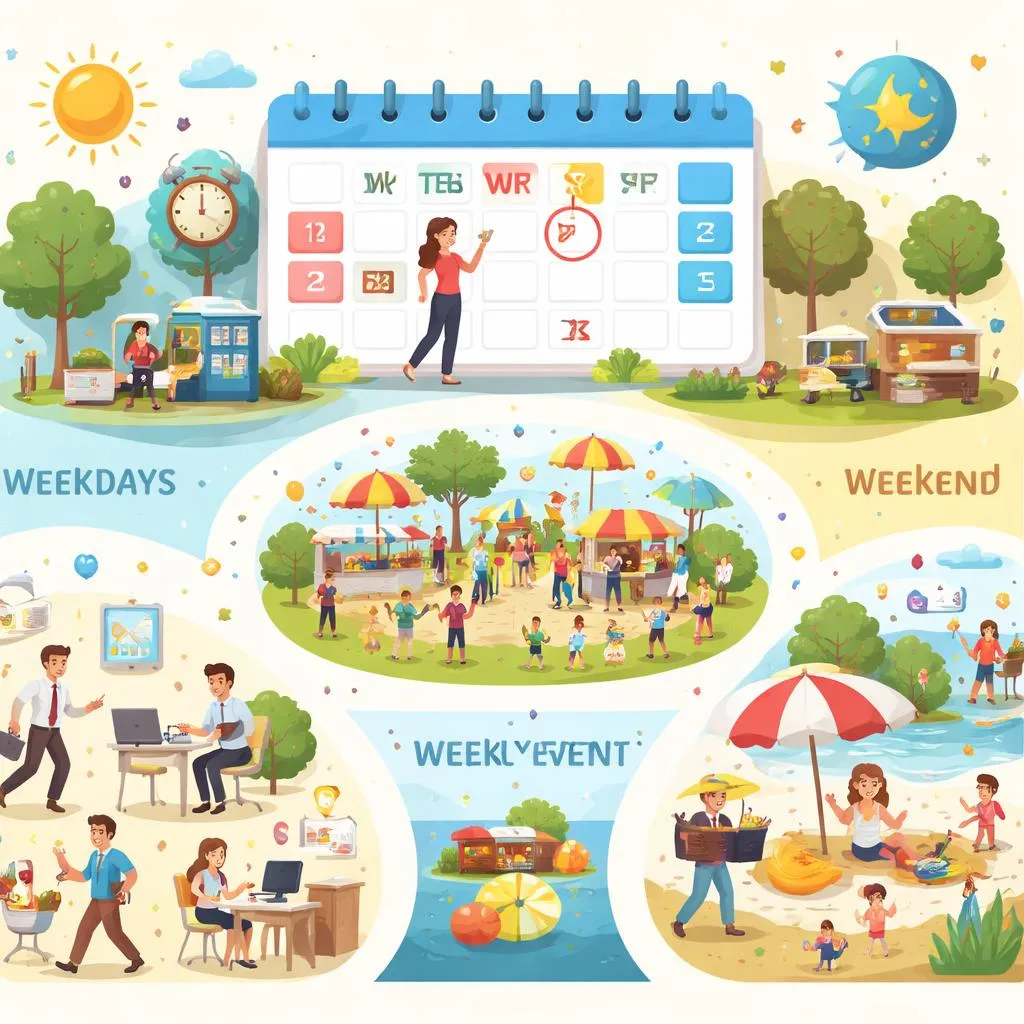

A week has seven days from Sunday to Saturday. A weekly meeting happens every Tuesday. The words “week, weekly, weekday, weekend” all come from one family. Each word talks about a period of seven days or parts of it. But each one has a different job in a sentence. Learning this family helps children understand schedules and calendars. Let us explore these four words together.
What Does “Same Word, Different Forms” Mean? One core idea can grow into many word shapes. The meaning stays the same at the heart. But the word changes its ending or combines for a new role. For example, “week” is a noun. “Weekly” is an adjective or an adverb. “Weekday” is a noun. “Weekend” is a noun. Knowing these four forms helps a child talk about time and routines.
Personal Pronouns Change Their Form Pronouns change from “he” to “him” or “his”. Our word family changes by adding suffixes and compounds. Think of “week” as the core unit of seven days. “Weekly” turns that unit into a description of frequency. “Weekday” combines week with day to name school/work days. “Weekend” combines week with end to name the rest days. Each form answers a simple question. What is seven days? Week. What happens every week? Weekly. What is a day from Monday to Friday? Weekday. What are Saturday and Sunday? Weekend.
From Verb to Noun to Adjective to Adverb – One Family, Many Words This family has nouns, an adjective, and an adverb. Let us start with the noun “week”. Noun: A week has seven days. “Week” means a period of seven days.
Next is “weekly” as an adjective or an adverb. Adjective: Our weekly shopping trip is on Thursdays. Adverb: The magazine comes out weekly. “Weekly” means happening once a week.
Then the noun “weekday”. Noun: I wake up early on weekdays. “Weekday” means any day from Monday to Friday.
Finally the noun “weekend”. Noun: We go camping on the weekend. “Weekend” means Saturday and Sunday.
One Root, Many Roles – How Words Grow from Actions to Qualities The Old English word “wice” meant a turn or succession. From this root, we built a family about seven-day periods. “Week” kept the main noun meaning. Adding -ly made “weekly” (every week). Combining “week” with “day” made “weekday” (a day of the week). Combining “week” with “end” made “weekend” (the end of the week). Children can see the same pattern in other families. For example, “month, monthly, monthday (rare), month end (not common). Learning compounds helps kids talk about calendars.
Same Meaning, Different Jobs – Is It a Verb or a Noun? Look at each word’s job carefully. “Week” is a noun. Example: I will see you in a week.
“Weekly” is an adjective or an adverb. Adjective example: Our weekly meeting is at 10 a.m. Adverb example: The trash is collected weekly.
“Weekday” is a noun. Example: Store hours are longer on weekdays.
“Weekend” is a noun. Example: We relax on the weekend. Each form has a clear job. Only “weekly” has two roles.
Adjectives and Adverbs – When Do We Add -ly? We add -ly to “week” to make “weekly”. Week + ly = weekly. No letter changes. No letters lost. The rule is simple: noun + ly = adjective or adverb. A simple reminder: “Week is seven days. Weekly happens every week. Weekday is Monday to Friday. Weekend is Saturday and Sunday.”
Watch Out for Tricky Spelling Changes (Double Letters, y to i, and More) “Week” has a double e. Add -ly to make “weekly”. Week + ly = weekly (keep double e). Combine with “day” to make “weekday”. Week + day = weekday (keep double e). Combine with “end” to make “weekend”. Week + end = weekend (keep double e). A common mistake is writing “week” as “weak” (not strong). Say “Week has double e. Weak has ea, meaning not strong.” Another mistake is “weekly” spelled “wekly” (missing e). Say “Weekly has double e from week.” Another mistake is “weekday” spelled “week day” as two words. “Weekday” as one word is correct. Another mistake is “weekend” spelled “week end” as two words. “Weekend” as one word is correct.
Let’s Practice – Can You Choose the Right Form? Try these sentences with your child. Read each one aloud. Pick the correct word from the family.
A ______ has seven days. Answer: week (noun)
Our ______ family dinner is every Wednesday night. Answer: weekly (adjective)
I go to school on every ______. Answer: weekday (noun)
The ______ is my favorite time to play outside. Answer: weekend (noun)
The garbage truck comes ______ on Mondays. Answer: weekly (adverb)
There are five ______ in a standard school week. Answer: weekdays (noun)
We took a trip for a whole ______. Answer: week (noun)
The ______ newspaper arrives on Fridays. Answer: weekly (adjective)
On the ______, we sleep later than usual. Answer: weekend (noun)
I practice piano every ______. Answer: weekday (noun)
After the practice, ask your child one question. Is this word a seven-day period, something every week, a school/work day, or a rest day? That simple question teaches grammar through time management.
Tips for Parents – Help Your Child Learn Word Families in a Fun Way Use a calendar to teach “week”. Say “Point to one week on the calendar.”
Use a routine to teach “weekly”. Say “Our weekly treat is ice cream on Fridays.”
Use a schedule to teach “weekday”. Say “You have homework on weekdays.”
Use a fun day to teach “weekend”. Say “The weekend is for resting and playing.”
Play “fill in the blank” during car rides. Say “There are seven days in a ______.” (week) Say “We have a ______ pizza night every Friday.” (weekly) Say “I wake up at 7 a.m. on ______.” (weekdays) Say “We visit Grandma on the ______.” (weekend)
Read a story about a character’s weekly routine. Ask “What does the character do on weekdays?” Ask “How does the character spend the weekend?”
Turn a drawing activity into a word lesson. Draw a calendar page with 7 boxes. Label “week”. Draw a clock with a checkmark each day. Label “weekly chore”. Draw a child with a backpack on Monday. Label “weekday”. Draw a child playing on Saturday. Label “weekend”.
When your child makes a mistake, stay calm. If they say “The week is weak,” say “Week is time. Weak is not strong. Different words.” If they say “I do it week,” for a repeated action, say “Almost. I do it weekly. Weekly means every week.”
Write the four words on sticky notes. Put them on a family calendar. Each time you plan the week, point to “week”.
Remember that weeks give our lives a rhythm. Use these words to build routine. “Weekdays are for learning. Weekends are for adventure.” Soon your child will know the days of the week. They will understand weekly chores. They will respect weekday bedtime. And they will love the weekend. That is the timely power of learning one small word family together.