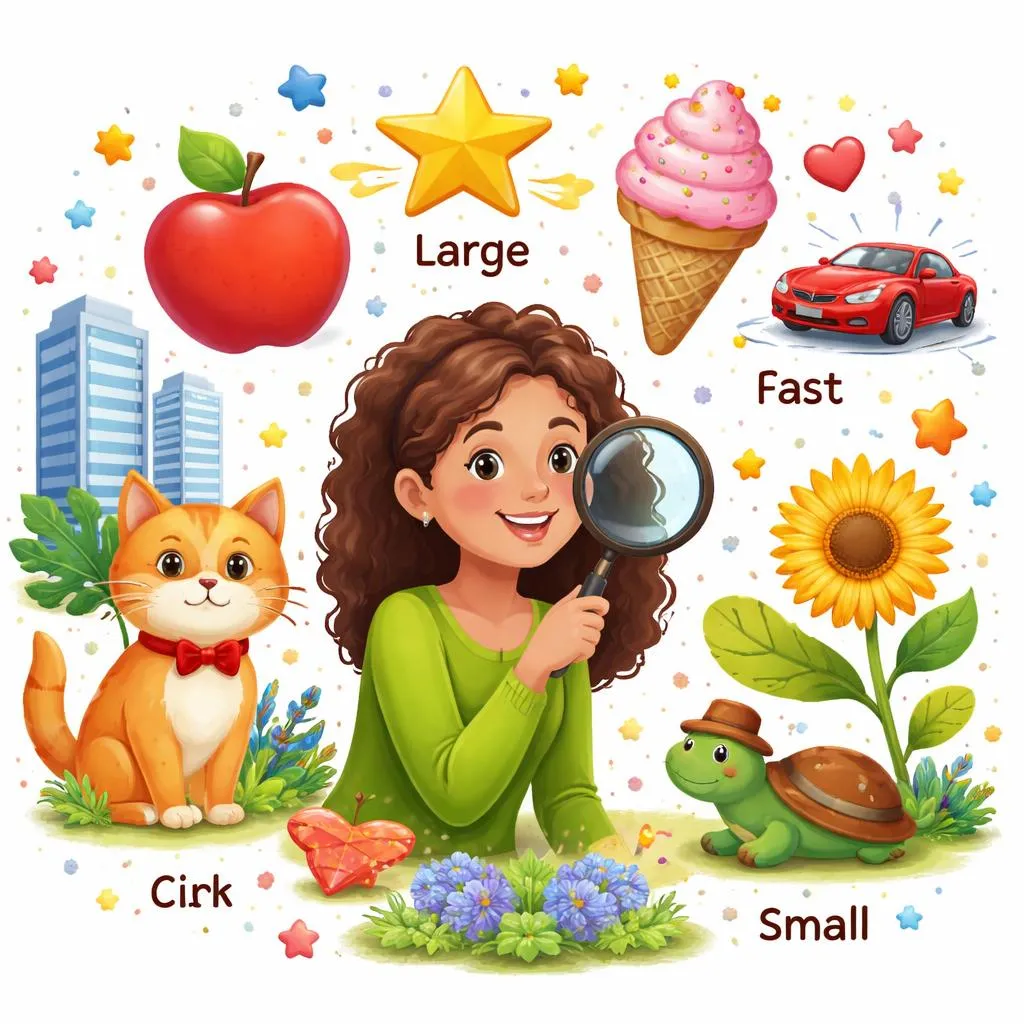

In English grammar, adj is the short form of the word adjective. When you see “adj” in a dictionary or grammar book, it tells you that the word describes a noun. An adjective gives more information about a person, place, thing, or idea.
For example, in the sentence “She has a beautiful dress,” the word beautiful is an adjective because it describes the noun dress.
What Does an Adjective Do?
An adjective answers questions like:
What kind? Which one? How many?
For example:
A red apple – red tells what kind of apple. That house – that tells which house. Three books – three tells how many books.
Adjectives help make sentences clearer and more detailed.
Examples of Adj in Sentences
Here are some simple examples:
The tall boy is my brother. She bought a new phone yesterday. It was a cold morning. They live in a small village.
In each sentence, the adjective adds extra meaning to the noun.
Types of Adjectives
There are different types of adjectives in English.
Descriptive adjectives describe qualities, such as big, happy, fast, or interesting.
Demonstrative adjectives point to specific nouns, such as this, that, these, and those.
Possessive adjectives show ownership, such as my, your, his, her, our, and their.
Number adjectives show quantity, such as one, two, many, or several.
Understanding types of adjectives helps students use them correctly in writing.
Position of Adjectives
In English, adjectives usually come before the noun.
A beautiful garden An old building A smart student
However, adjectives can also come after linking verbs.
The garden is beautiful. The building looks old. The student seems smart.
Learning adjective position improves sentence structure.
Why Learning Adj Is Important
Adjectives make language colorful and expressive. Without adjectives, sentences would be very simple and sometimes unclear. Compare these two sentences:
She has a car. She has a red sports car.
The second sentence gives more detail and creates a clearer picture.
Building strong adjective vocabulary helps improve both speaking and writing skills.
What Is an Adj in English Grammar?
Tags: Adjective Definition, Adj Meaning, English Grammar Basics, Parts Of Speech, Adjective Examples
In English grammar, adj is the short form of the word adjective. When you see “adj” in a dictionary or grammar book, it tells you that the word describes a noun. An adjective gives more information about a person, place, thing, or idea.
For example, in the sentence “She has a beautiful dress,” the word beautiful is an adjective because it describes the noun dress.
What Does an Adjective Do?
An adjective answers questions like:
What kind? Which one? How many?
For example:
A red apple – red tells what kind of apple. That house – that tells which house. Three books – three tells how many books.
Adjectives help make sentences clearer and more detailed.
Examples of Adj in Sentences
Here are some simple examples:
The tall boy is my brother. She bought a new phone yesterday. It was a cold morning. They live in a small village.
In each sentence, the adjective adds extra meaning to the noun.
Types of Adjectives
There are different types of adjectives in English.
Descriptive adjectives describe qualities, such as big, happy, fast, or interesting.
Demonstrative adjectives point to specific nouns, such as this, that, these, and those.
Possessive adjectives show ownership, such as my, your, his, her, our, and their.
Number adjectives show quantity, such as one, two, many, or several.
Understanding types of adjectives helps students use them correctly in writing.
Position of Adjectives
In English, adjectives usually come before the noun.
A beautiful garden An old building A smart student
However, adjectives can also come after linking verbs.
The garden is beautiful. The building looks old. The student seems smart.
Learning adjective position improves sentence structure.
Comparative and Superlative Adjectives
Adjectives can also compare things. When we compare two things, we often use the comparative form. When we compare three or more things, we use the superlative form.
For short adjectives, we usually add -er or -est.
Tall → taller → tallest Fast → faster → fastest Small → smaller → smallest
For longer adjectives, we use more and most.
Beautiful → more beautiful → most beautiful Interesting → more interesting → most interesting Comfortable → more comfortable → most comfortable
For example:
This book is more interesting than that one. She is the tallest student in the class.
Learning comparative and superlative forms helps students describe differences clearly.
Order of Multiple Adjectives
Sometimes more than one adjective describes the same noun. In English, adjectives usually follow a specific order, although native speakers often learn this naturally.
A common order is:
Opinion, Size, Age, Shape, Color, Origin, Material, Purpose
For example:
A beautiful small old round wooden table
Although this looks complex, regular reading helps learners understand the natural pattern.
Adjectives in Daily Communication
Adjectives are everywhere in daily conversation. People use them to describe feelings, weather, food, and experiences.
The weather is sunny and warm today. The movie was exciting and funny. She feels tired but happy.
Without adjectives, communication would feel incomplete. Saying “The weather is sunny” gives more information than simply saying “The weather is.”
Common Mistakes with Adjectives
Learners sometimes confuse adjectives and adverbs. Adjectives describe nouns, while adverbs describe verbs, adjectives, or other adverbs.
Correct: She is a quick learner. Correct: She runs quickly.
In the first sentence, quick describes the noun learner. In the second sentence, quickly describes the verb runs.
Understanding this difference prevents common grammar errors.
Why Adjectives Matter in Writing
In writing, adjectives create clear images for the reader. Compare these sentences:
He lives in a house. He lives in a large white house near the river.
The second sentence is more detailed and vivid because it uses adjectives.
When students learn to choose precise adjectives instead of very basic words like “good” or “nice,” their writing becomes stronger and more expressive.
Building adjective vocabulary step by step improves confidence in both speaking and writing. With regular practice, using adjectives naturally becomes an important part of clear and effective English communication.
Adjectives and Feelings
Adjectives are especially important when describing emotions and personal experiences, because they help express thoughts clearly and accurately. Instead of saying “I feel bad,” a speaker can choose a more specific adjective such as tired, upset, nervous, disappointed, or worried. Each word communicates a slightly different feeling.
For example:
I feel nervous before the exam. She was excited about the school trip. They felt proud of their hard work.
By selecting precise adjectives, communication becomes more meaningful and expressive.
Adjectives in Academic Writing
In school assignments, strong adjectives improve clarity and quality. Instead of writing “The experiment was good,” students can write, “The experiment was successful and informative.” This revision sounds more academic and specific.
Similarly, instead of saying “The story was very interesting,” a student could write, “The story was engaging and thought-provoking.” Choosing accurate adjectives reduces repetition and strengthens writing style.
Teachers often encourage students to replace weak adjectives such as good, bad, big, or nice with more descriptive alternatives.
Building Adjective Vocabulary
To improve adjective usage, learners can keep a vocabulary notebook organized by topic. For example:
Weather: sunny, cloudy, stormy, humid, freezing Personality: kind, patient, generous, confident, honest Appearance: tall, slim, elegant, neat, stylish
Grouping adjectives by theme makes them easier to remember and apply in real situations.
Regular reading also introduces new adjectives naturally. When students notice unfamiliar descriptive words in books, they can write them down and practice using them in sentences.
Practice Activity
Rewrite the following sentences with stronger adjectives:
The food was good. The test was hard. The movie was nice.
Possible improvements:
The food was delicious and fresh. The test was challenging but fair. The movie was entertaining and inspiring.
Practicing small changes like these helps learners develop more advanced and confident English writing skills.