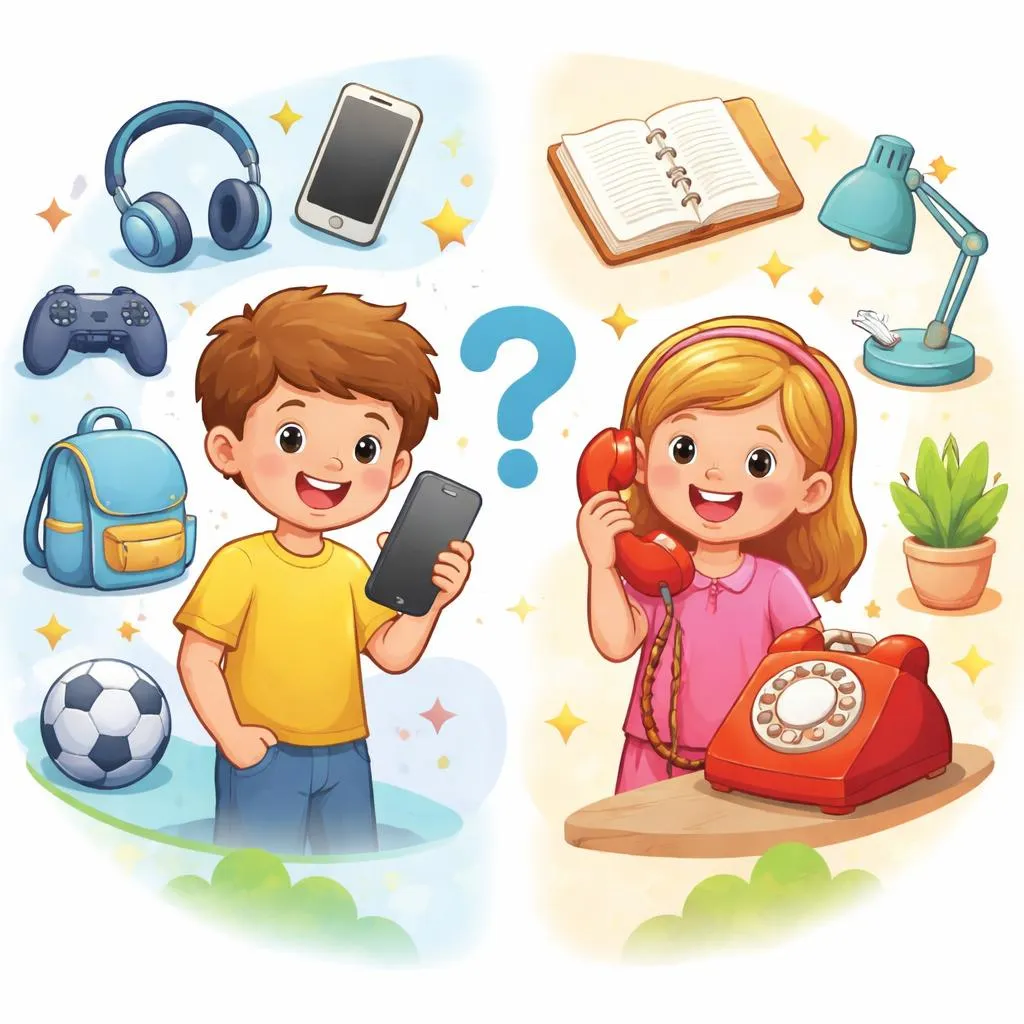

Start! Find a Pair of 'Talking Twin' Words
Hello, word explorer! Do you talk to friends far away? You might use your phone. Your grandma might call it the telephone. They are both devices for talking. Are they the same? This is a fun tech puzzle. Today we explore a word pair. We explore phone and telephone. They are like a cool nickname and a full, proper name. One is short and modern. One is long and classic. Knowing the difference is a superpower. Your talk about communication will be clear and smart. Let us start our word call!
Be a Language Observer now. Our first clue is at home. You say, "I can't find my phone!" Your grandma says, "Answer the telephone." They are both about the ringing device. But are they the same? Let us test with two sentences.
"I text my friend on my phone every day." This sounds casual, modern, and personal. "The office has a telephone on every desk." This sounds formal, business-like, and a bit old.
They are both for calls. But one feels like a pocket friend. One feels like an office tool. Your observation mission starts. Let us call into their word world.
Adventure! Call Into the Word World
Feel the Word's Casual and Formal Vibe!
Feel the word phone. It is a casual, fast, everyday word. It feels like texting, apps, and your personal device. The word telephone is a formal, proper, and older word. It feels like a landline, an operator, and official business. Phone is the friendly nickname. Telephone is the official full name. One is for chatting. The other is for announcing. Let us see this at school.
You tell a friend, "I left my phone in my backpack." This is natural and quick. In a history lesson, you learn about Alexander Graham Bell inventing the telephone. This is the proper, historical term. Saying he invented the "phone" is okay, but "telephone" is more precise. The feeling is different. One is about your life. The other is about history.
Compare Their Modern and Traditional Uses!
Think about a fast sports car and a classic car. The word phone is the sports car. It is fast, modern, and does everything. The word telephone is the classic car. It is the original, elegant model. Their use is a clue. A phone today is a smartphone. It calls, texts, plays games, and takes photos. A telephone usually means a device just for voice calls. It is often a landline. One is a multi-tool. The other is a specialist tool. Let us test this on the playground.
You are playing a game. You shout, "I need to call my mom on her phone!" This is about a mobile device. Your friend pretends to be in an old movie. He says, "I must use the telephone!" This sets an old-time scene. The playground shows the difference.
Meet Their Best Word Friends!
Words have favorite talking partners. The word phone likes modern, action words. It teams up with 'cell', 'smart', 'answer the', 'on the', 'call on my', and 'phone case'. Answer the phone. A smartphone. The word telephone likes official and traditional words. It teams up with 'pole', 'book', 'directory', 'number', 'landline', and 'receiver'. A telephone pole. A telephone book. Their partners are different. Let us go back to nature.
A bird might land on a telephone wire. This is the classic term for the wire. You might take a phone picture of the bird. This is the modern device. You would not say "phone wire" as often. The word friends set the time period.
Our Little Discovery!
We explored the world of talking devices. We made a clear discovery. The words phone and telephone are different. Telephone is the original, full name for the device that sends voice over distance. It sounds formal and traditional. Phone is the short, modern, casual version of the same word. Today, "phone" often means a mobile, smart device. Phone is the nickname. Telephone is the birth certificate name. One is for everyday chat. The other is for official talk. This is the main difference.
Challenge! Become a Talking Word Expert
"Best Choice" Challenge!
Let us look at a nature scene. A monkey in a zoo sees a tourist holding a device. The tourist is talking into it. The monkey sees a phone. Is it Phone or Telephone? The champion is Phone! It is the common, modern word for the handheld device. Now, imagine a historical documentary. It shows the first device that could send a human voice over wires. This was the telephone. Is it phone or telephone? The champion is telephone! It is the correct, historical term for the invention. Excellent!
"My Sentence Show"!
Now, create your own sentences. Here is a fun scene: Imagine you are playing a game on a handheld device. It also makes calls. Use the word phone in one sentence. Now imagine an old detective movie. The detective gets a call on a big, black desk device. Use the word telephone in another. Try it! Here is an example. Sentence one: "My new phone has a great camera for photos." Sentence two: "The detective picked up the ringing telephone on his desk." See the difference? The first is about a modern, multi-use gadget. The second sets an old-fashioned, specific scene.
"Eagle Eyes" Search!
Can you find the word that needs help? Read this sentence: "In the 1920s, most families were very excited to get a phone installed in their home for the first time." Hmm. This is a mix. In the 1920s, the device was called a telephone. Using "phone" here is a bit too modern. A better, more historical sentence is: "In the 1920s, most families were very excited to get a telephone installed in their home for the first time." You fixed it!
What a clear and connected exploration! You started as a curious caller. Now you are a word expert. You know the secret of phone and telephone. You can feel their different casual and formal vibes. You know telephone is the formal, original name. You know phone is the short, modern version. You know their best word friends. This is a real language superpower.
You can learn amazing things from this article. You now know that 'telephone' is the full, formal name for the device that lets people talk over distances, often associated with older landlines. You understand that 'phone' is the shortened, modern, and casual version of the same word, and today it usually means a mobile smartphone. You can explain that 'telephone' is for history and official use, and 'phone' is for everyday conversation. You learned terms like 'smartphone' and 'telephone pole'.
How can you use this today? It is easy and fun. At home, ask: "Where is the telephone?" if you have a landline. Ask: "Where is my phone?" for your mobile. Watch an old movie. Listen for the word telephone. Watch a modern show. Listen for the word phone. Draw two pictures. Draw an old-fashioned black telephone. Draw a modern smartphone. You are using your new skill every day.
Keep your explorer ears open. The world is full of phones and telephones. You are learning the words to describe them all. Great work, word expert. Your English journey is getting more precise and connected with every new word pair you discover!