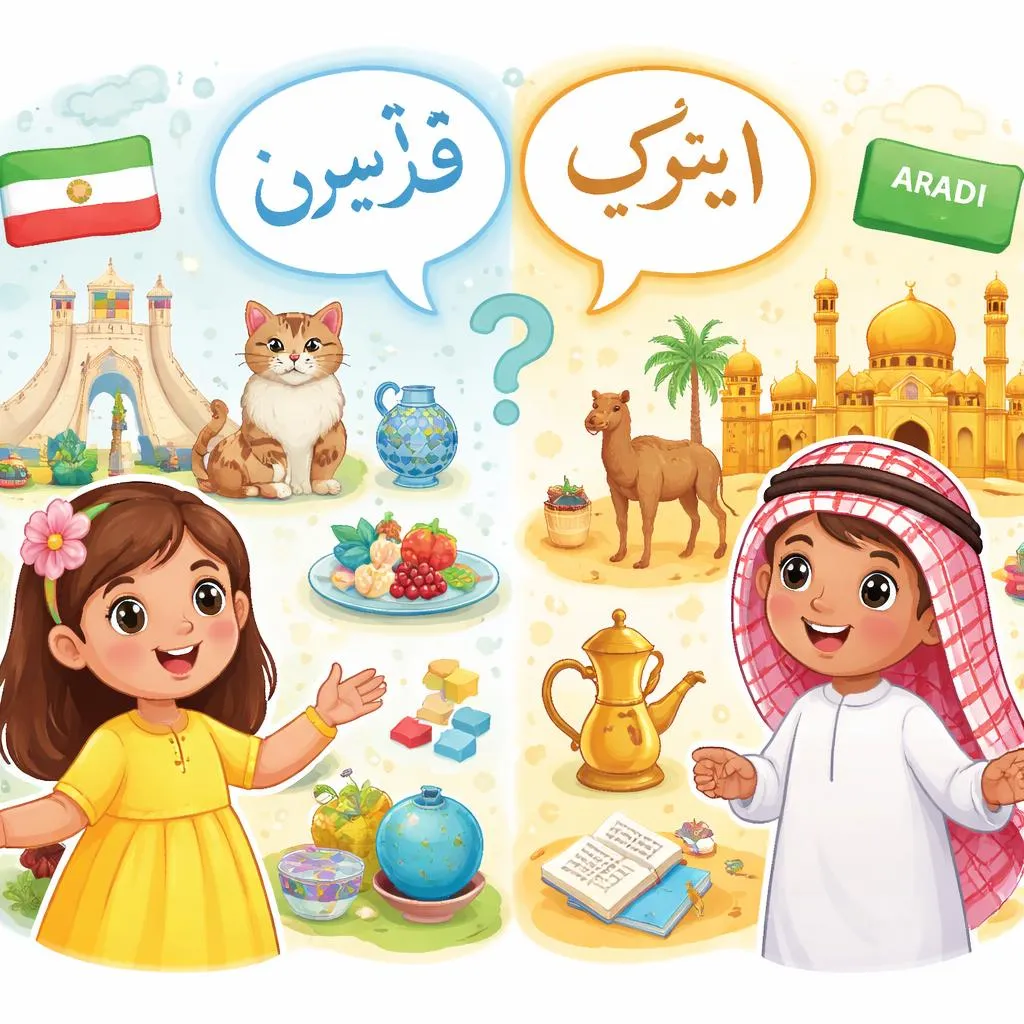

Hello, young language explorers and world citizens. Today we are going on a special trip. We are going to learn about two amazing languages. They are Persian and Arabic. People sometimes think they are the same, but they are different friends. Let us look at Persian vs Arabic language. We will learn about their alphabets, their sounds, and where people speak them. This will help us understand our big, wonderful world better. Are you ready. Let us begin our adventure.
What is persian vs arabic language?
When we talk about persian vs arabic language, we are comparing two languages. We are looking at how they are similar and how they are different. Persian is the language of Iran, and also spoken in Afghanistan and Tajikistan. Arabic is the language of the Arab world, like Saudi Arabia, Egypt, and many other countries. They are both very old and beautiful languages. But they come from different language families. Think of them like two different types of trees. They both have leaves, but the leaves look different. Learning about persian vs arabic language helps us appreciate different cultures and people.
Meaning and explanation
The meaning of studying persian vs arabic language is about understanding diversity. Let us explain. Every language is a way to share ideas and stories. Persian and Arabic are two important ways. The explanation of their differences starts with their history. Arabic is a Semitic language. Its grammar and word roots are different. Persian is an Indo-European language. This means it is related to languages like English, French, and Hindi in a very, very distant way. But Persian has borrowed many words from Arabic over a long time. This makes them seem similar sometimes. But their core grammar and many basic words are different. Learning about persian vs arabic language teaches us how languages can meet, mix, and still stay unique.
Categories or lists
We can compare Persian vs Arabic language by looking at different parts. Let us make lists. One category is The Alphabet. Both use a script that looks like beautiful flowing lines. But the alphabets are a bit different. The Arabic alphabet has 28 letters. The Persian alphabet has 32 letters. It uses the Arabic script but adds four extra letters for sounds that Arabic does not have. Another category is Sounds. Some sounds are the same. Some are different. Arabic has some throaty sounds that are special. Persian has sounds like "p" and "ch" that Arabic does not have in its alphabet.
Another list is for Where They Are Spoken. Arabic is spoken in many countries across the Middle East and North Africa. Persian (also called Farsi) is mainly spoken in Iran, Afghanistan (as Dari), and Tajikistan (as Tajiki). We can also list Sample Words. Hello in Arabic is "Marhaba." Hello in Persian is "Salam." Thank you in Arabic is "Shukran." Thank you in Persian is "Mamnoon." Seeing these lists side by side helps us see the Persian vs Arabic language comparison clearly.
Daily life examples
You might see or hear about Persian vs Arabic language in your daily life. Here are some scenes. First, in your community. You might have neighbors or friends from Iran or an Arab country. You can learn to say hello in both languages. "Salam" to your Persian friend. "Marhaba" to your Arab friend. This makes them smile. You might see writing on a restaurant or a shop. The signs might be in Arabic or Persian script. They look curly and artistic.
Second, in stories or movies. You might watch a cartoon that shows a desert. They might use Arabic words. You might read a story about ancient Persia. They might use Persian names. You can notice the difference. Third, during holidays. You might learn about Nowruz, the Persian New Year. People say "Nowruz Mobarak" (Happy New Year in Persian). You might learn about Ramadan. People say "Ramadan Kareem" (in Arabic). These are small touches of the Persian vs Arabic language in celebrations. Daily life gives you chances to see, hear, and appreciate both.
Printable flashcards
Printable flashcards are a great way to see Persian vs Arabic language differences. How to make them. You can make "Alphabet Comparison Cards." On one side, show an Arabic letter like "ب" (Baa). On the other side, show the same letter in Persian, which looks the same but might be used in different words. You can also make "Word Pair Cards." One card has the Arabic word for book: "Kitab" (كتاب). The other card has the Persian word for book: "Ketab" (کتاب). They look and sound similar because Persian borrowed the word.
Another idea is "Country Cards." A card for Egypt with the Arabic flag and the word "Egypt" in Arabic script. A card for Iran with the Persian flag and the word "Iran" in Persian script. How to use the cards. Play a matching game. Match the Arabic greeting to the Persian greeting. Play a sorting game. Sort the cards into an "Arabic" pile and a "Persian" pile based on the script or the country. Printable flashcards make the comparison visual and hands-on. You can see the beautiful writing.
Learning activities or games
Learning about Persian vs Arabic language should be a fun discovery. Let us play some games. First, "Hello Around the World." Use a globe or a map. Point to a country in the Arab world like Egypt. Everyone says "Marhaba!" Point to Iran. Everyone says "Salam!" This simple game teaches greetings and geography together. You can add more countries and phrases.
Second, play "Script Detective." Show kids a word written in Arabic script and the same word in Persian script. Ask them to spot the differences. For example, the letter "پ" (Pe) exists in Persian but not in Arabic. Give them a magnifying glass (a toy one) to be detectives. This sharpens observation skills.
Third, the "Word Borrowing" story. Explain that languages borrow words like friends borrow toys. Tell a simple story using a word that both languages share, like "Shukran/Mamnoon" for thanks, but explain they are different. Then, have kids draw a picture of a gift and label it with both words. This teaches the concept of loanwords.
For a craft, make "Name Art." Help kids write their own name in simple, stylized letters inspired by Arabic or Persian calligraphy. They can use markers and curvy lines. They can write "Salam" or "Marhaba" beautifully on a card. For a listening game, play "Sound Match." Record or find short audio clips of someone saying a word in Arabic and then in Persian. Play them. Ask kids if they think the word sounds the same or different. This trains their ear. All these activities make the Persian vs Arabic language comparison an engaging, positive experience. You are learning about people and cultures through their words.