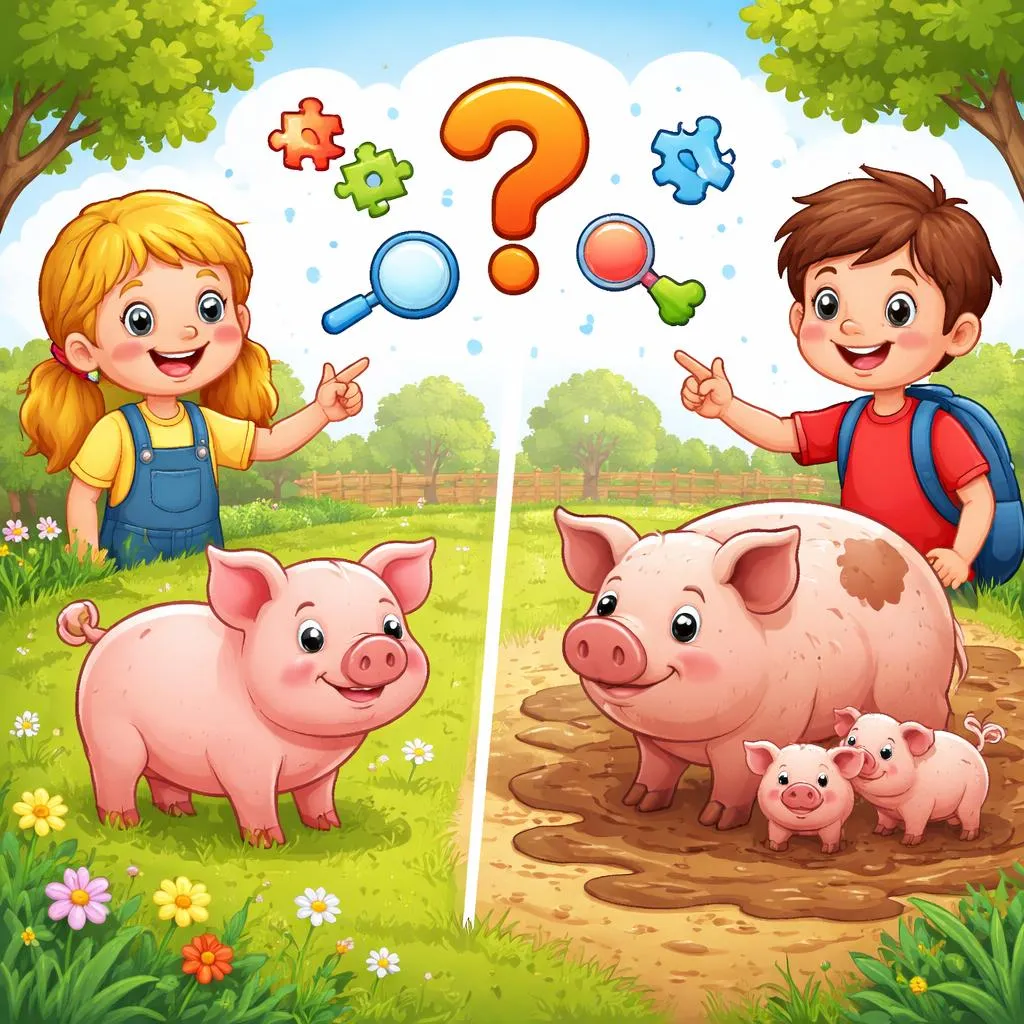

Hello, word explorer! Have you ever seen a pink, curly-tailed animal on a farm? It says "oink!" What do you call it? You probably say "pig." Now, imagine reading an old story or a science book. It might use the word "swine." They sound like they could be the same. Are they? This is a fun word puzzle. Today we explore a word pair. We explore pig and swine. They are like word cousins from different times. One is common today. One is a bit old-fashioned. Knowing the difference is a superpower. Your reading and talking will be sharp. Let us start our word adventure!
Be a Language Detective now. Our first clue is at home. You watch a cartoon about a farm. It has a funny pig character. Then, you hear an adult say, "Don't eat like a swine!" They are talking about manners. They seem related. But are they the same? Let us test with two sentences.
"The little pig rolled in the mud to stay cool." This is about a farm animal. "He has the manners of a swine." This is an insult about behavior.
They both point to the same kind of animal. But one is neutral. One is negative. Your detective mission starts. Let us dig into their word pen.
Adventure! Root Around in the Word Pen
Feel the Word's Tone!
Feel the word pig. It is a direct, common word. It can be neutral or even cute. Think of Wilbur from Charlotte's Web. It can also be messy. The word swine is a harsh, strong word. It almost always sounds negative or formal. It is used in science or to insult someone. Pig is the everyday word. Swine is the formal or nasty word. One is a simple oink. The other is a grunt of disgust. Let us see this at school.
In a children's story, you read: "The pig built a house of straw." This is a normal story word. In a biology textbook, you might read: "Swine are often used in medical research." This is a formal, scientific term. Saying "Pigs are used in research" is also okay. But "swine" sounds more technical. The tone is very different.
Compare Their Use and Formality!
Think about a playground nickname and a full official name. The word pig is the nickname. It is used in everyday talk. It is for the animal, and sometimes for a messy person. The word swine is the official name. It is used in formal contexts like farming, science, or old sayings. It is also a strong insult. Pig can be singular or plural. Swine is the same for singular and plural. One swine. Many swine. The formality level is key. Let us test this on the playground.
You play a game. You call a messy friend a "pig" in a friendly way. It is a light tease. But if you call someone a "swine," it is a very serious insult. The word swine has more weight and anger. The playground shows the difference in force.
Meet Their Best Word Friends!
Words have common partners. The word pig likes everyday and farm words. It teams up with 'pen', 'farm', 'poke', 'bank', and 'fly'. You put a pig in a pen. You buy a piggy bank. The word swine likes formal and negative words. It teams up with 'herd', 'flu', 'fever', and 'pearls before swine'. You hear about swine flu. You should not cast pearls before swine. Their partners are from different worlds. Let us go back to school.
In an agriculture class, you might learn about swine management. This is a formal term for pig farming. In art class, you draw a cute pig with a curly tail. You would not draw a "cute swine." The word friends set the scene.
Our Little Discovery!
We rooted around in the word pen. We made a clear discovery. The words pig and swine mean the same animal. But they are used very differently. The word pig is the normal, everyday word. It can be neutral or a little messy. The word swine is formal, scientific, or very negative. It is used in farming science or as a strong insult. Pig is for stories and farms. Swine is for textbooks and insults. One is casual. The other is formal or harsh.
Challenge! Become a Farm Word Expert
"Best Choice" Challenge!
Let us look at two scenes. Read each one. Pick the champion word. Scene one: You visit a petting zoo. A child points and says, "I want to feed the little pink ______!" Is it Pig or Swine? The champion is Pig! It is the friendly, common word. Scene two: A news report talks about a sickness that affects these animals. It says, "Doctors are monitoring the ______ flu outbreak." Is it pig or swine? The champion is swine! The formal term for the illness is "swine flu." Great thinking!
"My Sentence Show"!
Now, create your own sentences. Here is a scene: Imagine a muddy farmyard after the rain. Use the word pig in one sentence. Use the word swine in another. Try it! Here is an example. Sentence one: "The pig enjoyed the muddy puddle." Sentence two: "The farmer vaccinated the swine against disease." See the difference? The first is a simple observation. The second sounds like a professional farm task.
"Eagle Eyes" Search!
Can you find the word that needs help? Read this sentence: "My grandpa says that taking care of swine is hard work, but he loves his little swine named Petunia." Hmm. Using "swine" twice sounds odd. The first use is okay for formal farm work. But the name "Petunia" is for a pet. The second "swine" should be the friendlier word. "My grandpa says that taking care of swine is hard work, but he loves his little pig named Petunia." This mix is perfect! The first is the job. The second is the pet. You fixed it!
What a fun word exploration! You started as a curious learner. Now you are a word farmer. You know the secret of pig and swine. You can feel their different tones. You see their formality levels. You know their best word friends. This is a real language superpower.
You can learn amazing things from this article. You now know that 'pig' is the common, everyday word for the farm animal. You understand that 'swine' is a more formal or scientific word, and it can be a strong insult. You can explain that a farmer might talk about 'swine' in a business meeting but call his pet a 'pig'. You learned that 'swine' is also the word used in terms like 'swine flu'. Your vocabulary is now more precise for different situations.
How can you use this today? It is easy and fun. When you read a storybook or watch a cartoon, notice if they use the word pig. When you hear a news report or read a science article, listen for the word swine. Try not to use 'swine' as an insult, as it is very strong. Instead, use your knowledge to understand what you read and hear. You are using your new skill every day.
Keep your explorer eyes open. Words can have different outfits for different occasions. You are learning to dress your words correctly. Great work, word expert. Your English journey is getting more interesting with every new word pair you discover!