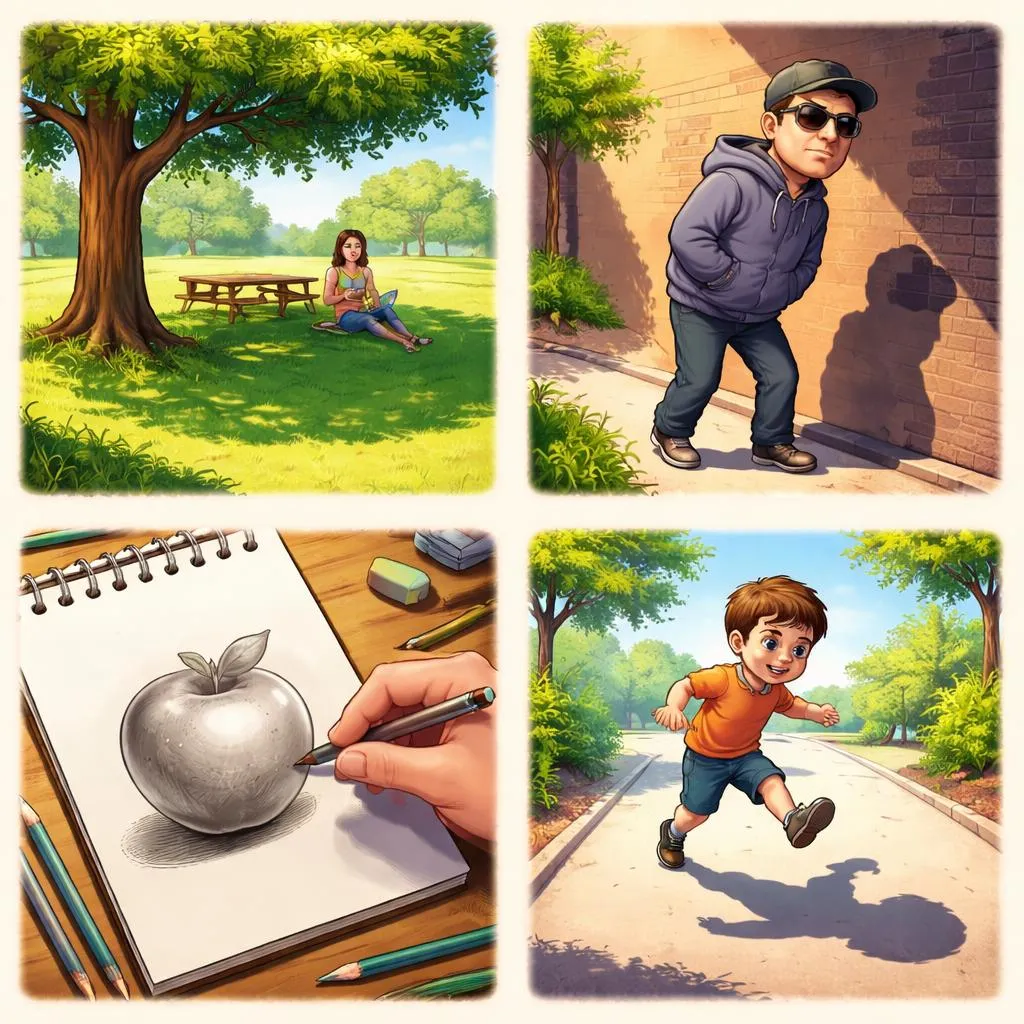

The sun creates light and dark spaces. Words help us describe those spaces. The words “shade, shady, shading, shadow” come from one family. They all talk about darkness or protection from light. But each word has a different job in a sentence. Learning this family helps children observe the world more carefully. Let us explore these four words together.
What Does “Same Word, Different Forms” Mean? A single idea can produce several word forms. The root meaning stays the same at the center. But the word changes its ending or shape for a new role. For example, “shade” can be a noun or a verb. “Shady” is an adjective that describes a place or a person. “Shading” is a verb form that shows ongoing action. “Shadow” is a noun that names a dark shape. Understanding these forms makes a child a better observer and writer.
Personal Pronouns Change Their Form Pronouns change from “he” to “him” or “his”. Our word family changes by adding letters, not by changing person. Think of “shade” as the main word for darkness or protection. “Shady” turns that idea into a description. “Shading” shows the action of creating shade. “Shadow” names a specific dark shape that follows an object. Each form answers a different question. What do I sit under? Shade. How does it feel? Shady. What am I doing? Shading. What follows me? Shadow.
From Verb to Noun to Adjective to Adverb – One Family, Many Words This family includes nouns, a verb, and an adjective. Let us start with the noun “shade”. Noun: Let us sit in the shade. “Shade” means a cool dark area away from sunlight.
“Shade” can also be a verb. Verb: Please shade your eyes from the sun. Here “shade” means to block light.
Next is the adjective “shady”. Adjective: This spot under the tree is shady. “Shady” can also describe a dishonest person. Example: That deal sounds shady.
Then we have the verb form “shading”. Verb (ongoing): The artist is shading the drawing. “Shading” means adding darkness to a picture.
Finally the noun “shadow”. Noun: The tree cast a long shadow. “Shadow” means the dark shape on the ground. All four words grow from the same root about darkness.
One Root, Many Roles – How Words Grow from Actions to Qualities The Old English word “sceadu” meant shade or shadow. From this root, we built a whole family. “Shade” kept the main meaning of darkness. Adding -y made the adjective “shady”. Adding -ing made the continuous verb “shading”. “Shadow” grew as a separate noun for a specific dark shape. Children can see similar patterns in other families. For example, “rain, rainy, raining”. Learning roots helps kids guess meanings of new words.
Same Meaning, Different Jobs – Is It a Verb or a Noun? Look closely at each word’s job. “Shade” can be a noun or a verb. Noun example: The shade felt cool. Verb example: Shade the plant from too much sun.
“Shady” is always an adjective. Example: This path is shady in the afternoon.
“Shading” is a verb form or a noun. Verb example: She is shading the sky blue. Noun example: The shading in this drawing looks real.
“Shadow” is a noun. Example: My dog follows my shadow. Sometimes “shadow” works as a verb too. Example: A policeman shadowed the suspect. That is less common, but good to know.
Adjectives and Adverbs – When Do We Add -ly? We can make an adverb from “shady”. Add -ly to get “shadily”. Example: He acted shadily during the game. But “shadily” is rare in children’s speech. We can also make an adverb from “shadow”. “Shadowily” means in a shadow-like way. Example: The figure moved shadowily across the wall. These adverbs are advanced words. For young learners, focus on “shady” as an adjective first. Add adverbs later when the child is ready.
Watch Out for Tricky Spelling Changes (Double Letters, y to i, and More) “Shade” has no double letters. Add -y to make “shady”. Shade → shad + y (drop the e? Yes, drop the e). We drop the final -e before adding -y. Same with “shading”. Shade → shad + ing (drop the e again). “Shadow” has no tricky changes. Shadow + y = shadowy (keep the word, add y). A common mistake is writing “shadey” instead of “shady”. Remind your child: “Drop the e before adding y.” Another mistake is “shaddow” with double d. Say “Shadow has only one d, like window.” These small reminders prevent big spelling errors.
Let’s Practice – Can You Choose the Right Form? Try these sentences with your child. Read each one aloud. Pick the correct word from the family.
Let us sit in the ______ under this big tree. Answer: shade (noun)
This corner of the yard feels cool and ______. Answer: shady (adjective)
The artist is ______ the left side of the face. Answer: shading (verb form)
The tall building threw a long ______ across the street. Answer: shadow (noun)
Please ______ your eyes from the bright light. Answer: shade (verb)
Do not trust that ______ character in the story. Answer: shady (adjective)
The pencil ______ makes the drawing look three-dimensional. Answer: shading (noun)
A dog walked beside its own ______. Answer: shadow (noun)
This lemonade stand gets ______ in the afternoon. Answer: shady (adjective)
The clouds are ______ the sun right now. Answer: shading (verb form)
After the practice, ask your child one question. Is this word a thing, a description, an action, or a dark shape? That simple question builds grammar skills naturally.
Tips for Parents – Help Your Child Learn Word Families in a Fun Way Go outside on a sunny day. Point to a dark spot under a tree. Say “This is shade.” Then say “This spot feels shady.” Then find a shadow on the ground. Say “Look at my shadow. It follows me.”
Use art time to teach shading. Give your child a pencil and paper. Draw a circle and shade one side darker. Say “You are shading this circle.” That connects the word to a real action.
Play “fill in the blank” during a walk. Say “Let us stop in the ______.” (shade) Say “This bench is ______ in the morning.” (shady) Say “See how the fence is ______ the grass.” (shading) Say “The bird made a ______ on the wall.” (shadow)
Read picture books with strong sunlight. Ask “Where is the shade in this picture?” Ask “What object makes a shadow?” Ask “Which part of the drawing has shading?”
Turn a flashlight into a teaching tool. Shine it on a toy. Move your hand close to the toy. Say “My hand makes a shadow.” Move your hand far away. Say “Now the shadow is bigger.”
When your child makes a mistake, stay gentle. If they say “Let us sit in the shadow,” say “Almost. We sit in the shade. A shadow moves with you.” Then point to your own shadow on the ground.
Celebrate when your child uses “shady” correctly. Say “You just used an adjective. Good job!” Praise builds confidence faster than correction.
Remember that word families take many repetitions. Use the same four words over different days. Shade for resting. Shady for describing. Shading for drawing. Shadow for following. Soon your child will see the world in words. They will rest in the shade. They will call a cool spot shady. They will enjoy shading their drawings. And they will chase shadows at sunset. That is the beauty of learning one small word family.